
Is Heads or Tails More Likely? 7 Proven Facts
 10 min read
Is heads or tails more likely? No. On a fair coin, heads and tails each have a 50% chance, so neither wins more over time. The only real nudge is a tiny 51% lean toward whichever side starts facing up, which is too small to notice and does not change who wins a call.
Here is the short version of why. A coin has two sides, a fair toss has two equally likely outcomes, and the coin has no memory of what happened before. Small effects do exist, such as the same-side tendency and the way a spun coin behaves, but none of them give heads or tails a real edge in an ordinary flip. The sections below go through each one, so you will know exactly when the answer is “equal” and when it is “almost equal.”
If you have ever stood with a coin in your hand wondering which side will come up, you are not alone. People ask is heads or tails more likely for settling arguments, for sports tosses, for school probability homework, and for plain curiosity. This guide answers all of those versions of the question in one place. You can also flip a coin online while you read and watch the results for yourself.
Key takeaways
- The short answer to is heads or tails more likely is no: both sides sit at 50% on a fair coin.
- A hand-flipped coin lands on its starting side about 51% of the time, a very small effect.
- A quarter behaves the same way as any other balanced coin.
- Spinning a coin on a table is different from flipping it, and can lean toward one side.
- Streaks do not mean one side is “due” or more likely next.
- Nobody wins more calls by always choosing heads or always choosing tails.
- Big experiments with real coins end up close to half and half.
Is Heads or Tails More Likely? The Simple Answer
In plain terms, is heads or tails more likely on a single flip? No. A fair coin has two sides and two outcomes, so heads has a 1 in 2 chance and tails has a 1 in 2 chance. That works out to 50% each.
This is the same reason a fair coin is used to settle disputes, start games, and make small decisions. Neither side is built to win. If you want the step-by-step reasoning, our guide on why a coin toss is 50/50 breaks it down, and probability of heads on one flip and probability of tails on one flip cover each side on its own. The general idea is also explained on the Wikipedia page for coin flipping.
Which Is More Likely, Heads or Tails, in Real Experiments?
Math is one thing, but what happens when people actually flip coins thousands of times? The famous example is John Kerrich, a mathematician who tossed a coin 10,000 times while interned in Denmark during World War II. He recorded 5,067 heads, which is very close to half. That result is often used to show the law of large numbers at work: the more you flip, the closer the share of heads gets to the expected value.
That does not mean every short run looks even. In 20 flips you can easily see 13 heads or 7 heads. That is normal randomness, not proof that one side is winning. Over a very large number of flips the gap shrinks toward nothing. For more on how the numbers behave, see our page on coin flip probability.
Is a Coin More Likely to Land on Heads or Tails? The 51% Same-Side Effect
Here is the one real exception, and it is worth understanding. A paper by Diaconis, Holmes and Montgomery showed that a coin flipped by hand and caught in the air tends to land on the same side it started on slightly more often. Their estimate was around 51%, and a later experiment with more than 350,000 flips, published on arXiv, found the same small same-side tendency.
So is heads or tails more likely if you know which side started up? Technically, the starting side, by about one percentage point. But you would need thousands of flips to even notice it, and the person flipping often does not know or control which side starts up. For a casual call, the odds are still effectively 50/50. We discuss this in more depth in is a coin flip really 50/50.
Is Heads or Tails More Likely on a Quarter?
Many people ask this about a quarter, because it is the coin most of us carry. A US quarter has a portrait on one side (heads) and a design on the other (tails).
So is heads or tails more likely on a quarter? No. A normal quarter is balanced well enough that a flip gives heads and tails almost equal chances. The portrait side has slightly more detail than the back, but that difference is far too small to change how the coin falls in a regular toss. The same goes for other common coins. For a closer comparison of the two faces, see heads vs tails on a coin.
What Comes Up More, Heads or Tails, in Games and Tosses?
Another version of the question is whether one side wins more often in games. People ask, does heads or tails win more at the start of a match, in a quick bet, or when they use a coin to decide who goes first?
The honest answer is that the caller does not gain an edge by choosing one side. Heads wins about half the time and tails wins about half the time. If you flip a coin and call heads every time, you will win roughly half your calls, and the same goes if you always call tails. Picking the same side over and over does not beat the odds, and switching around does not either. If you like having a method for calling, how to call heads or tails has a few simple tips.
What About Spinning a Coin or Standing It on Edge?
Here the answer changes. Spinning a coin on a table is not the same as flipping it in the air. When a coin spins, small differences in weight on each side matter much more. Persi Diaconis has said a spun penny can land tails up far more often than heads, because the head side of an old penny carries slightly more material and shifts the balance.
So if you spin instead of flip, is heads or tails more likely? It depends on the coin. A spun coin can lean toward one side, sometimes by a lot, while a flipped coin stays near even. That is why fair games use flips, not spins. If you want to try it, our free spin a coin tool lets you see how it works. A coin landing on its edge is possible but very rare, so for normal purposes it is ignored.
Why It Feels Like One Side Comes Up More
If both sides are equal, why do so many people feel one comes up more? A few habits of the mind explain it.
Streaks get attention. A run of four heads in a row stands out. A normal mix of heads and tails does not, so we remember the streak and forget the average.
We see patterns that are not there. Random sequences often look “unbalanced” to the eye, even when they are perfectly normal. This links to the confirmation bias people fall into when they expect a pattern.
Personal stories stick. If you lost three tosses on tails, you may decide tails is unlucky, and from then on every loss seems to confirm it. If this idea interests you, our article on is heads or tails good luck looks at the superstition side.
Is Heads or Tails More Likely After a Streak?
This is one of the most common doubts. After five heads in a row, many people feel tails must be “due.” But the coin has no memory. The next flip is still 50/50, whatever came before.
So is heads or tails more likely after a streak? No. Each toss is independent. This mistake has a name, the gambler’s fallacy, and it fools almost everyone at some point. If you want the numbers behind long runs, read 5 heads in a row probability and is tails due after many heads.
Is Heads or Tails More Likely? Quick Comparison
| Situation | Heads | Tails | Which is more likely? |
| Fair coin, one flip | 50% | 50% | Neither |
| Quarter, one flip | About 50% | About 50% | Neither |
| Starts heads-up, hand flip | About 51% | About 49% | Slightly heads |
| Starts tails-up, hand flip | About 49% | About 51% | Slightly tails |
| After a streak of heads | 50% | 50% | Neither |
| Spun coin on a table | Depends on coin | Depends on coin | Can lean one way |
How to Test It Yourself
The best way to settle is heads or tails more likely is to run your own test. Here is a quick one:
- Flip a coin 100 times, by hand or with the free online coin flip tool.
- Keep a simple tally of heads and tails.
- Repeat the test two or three times.
- Compare your totals with the 50/50 expectation.
Your totals will probably land somewhere between 40 and 60 heads. That spread is normal. If you push the number of flips higher, the share of heads settles closer to half. Our coin flip 50 percent chance page explains why the numbers drift but do not break the rule.
Final Thoughts
So, is heads or tails more likely? On a fair flip, the answer is no. Heads and tails are equal for practical purposes, whether you use a quarter, another balanced coin, or a free online tool. The tiny same-side effect is real but far too small to change a normal call, and streaks or personal stories only make it feel like one side is winning.
If you remember one thing, make it this: the coin does not care what you picked, and it does not remember what happened last time. That is the simplest answer to is heads or tails more likely. To see it for yourself, try our coin flip tool now. For more guides, visit the coin flip blog, or go deeper with coin flip probability.
Is heads or tails more likely?
Neither. On a fair coin, heads and tails each have a 50% chance. A hand-flipped coin may land on its starting side about 51% of the time, but this tiny effect does not decide ordinary calls.
Is a coin more likely to land on heads or tails?
No. A balanced coin has no built-in preference. Any difference you see in a short run is normal random variation and fades as you flip more times.
Does heads or tails win more?
Neither wins more over time. If you always call heads or always call tails, you will win about half your calls either way.
Is heads or tails more likely on a quarter?
No. A normal US quarter is balanced well enough that heads and tails are practically equal. The small difference in design detail does not change the odds in a flip.
Which side comes up more after a long streak?
Neither. Each flip is independent, so a streak of heads does not make tails more likely next.
Is heads or tails more likely when you spin a coin?
It can be. A spun coin can lean toward one side because of how weight is spread across it. That is different from a flip, which stays close to 50/50.
Where can I flip a coin online for free?
You can use our free online coin flip for a quick heads or tails result in one click.

Related Articles
Is Heads or Tails Good Luck? 7 Surprising Truths
Is heads or tails good luck? No. On a fair coin, heads and tails each land about 50% of the time, so neither side is luckier,…

Flip a Coin 10 Times: What to Expect from 10, 20, 30 and 50 Flips
If you flip a coin 10 times, you’ll most often land on about 5 heads, but anything from 3 to 7 heads is completely normal. That…
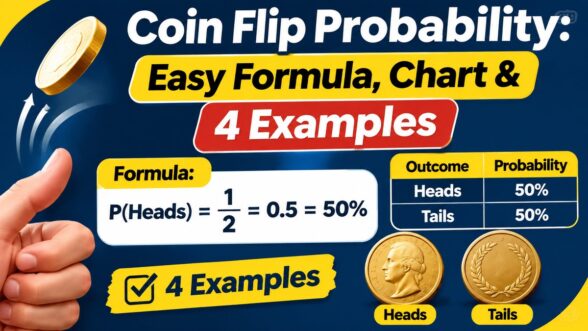
Coin Flip Probability: Easy Formula, Chart & 4 Examples
Ask ten people about coin flip probability and nine will say “fifty-fifty” without blinking. They’re right. A fair coin lands on heads 1/2 of the time…
Need a Quick Decision?
Flip a coin and let chance decide — instantly, honestly, and for free.
Flip a Coin