
Is Tails Due After Many Heads? What Coin Flip Streaks Really Mean
 Updated October 22, 2026
13 min read
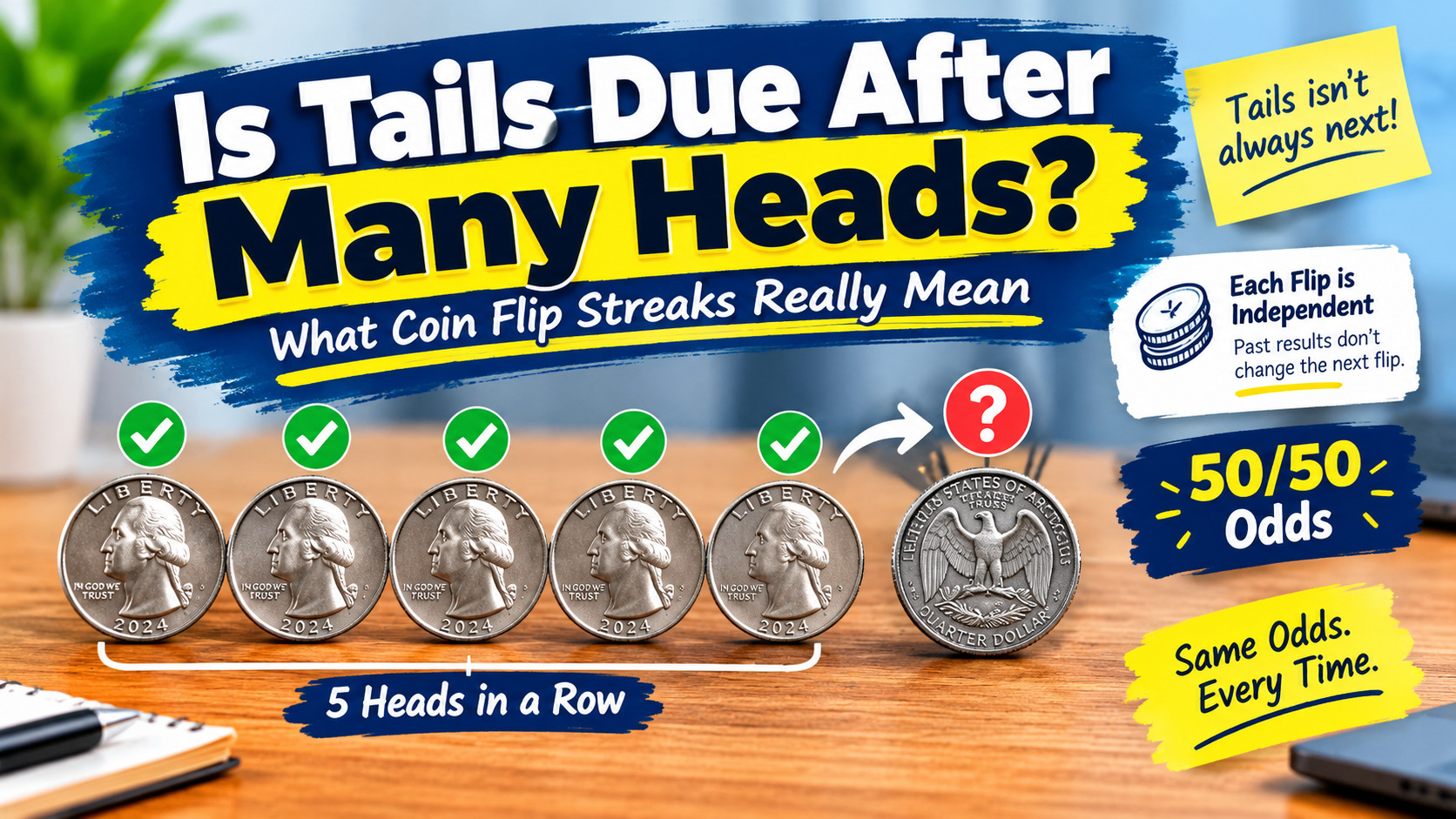
Is Tails Due After Many Heads? What Coin Flip Streaks Really Mean..Heads. Heads. Heads. Heads. Heads. Now you’re holding your breath, aren’t you? Surely tails is due.
Here’s the straight answer: on a fair coin, no. The coin has no memory and no sense of fairness. The next flip is 50/50 whether you’ve just seen five heads or fifteen.
That “it has to switch soon” feeling is one of the most common hunches in probability, and it’s worth understanding properly because it follows us into games, bets and everyday guesses. In this guide you’ll see the real odds after 5 and 10 heads, why a streak can’t tilt the next flip, how often streaks show up by pure chance, and the one situation where a long streak should make you suspicious (of the coin, not of tails). There’s also a small experiment you can run yourself. To follow along, open the free online coin flip and keep a tally as you read.
Is Tails Due After Many Heads?
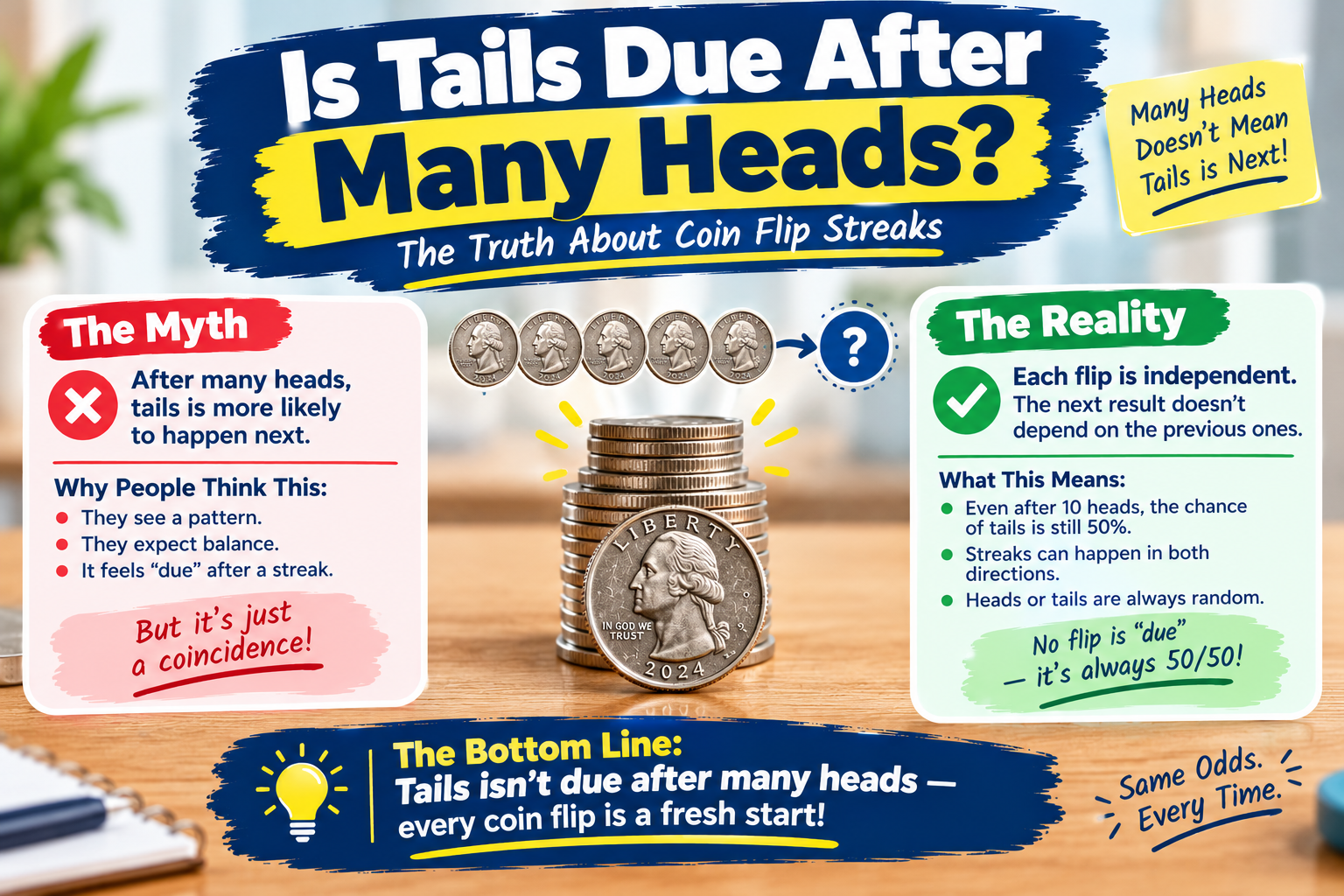
No. Tails isn’t “due.” Every flip of a fair coin is independent, so after five heads, or even ten, the next flip is still 50% heads and 50% tails. Past flips don’t change what the coin does next.
Two assumptions sit behind that answer, and I’d rather say them out loud. First, the coin is fair, meaning heads and tails each have a probability of 1/2. Second, the flips are independent, meaning one result has no pull on the next. If both hold, the next-flip probability after any streak is simple:
P(tails) = 1/2
Picture a friend asking, “I’ve rolled three sixes in a row. Is a six less likely now?” You’d say no without blinking. The die isn’t keeping score, and neither is a coin. If you want a gentle refresher on the basics, probability basics on Khan Academy covers them well. Our own page on coin flip probability goes through the same ideas with coin examples.
Chance of Tails After 5 Heads
The chance of tails after 5 heads is 50% on a fair coin. The famous 1/32 figure (3.125%) is the chance of getting 5 heads in a row from the start. It describes the whole sequence, not the next flip.
This is where most people get tangled up, so let’s pull two questions apart.
Question one: before you flip anything, what’s the chance of five heads in a row? That’s (1/2)^5 = 1/32 = 3.125%. Fairly rare.
Question two: you already have five heads. What’s the chance the sixth flip is tails? Those five heads are done, in the past tense. One flip is left, and it’s 1/2.
Here’s another way to see it. After five heads, there are two possible six-flip sequences: HHHHHH and HHHHHT. Each has the same probability, (1/2)^6 = 1/64. One looks “special” and the other looks “normal,” but the coin doesn’t care how they look.
| Streak so far | Chance of tails on the next flip (fair coin) |
| 1 head | 50% |
| 3 heads | 50% |
| 5 heads | 50% |
| 10 heads | 50% |
| 20 heads | 50% (if you know the coin is fair) |
Want the sequence math on its own page? We have one on the 5 heads in a row probability.
Chance of Tails After 10 Heads
The chance of tails after 10 heads is still 50% for a fair coin. Getting 10 heads in a row from the start is 1/1,024, about 0.098%, but that number belongs to the whole sequence, not the next flip.
Same logic, bigger drama. Ten heads from the very start has a probability of (1/2)^10 = 1/1,024, roughly 0.098%. That’s a genuinely unusual sequence. But once you’ve watched ten heads land, the eleventh flip is a fresh 50/50, exactly like the first one was.
Now the honest wrinkle. Everything above assumes you know the coin is fair. If you don’t, ten heads is a hint that the coin might lean toward heads, and betting on tails could be the wrong move. Notice what’s going on there. You’re not saying tails is due. You’re saying the coin itself might be loaded. Those are very different thoughts, and I’ll come back to them. For the full breakdown, see our page on the 10 heads in a row probability.
Heads Streak and Next Coin Flip Odds
A streak cannot change the next flip’s odds. Each flip is an independent event, so earlier results don’t affect later ones. Every flip starts fresh at 50/50.
People often ask, “Can streaks change coin flip probability?” No, and independence is the reason. Two events are independent when knowing one result tells you nothing about the other. If you like the formal side, independence in probability theory is the idea behind all of this.
The multiplication rule makes it concrete. For independent flips, you multiply the probabilities:
P(HHHHH then T) = 1/2 x 1/2 x 1/2 x 1/2 x 1/2 x 1/2 = 1/64
P(HHHHH then H) = 1/64
Same number. Compare the two and the next flip comes out as a plain coin toss, because nothing about the first five flips shows up in the final factor. Each new flip brings its own 1/2.
A common worry is, “But doesn’t a heads streak raise the chance of tails, to even things out?” Evening out doesn’t work that way, and I’ll show you why in a minute. If you’d like to see the question handled head-on, read our page on does heads make tails more likely.
Can Tails Happen After Many Heads?
Yes. Tails can happen after any number of heads, and on a fair coin it shows up on the very next flip half the time. Every flip has a 1/2 chance of ending a heads streak.
Streaks don’t fade out slowly or “run their course.” They end the moment a tails appears, and that can be any flip. A run of 5 heads ends on the next flip with probability 1/2. A run of 1 head ends on the next flip with probability 1/2. Same thing.
That gives a neat fact: on average, a run of heads in a fair-coin sequence lasts 2 flips. Short runs are common. Long ones are rare but absolutely possible.
How common? Here’s the chance of seeing a run of at least 5 heads somewhere inside a longer sequence:
| Number of flips | Chance of a run of 5+ heads somewhere |
| 10 flips | about 11% |
| 20 flips | about 25% |
| 100 flips | roughly 80% |
Those percentages are approximate, but the message is firm: in a long enough stretch of random tosses, streaks are normal. If you flip 100 times and never see five heads in a row, that would be the strange outcome. We go deeper on this in coin flip streaks explained.
Coin Flip Streak Prediction Accuracy
Betting on tails after a heads streak wins 50% of the time on a fair coin. Betting on heads wins 50% too. No streak-based rule beats 50%, so streak prediction accuracy is exactly even.
Say you and a friend bet a dollar per flip. You always bet tails after four heads in a row. Over thousands of bets, you’d win about half of them. Your friend, who always bets heads in the same spot, would also win about half. Neither of you has an edge. At even money, your expected value is zero:
Expected value = (1/2 x +1) + (1/2 x -1) = $0
That’s why “how accurate is betting on tails after a streak?” has such a boring answer. It’s 50%, the same as guessing blindly. A lot of casino folklore is built on the opposite belief, that watching a color or number repeat tells you what’s coming. Tables don’t remember either.
One more distinction worth keeping straight: probability is about what’s likely given what you know, while prediction is calling one specific outcome. Even if you know the odds perfectly, a 50/50 event can’t be predicted better than a coin toss.
Why It Feels Like Tails Is Due
It feels that way because of the gambler’s fallacy, the belief that a streak makes the opposite result due. Our brains expect short sequences to look balanced, and we misread the law of large numbers.
The gambler’s fallacy says a streak raises the odds of the opposite outcome. Its mirror image is the hot hand idea: the belief that a streak is more likely to continue. They point in opposite directions but share one mistake. Both quietly assume the coin has some kind of memory. If this is your main interest, we cover it separately in coin flip gambler’s fallacy.
Why do we fall for it? Three reasons come up again and again.
We expect randomness to look tidy. Ask most people to write a “random” sequence of flips and they alternate far too often. Real random sequences have clumps, and the clumps feel suspicious.
We also half-remember the law of large numbers, which says the share of heads drifts toward 50% over many flips. True. But the coin doesn’t repair earlier results. It just keeps flipping, and the early lopsidedness gets diluted. Suppose you start with 10 heads in 10 flips, then flip 1,000 more and get about 500 heads. You’d have roughly 510 heads in 1,010 flips, about 50.5%. No extra tails were needed to “catch up.”
And finally, a long streak is vivid. We remember the five-in-a-row moment and forget the dozens of ordinary flips around it.
When a Long Heads Streak Means the Coin Might Be Biased
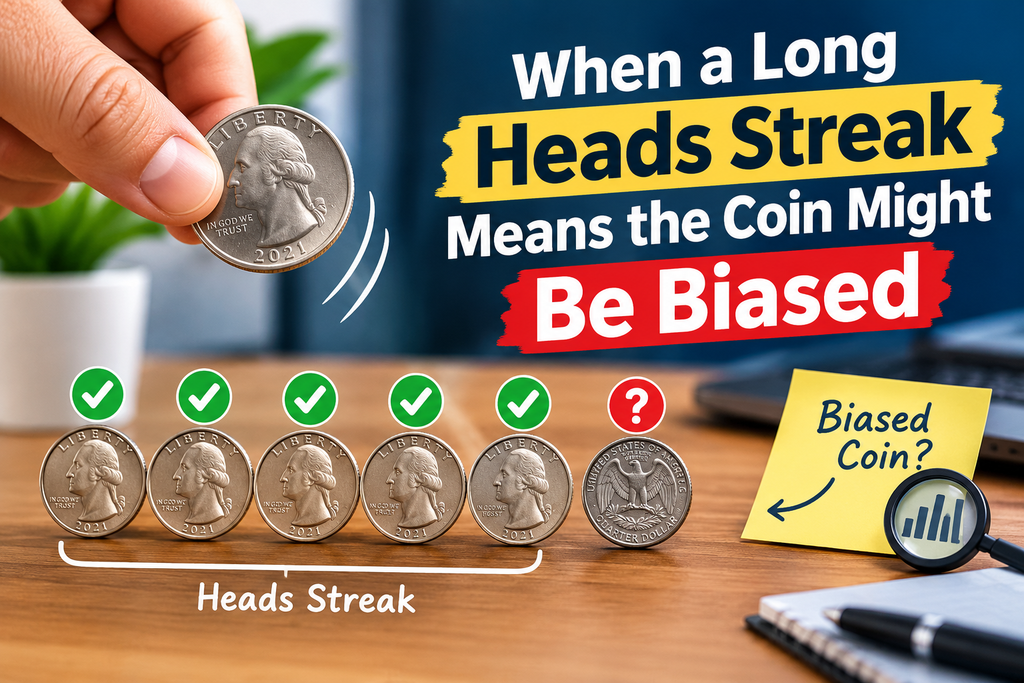
A very long streak can hint that the coin isn’t fair. For example, 20 heads in a row on a fair coin is 1 in 1,048,576. The suspicion falls on the coin, not on tails being due.
Back to that honest exception. If you’re sure a coin is fair, no streak changes the next flip. If you’re not sure, a long streak is evidence, because a heavily lopsided result is much easier to explain with a biased coin than with luck. Twenty heads in a row has a probability of (1/2)^20 = 1/1,048,576. At that point many people would reasonably start checking the coin.
How many heads prove bias? There’s no fixed cutoff. A longer streak is stronger evidence, but no single number flips a switch from “lucky” to “rigged.” That’s why careful testing looks at many flips, not one dramatic run. If you want to understand what a real toss involves first, see how does a coin flip work.
Digital flips make a useful comparison. A heads or tails generator relies on a random number generator. Most are pseudo-random, meaning they follow a mathematical process designed to behave like randomness, and each result is independent of the last. If you’re curious how that works, NIST has material on random bit generation. Either way, streaks in a good generator are just as normal as streaks in a real coin.
Try a Simple Streak Experiment
Flip a coin 200 times, mark every run of three heads, and write down the flip that follows. You should see tails after roughly half of them. Small samples wander, so don’t panic over small gaps.
You don’t have to take my word for any of this. I haven’t run it for you, so here’s how to run it yourself:
- Flip a coin 200 times (or use a coin toss simulator so your thumb doesn’t get tired). Write each result as H or T.
- Circle every spot where three heads appeared in a row.
- Next to each circle, note whether the very next flip was heads or tails.
- Count them up. Tails should follow about half the time.
Expect some wobble. If you only find 12 such spots, you might see 8 tails and 4 heads, and it’ll feel like proof of something. It isn’t. Small samples wander. Repeat the experiment a few times, or add more flips, and the share gets closer to 50%. It also makes a nice classroom activity: split a group in two, let each half flip, and compare results. Prefer your phone? You can flip a coin online and keep the tally in a notebook.
Conclusion
After any streak, the next flip of a fair coin is 50/50. The 1/32 and 1/1,024 figures belong to the whole sequence, counted from the first flip, not to the flip you’re about to make. Tails can show up at any moment, so a streak can end on the very next toss or run much longer. Betting on a streak gets you 50%, the same as a blind guess. And if a streak ever looks too long to believe, question the coin, not the idea that tails owes you one.
Try our free online coin flip tool and see streaks for yourself.
Is tails due after many heads?
No. On a fair coin, tails is never “due.” Each flip is independent, so the chance of tails stays at 50% after one head, five heads or ten. The coin doesn’t track earlier results or try to balance them out over time.
What is the chance of tails after 5 heads?
It’s 50% on a fair coin. The 1/32 (3.125%) figure is the chance of getting 5 heads in a row from the start. Once you already have those five heads, only the next flip remains, and it’s an ordinary 50/50 flip.
What is the chance of tails after 10 heads?
Still 50% if the coin is fair. Ten heads in a row from the start is 1/1,024, about 0.098%, but that describes the full sequence. The eleventh flip is independent, so heads and tails are equally likely.
Can streaks change coin flip probability?
No. For a fair coin, a streak is just a record of what already happened, so it can’t change the next flip. The only thing that can change the odds is the coin itself, such as a weighted or damaged coin.
Does a heads streak increase the chance of tails?
No. A heads streak doesn’t make tails more likely. That belief is the gambler’s fallacy. The law of large numbers says results even out over many flips by dilution, not because the coin pushes back toward tails.
Can tails happen after many heads?
Yes, and it can happen on any flip. Each flip ends a heads streak with probability 1/2. Long streaks are rare, but when one occurs, the next flip is still a plain 50/50 toss, so tails can arrive right away.
How accurate is predicting tails after a streak?
It’s 50% accurate on a fair coin. Predicting heads after a streak is also 50%. No streak-based rule beats an even guess, because each flip is independent. Anything that looks like a winning pattern in a small sample is usually luck.
When does a long streak mean a coin is biased?
There’s no fixed number. A longer streak is stronger evidence that the coin may favor heads, and 20 in a row on a fair coin is 1 in 1,048,576. If you suspect bias, test it with many more flips instead of reading one run.

Related Articles

Coin Flip GIF: 5 Free Ways to Get Animations, Sounds and Images
The safest way to get a coin flip gif is to use a free online flipper or a CC0 / public-domain animation, then save it as…

Flip a Coin 100 Times: Ultimate 2026 Guide + Free Simulator
Flip a coin 100 times and you’ll usually see about 50 heads and 50 tails, but anything from roughly 40 to 60 heads is normal. You…

Heads and Tails Coin Flip: The Ultimate 2026 Guide
A heads and tails coin flip is the quickest fair way to settle a decision between two options. You toss a coin, one side lands up,…
Need a Quick Decision?
Flip a coin and let chance decide — instantly, honestly, and for free.
Flip a Coin