
Probability of Heads on One Flip: Odds, Chance and the Simple Math
 Updated November 11, 2026
8 min read
In this article
- What Is the Probability of Heads on One Flip?
- How to Calculate Coin Flip Probability, Step by Step
- Probability of Tails on One Fair Coin Flip
- Probability vs Odds in a Coin Flip
- Is a Coin Flip Really 50/50?
- Probability of a Coin Landing on Its Edge
- Probability of Heads After Getting Heads
- What Happens Over Many Flips?
- Common Mistakes People Make
Cricket. Toss time. The umpire flicks a coin, the captain shouts “heads,” and a few thousand people hold their breath over what is, honestly, a coin.
So what are his chances? The probability of heads on one flip is 1/2. Or 0.5. Or 50%, whichever you like. Tails gets exactly the same. “Probability” just means how likely something is, as a number between 0 and 1. Below I’ll do the math slowly, sort out odds versus probability, and poke at the strange stuff: heads after heads, and a coin standing on its edge. If you’d rather flip as you read, our coin flip tool is right there.
What Is the Probability of Heads on One Flip?
For a fair coin, the probability of heads on one flip is 1/2, or 50%. “Fair” means neither side is favored, so the heads probability and the tails probability come out identical.
That’s it. That’s the whole answer for a single coin flip probability.
The only thing to watch is “one flip.” Each toss is its own little event. What happened last time doesn’t matter, and the number stays put.
If you like the 0-to-1 scale, picture a slider. Zero is “never,” one is “always,” and heads sits right in the middle at 0.5. Careful, though. That doesn’t mean you’ll get one head in every two flips. It means that if you keep flipping for a long time, about half of them will be heads.
How to Calculate Coin Flip Probability, Step by Step
Want to work it out yourself? Divide the outcomes you want by everything that can happen. For heads, it goes like this:
- List every outcome. A coin has two: heads and tails.
- Count the ones you want. Heads is just 1.
- Divide: 1 ÷ 2 = 0.5.
- Multiply by 100 if you want a percentage. 0.5 becomes 50%.
Same trick on a die. Rolling a 6 is one outcome out of six, so 1/6, about 16.7%.
Now two flips, or three. You multiply, because flips are independent, which just means one flip can’t nudge the next. Two heads in a row is 1/2 × 1/2 = 1/4, so 25%. Three is 1/8, or 12.5%. Five is 1/32, about 3.1%. And at least one head in two flips? That’s everything except two tails: 1 − 1/4 = 3/4, or 75%. I let code check all of this, because my mental math isn’t something I’d bet on.
Probability of Tails on One Fair Coin Flip
Also 1/2, or 50%. Heads and tails cover every result, and their chances add up to 1. So tails is 1 − 0.5 = 0.5.
That subtraction trick works on everything. A 30% chance of rain means a 70% chance of staying dry. With a fair coin there’s nothing left over to tip the scale, so the chance of heads and the chance of tails on one coin flip sit in exactly the same spot.
Probability vs Odds in a Coin Flip
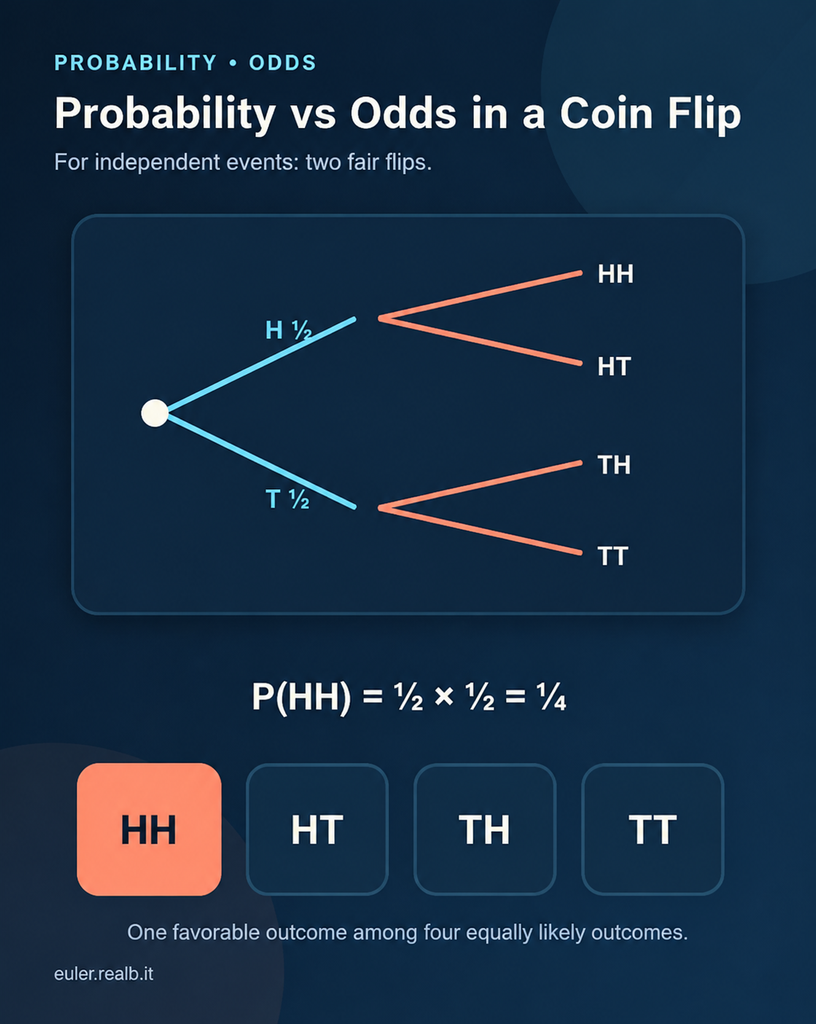
People use these two like they mean the same thing. They don’t, though they’re related.
Probability compares what you want with everything that could happen. Odds compare what you want with what you don’t. For a fair coin, the probability of heads is 1 out of 2, and the odds of heads are 1 to 1, often called even odds.
Wikipedia’s page on odds gives the conversion: divide the probability by one minus the probability. Here, 0.5 ÷ 0.5 = 1, so 1 to 1. Tails works out the same way.
| Event | Probability | Odds in favor |
| Heads on a fair coin | 1/2 (50%) | 1 to 1 |
| Tails on a fair coin | 1/2 (50%) | 1 to 1 |
| Rolling a 6 | 1/6 (16.7%) | 1 to 5 |
| Heads on a 51% coin | 51/100 | 51 to 49 |
So “1 in 6” is a probability, and “1 to 5” is odds. Same die, different language.
Is a Coin Flip Really 50/50?
Pretty much, but real coins have a quirk. A 2007 paper by Persi Diaconis, Susan Holmes and Richard Montgomery, “Dynamical Bias in the Coin Toss”, says a coin flipped hard tends to land on the side it started on, about 51% of the time.
Did anybody check? They did. In 2023 a team led by František Bartoš measured 350,757 real flips and got 50.8% on the starting side. Notice who gets the edge: the starting side, not heads or tails. For a hand flip that settles who buys the tea, it’s fair enough. We dig into the physics in our guide on how does a coin flip work.
On a phone it’s different. A simulator has no starting side, because it just picks a random number. More on that in how a coin flip simulator works.
Probability of a Coin Landing on Its Edge
Tiny. A 1993 paper in Physical Review E put it at about 1 in 6,000 for an American nickel, using a computer model. Here’s the abstract.
Call it 0.017%. If you count it, heads drops to about 49.99%, and nobody counts it. A flip is a two-outcome event for a reason. If a coin does stand on its edge, or rolls under the sofa, just flip again.
Probability of Heads After Getting Heads
Still 1/2. The coin has no memory, so flip one can’t touch flip two. Before you started, two heads in a row had a 1/4 chance. But once the first head is down, only one flip is left, and it’s 50/50. The probability of heads on one flip doesn’t care what came before.
I tested it anyway, on 10,000 virtual flips (seed 2026). Heads came up 5,122 times, tails 4,878. After a head, the next flip was heads 2,622 times out of 5,121, or 51.2%. After a tail, heads came up 2,499 times out of 4,878, also 51.2%. I half expected some tiny pattern to show up. Nope.
What Happens Over Many Flips?

The share of heads settles near 50% as you flip more, but a handful of flips can wander a long way off. This is the law of large numbers: more flips, steadier results. Here’s one run of 100,000 flips (seed 9), peeked at along the way.
| Flips | Heads | Share of heads |
| 10 | 5 | 50.0% |
| 100 | 56 | 56.0% |
| 1,000 | 515 | 51.5% |
| 10,000 | 5,006 | 50.06% |
| 100,000 | 50,187 | 50.19% |
The typical wobble, which statisticians call the standard deviation, is √(0.25 ÷ n), where n is the number of flips. At 10 flips it’s about 16 percentage points. At 100 it’s 5, and at 10,000 it’s only 0.5. So 56 heads in 100 flips is no big deal. The coin didn’t change. You just hadn’t flipped enough yet.
Common Mistakes People Make
These come up again and again when people work out the odds of heads and the odds of tails:
- Thinking a streak means a switch is “due.” It isn’t. That’s the gambler’s fallacy, the idea that past flips change the next one. See coin flip streaks explained for more.
- Mixing up odds and probability. 1 in 2 is probability, 1 to 1 is odds.
- Expecting a perfect split from a small sample. Ten flips can easily give 7 heads, and only about 24.6% of 10-flip sets split exactly 5 and 5.
- Calling a 51% coin “obviously biased.” My simulated 51% coin gave 5,145 heads in 10,000 flips, and you’d need plenty of flips to spot that.
- Is a coin flip really 50/50?
- For everyday decisions, yes. In theory, a hard-flipped coin lands on its starting side about 51% of the time, and a 2023 study of 350,757 flips measured 50.8%. It’s a small lean, and you’d never notice it in a single flip.
- Key Takeaways
- The probability of heads on one flip is 1/2 (0.5, or 50%) for a fair coin. Tails is the same.
- To work it out, divide the outcomes you want by all the possible outcomes.
- Odds of heads are 1 to 1, and probability is 1 out of 2. Two ways of saying one thing.
- Past flips don’t change the next one, so heads after heads is still 1/2.
- Real coins lean slightly toward the starting side (about 51% in theory, 50.8% measured), and a nickel lands on its edge about once in 6,000 tosses, by one model’s estimate.
- Want to see it live? Flip a coin on our heads or tails page or the coin toss page, or try more random tools.
- How we tested this. I used Python’s random module for 10,000 virtual flips (seed 2026), three more seeds (1, 2 and 3), and a 100,000-flip run (seed 9). Every probability was computed with exact fractions in code. I checked the research claims against the Diaconis paper, the 2023 abstract, and the 1993 abstract
What is the probability of heads on one flip?
The probability of heads on one flip is 1/2, which is 0.5 or 50%, for a fair coin. Both sides are equally likely. Real hand flips lean very slightly toward the side that started face up: about 51% in theory, and 50.8% in a large 2023 test.
What is the chance of getting tails on one flip?
It’s 1/2, or 50%, the same as heads. Heads and tails cover all the outcomes, so their chances add up to 1. If heads is 0.5, tails is 1 − 0.5 = 0.5. Landing on the edge is a possible third result, but it’s extremely rare.
What are the odds of heads on a coin flip?
The odds of heads are 1 to 1, often called even odds. That means one way to get heads for every one way to get tails. Odds compare “for” with “against,” while probability compares “for” with “all.” The probability here is 1/2.
Does getting heads make tails more likely next time?
No. Each flip is independent, so the chance of heads stays 1/2 whatever happened before. In my 10,000-flip test, heads followed a head 51.2% of the time and followed a tail 51.2% of the time. The coin has no memory.
Can a coin land on its edge?
Yes, but it’s very rare. A 1993 model estimated about 1 in 6,000 for an American nickel, roughly 0.017%. For everyday flips you can ignore it. If a coin lands on its edge or rolls under the couch, just flip it again.
Is a coin flip really 50/50?
For everyday decisions, yes. In theory, a hard-flipped coin lands on its starting side about 51% of the time, and a 2023 study of 350,757 flips measured 50.8%. It’s a small lean, and you’d never notice it in a single flip.

Related Articles

Is Heads or Tails More Likely? 7 Proven Facts
Is heads or tails more likely? No. On a fair coin, heads and tails each have a 50% chance, so neither wins more over time. The…
Is Heads or Tails Good Luck? 7 Surprising Truths
Is heads or tails good luck? No. On a fair coin, heads and tails each land about 50% of the time, so neither side is luckier,…

Flip a Coin 10 Times: What to Expect from 10, 20, 30 and 50 Flips
If you flip a coin 10 times, you’ll most often land on about 5 heads, but anything from 3 to 7 heads is completely normal. That…
Need a Quick Decision?
Flip a coin and let chance decide — instantly, honestly, and for free.
Flip a Coin