
How Does a Coin Flip Work? The Simple Science Behind Heads or Tails
 9 min read
In this article
- How Does a Coin Flip Work?
- How Does a Coin Flip Decide Heads or Tails?
- How Does a Fair Coin Flip Work?
- How Does Flipping a Coin Make a Decision?
- How Does an Online Coin Flip Generator Work?
- How to Flip a Coin Fairly
- How to Check Heads or Tails After Flipping
- Flip a Coin to Decide Something: Best Uses and Limits
- Common Myths About Coin Flips
You and a friend are starving. She wants pizza, you want burgers, and you’ve spent ten minutes saying “I don’t mind, you pick.” Finally somebody digs a coin out of a pocket, calls heads, and flips it. Ten seconds later, it’s settled.
So how does a coin flip work? Each option gets a side, the coin spins, and whatever’s facing up when it lands wins. Argument over. It’s also surprisingly fair, though not quite perfect, as you’ll see. Below I’ll cover why it works, how a coin flip generator does it on a screen, and when you shouldn’t trust a coin with the decision.
How Does a Coin Flip Work?
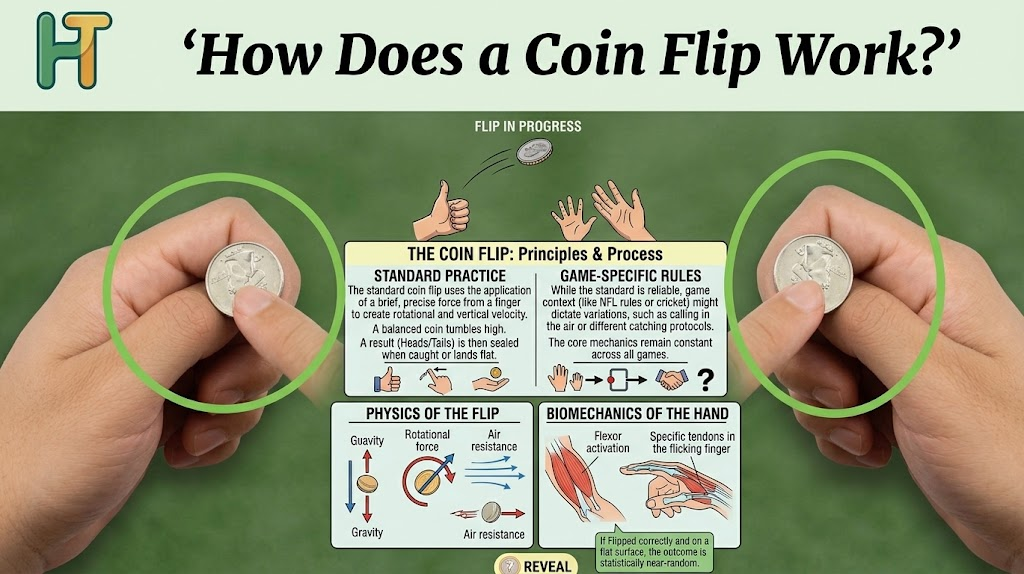
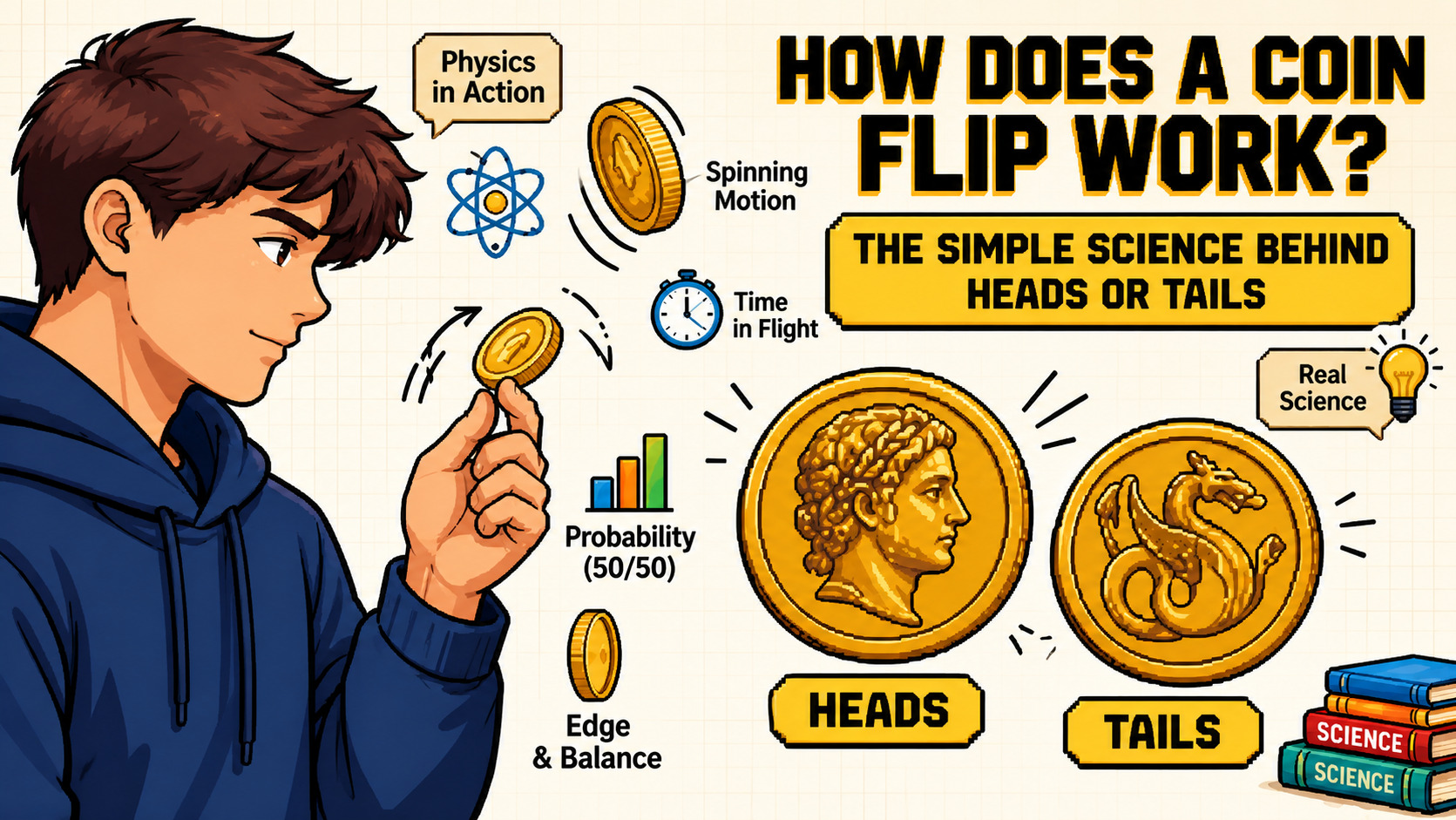
A coin flip works by turning a tie into a two-outcome event. You give heads to one option and tails to the other, toss the coin so it spins, and let it land. Whichever face points up wins. Since each side is about equally likely, nobody gets an edge.
A coin flip (some people say coin toss) is just a quick, public way to make a random choice between two things. Cricket does it before play starts. A captain calls a side while the coin’s still in the air, and whoever wins the toss picks bat or bowl. Nobody grumbles. The coin has no favorite team.
How Does a Coin Flip Decide Heads or Tails?
The face pointing up when the coin stops moving decides heads or tails. Two outcomes, no in-between, so there’s no doubt.
Order matters. Give each option a side first. Then somebody calls a side out loud. Only then does the coin leave the hand. Call it after the coin’s already in the air and you’re begging for an argument. (“I said tails!” “No, you didn’t.”)
Then the flip itself. Spin and air time make a flip hard to predict. If the coin barely turns, the flipper can more or less steer it, so toss it properly. Once it lands, the top face is your answer.
How Does a Fair Coin Flip Work?
A fair coin gives heads and tails the same chance, 50% each, and every flip is its own separate event.
That second part has a name: independent events. The coin has no memory. It doesn’t know it landed heads three times in a row. If probability basics make your eyes glaze over, hold on to this one idea: odds describe lots of flips, not what the next one “owes” you.
Now, real coins aren’t perfect. Back in 2007, three researchers (Persi Diaconis, Susan Holmes and Richard Montgomery) wrote a paper called “Dynamical Bias in the Coin Toss”, published in SIAM Review. Their math says a coin flipped hard lands on the side it started on about 51% of the time.
Someone eventually checked. A team led by František Bartoš, mostly at the University of Amsterdam, flipped 350,757 real coins and measured 50.8% landing on their starting side. Pretty close to the prediction. Heads against tails overall? About 50/50.
So is a coin flip really 50/50? For lunch, yes. The tiny edge belongs to whichever side starts face up, not to heads or tails. So how does a coin flip work if the coin isn’t perfect? Fine, as long as the stakes are small.
What 10,000 virtual flips looked like
I wanted real numbers, so I ran 10,000 virtual flips in Python. My main run gave 5,122 heads and 4,878 tails. A bit lopsided, but random doesn’t mean perfectly even. Across five runs, heads landed anywhere from 4,989 to 5,122 times. Want to watch it yourself? Our coin flip tool goes from one flip up to 10,000,000 and shows the tails percentage.
How Does Flipping a Coin Make a Decision?
Flipping a coin makes a decision by handing the choice to chance, so neither person has to back down. It’s a tie-breaker you both agreed to before seeing the result.
Why do people use coin flips to make decisions? Mostly because it’s fast, everyone can see it, and it feels neutral. It takes bias out too: you can’t nudge it your way by accident.
There’s another idea you’ll hear a lot: the coin works as a gut check. While it’s spinning, you notice which side you’re hoping for, and that hope tells you what you wanted all along. I can’t point to a study for that one, so call it a rule of thumb. Either way, if you flip a coin to decide something and your stomach drops at the result, listen to that.
How Does an Online Coin Flip Generator Work?
An online coin flip generator asks your device for a random number and turns it into heads or tails. No coin, no spin, just a quick bit of math.
Pseudo-random numbers in plain English
Computers can’t toss anything, so they cheat a little. They use a pseudo-random number generator, which is a formula that spits out numbers that look random but follow a fixed recipe. In JavaScript, Math.random() hands you a number from 0 up to (but not including) 1. A flipper can then say: under 0.5 is heads, 0.5 or higher is tails.
So how does a coin flip work online? Same idea, really. Two outcomes, equal chance. One catch: MDN says Math.random() isn’t safe for things like passwords, and points to crypto.getRandomValues() for that job. NIST sets standards for random bit generation in security systems, too. But for pizza versus burgers, a basic random number generator is plenty. Details on our tool are on the How It Works page.
Online coin flip vs real coin flip
| Real coin | Online generator | |
| Speed | A few seconds per flip | Instant, and many flips at once |
| Fairness | Close to 50/50 | Close to 50/50 if the generator is sound |
| Physical bias | Small ones, like the same-side edge | None, since nothing physical is flipped |
| Convenience | You need a coin | You need a phone or computer |
| Trust | You can watch it land | You trust the site’s code |
Two option coin flip generator and two choice random generator
A two option coin flip generator is just a coin flip with your own labels. Instead of heads and tails, you’ve got “pizza” and “burgers.” A two choice random generator does the same thing behind the scenes: pick a random number, match it to one of two options. Three options? A coin can’t split those evenly.
How to Flip a Coin Fairly
To flip a coin fairly, agree on the rules before the coin moves, call your side first, and give it a high, spinning toss. Then let it land and read it together. Here’s the routine:
- Agree on the rules. What counts as heads? What happens if it lands on its edge or rolls off?
- Give each option a side. Say it out loud: “Heads is pizza, tails is burgers.”
- Call before the flip. One person calls while the coin’s still in the flipper’s hand.
- Flip it properly. Send it up so it spins. Don’t just tip it over in your palm.
- Let it land where you can both see. Catch it or let it drop, whichever you agreed on.
- Read it together. Both of you look at the face-up side.
How to Check Heads or Tails After Flipping
Read the face pointing up once the coin has fully stopped. On most coins, heads is the side with the portrait and tails is the back. If your coin looks odd, decide which side counts as heads before you flip.
Landed on its edge, rolled under the sofa, or you can’t agree what you saw? Flip again. And if someone catches the coin, they should uncover it where both people can see.
Flip a Coin to Decide Something: Best Uses and Limits
Flip a coin to decide something small, when you’d honestly be fine with either result. Leave it alone when the choice is big or one option is clearly better.
Good for:
- Picking who goes first in a game
- Settling who pays for lunch (when nobody minds much)
- Breaking a tie everyone agreed to accept
Not good for:
- Big life decisions, like a job, a move or a relationship
- Health, since a coin knows nothing about your body
- Money, such as loans or investments
For more than two options, try a dice roller or spin the wheel.
Common Myths About Coin Flips
The big one: a coin gets “due” for a switch. It doesn’t. Five heads in a row don’t make tails more likely on the next flip.
That mistake is called the gambler’s fallacy. The coin has no memory, so each flip starts fresh. I tested it. In my main run, a flip came right after at least five heads in a row 378 times. The next flip was heads 197 of those times, about 52%.
Second myth: long streaks mean the coin is rigged. Nope. Across my five runs of 10,000 flips, the longest streak of one side ranged from 13 to 19. How does a coin flip work when a streak like that shows up? Same as always.
Is a coin flip really 50/50?
Very close. A fair coin gives each side 50%. Real hand flips lean slightly toward whichever side started face up. Researchers predicted about 51%, and a 2023 study of 350,757 flips measured 50.8%. That’s far too small to matter when you’re choosing lunch.
How does an online coin flip generator work?
It asks the computer for a random-looking number between 0 and 1. Under 0.5 means heads, and 0.5 or higher means tails. The number comes from a pseudo-random number generator, a formula that produces numbers with no visible pattern. You get the result instantly.
Is an online coin flip truly random?
Not in the strictest sense. Most use pseudo-random numbers, which come from a formula, not physical chance. For everyday choices that works fine. For security jobs like passwords, MDN says Math.random() isn’t safe and recommends crypto.getRandomValues() instead. For picking pizza or burgers, either one is fine.
Can you control the result of a coin flip?
Not reliably in a proper flip. The result depends on how hard and how high the coin is thrown and how fast it spins. A lazy flip can be steered. A high, fast-spinning toss that both people watch is much harder to steer.
Is it okay to decide important things with a coin flip?
For small choices, sure. For big ones like health, money or a major life change, no, because a coin knows nothing about your situation. A flip can help you notice what you’re hoping for, but make the final call with real information.
How do you flip a coin fairly with two people?
Agree on the rules, then give each option a side. One person calls before the flip, and the other tosses the coin high with plenty of spin. Let it land where you both can see it, and read the face-up side together.

Related Articles
Why Is It Called Heads or Tails? 7 Surprising Facts
Why is it called heads or tails? Because a coin’s two sides were pictured as opposite ends of a body: the front shows a head, usually…

Lucky Penny Heads or Tails? 7 Surprising Beliefs
Lucky penny heads or tails? Heads. According to the popular superstition, a penny found heads up is lucky and worth picking up, while a tails-up penny…

Spin a Coin: Ultimate 2026 Guide + Free Flip Tool
When you spin a coin on its edge, it often lands more on one side than the other, so spinning is usually less fair than flipping.…
Need a Quick Decision?
Flip a coin and let chance decide — instantly, honestly, and for free.
Flip a Coin