
How Does a Coin Flip Simulator Work? Odds, Accuracy and How Digital Coin Tosses Really Work
 9 min read
In this article
- How Does a Coin Flip Simulator Work?
- What Are Heads and Tails on a Coin?
- What Are the Odds of a Coin Flip?
- How Accurate Is a Coin Flip?
- Virtual Coin Flip vs Real Coin Flip
- How Does a Coin Flip Work in Football?
- How Does a Coin Flip Work in Probability Theory and Statistics?
- How Does a Coin Flip Work With Two Coins?
- Try a Coin Flip Simulator Online Free
- Common Myths About Coin Flips
You’re out with friends, someone wants to settle a bet, and nobody has a coin. So you open a coin flip simulator on your phone instead. It feels like magic, but the idea behind it is simple.
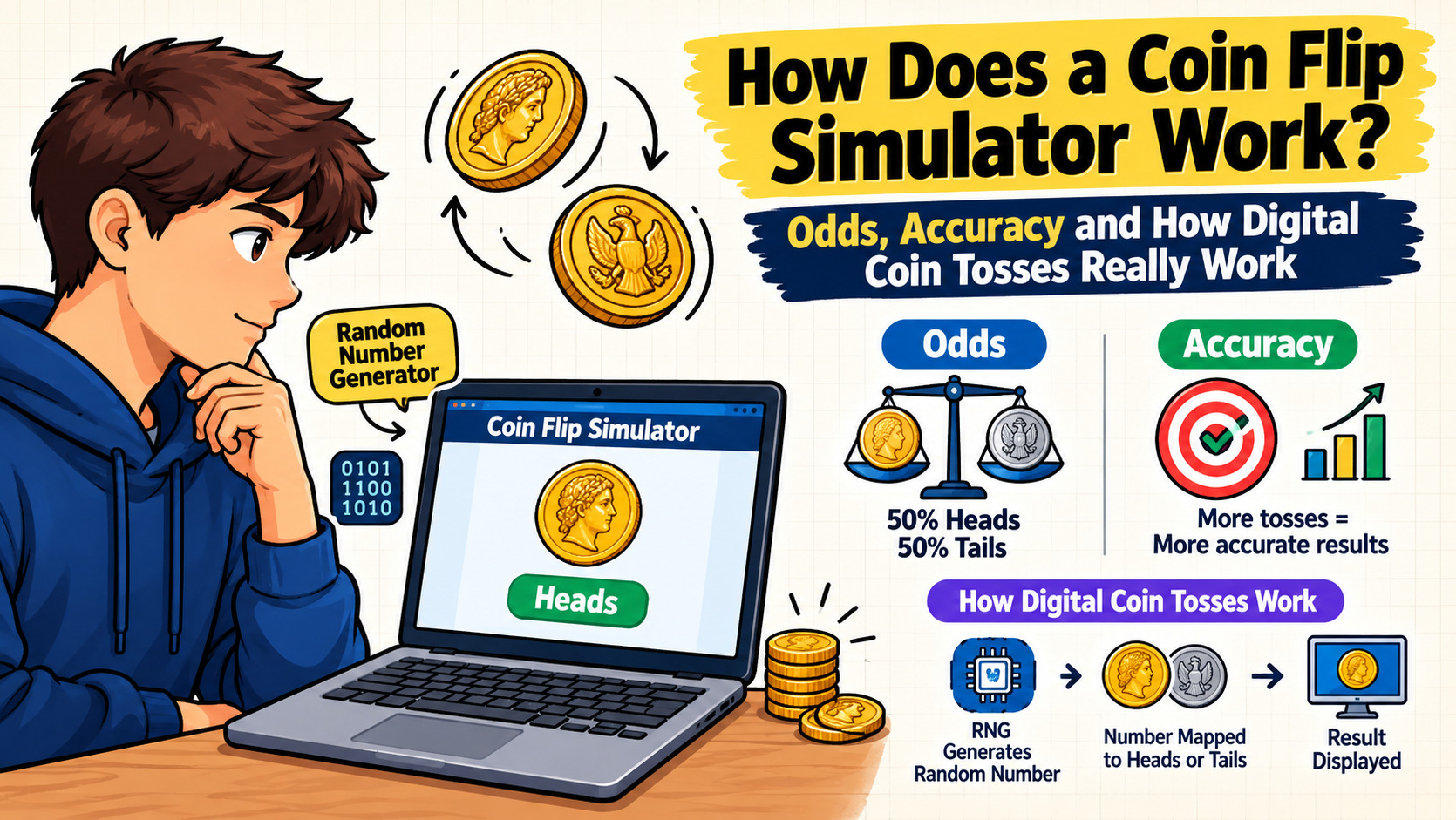
How does a coin flip simulator work? The computer picks a random number between 0 and 1. If it’s below 0.5, you get heads. If it’s 0.5 or higher, you get tails. The coin you see spinning is just decoration. Below, I’ll cover the odds, how accurate a flip really is, how football and statistics use coin tosses, and what changes when you flip two coins.
How Does a Coin Flip Simulator Work?

A coin flip simulator works by asking the computer for a random number and turning it into heads or tails. Numbers below 0.5 mean heads, and 0.5 or above means tails. Each result has an equal chance, so the simulator copies a fair coin without any metal involved.
The simulator needs only one number per flip, so it’s instant and can repeat thousands of times in a second.
How does a virtual coin flip work?
A virtual coin flip works the same way: the number is chosen first, and the spinning coin is built around it. Typically the animation is just for show. It can’t change the result, because the code already knows whether it’s heads or tails before the coin appears on screen.
How does a digital coin toss work?
So how does a coin flip simulator work in code? It’s a few lines on a website or in an app. It asks the device for a number, compares it with 0.5, and shows the answer. That’s why a good simulator can give you one flip or a huge batch in a blink.
Pseudo-random vs true random in plain English
Most simulators use a pseudo-random number generator. That’s a formula that produces numbers that look random but start from a hidden “seed,” which is just the starting number for the formula. In JavaScript, Math.random() gives a number from 0 up to, but not including, 1. MDN says it isn’t suitable for security work.
For that, MDN points to crypto.getRandomValues(), which is cryptographically strong. Even that one isn’t “true random” in the physical sense: browsers still use a formula, seeded with enough unpredictable input. For choosing pizza or burgers, either is plenty.
What Are Heads and Tails on a Coin?
Heads is the front of the coin, usually the side with a person’s portrait. Tails is the back. The proper names are obverse (front) and reverse (back).
Which side is which depends on the country and the coin. On a US quarter or penny, heads is the portrait side. Some coins show no head at all, so people simply agree which face counts as heads before they flip. People use the terms because they’re short, and everyone understands them.
What Are the Odds of a Coin Flip?
The odds of a coin flip are 50/50, which you can write as 1 in 2, 0.5, or 50%. Heads and tails each have the same chance. A coin landing on its edge is possible but very rare, so we ignore it.
Each flip is independent, meaning earlier flips don’t affect the next one. The chance of heads is 50% every time. If these ideas are new, read our probability basics guide first. Odds across several flips change, though. Three heads in a row is 1 in 8 (12.5%), because you multiply: 1/2 × 1/2 × 1/2.
How Accurate Is a Coin Flip?
A real coin flip is very close to 50/50 but has a tiny bias toward the side it started on. In 2007, Persi Diaconis, Susan Holmes and Richard Montgomery published “Dynamical Bias in the Coin Toss”. Their model puts the same-side chance at about 51%.
In 2023, a team led by František Bartoš ran a huge test of 350,757 real flips. They measured 50.8%, and the rate varied between people. Heads versus tails overall came out at about 50/50. For a deeper look at the physics, see our guide on how does a coin flip work.
So how does a coin flip simulator work when nothing is tossed? There’s no physical bias at all. But it’s only as good as its random number generator, and a decent one gives you a fair 50/50 for everyday choices.
Virtual Coin Flip vs Real Coin Flip
Both give you heads or tails. So how does a coin flip simulator work differently from a real coin? Mostly in speed, bias and trust.
| Real coin | Virtual coin flip | |
| Speed | A few seconds | Instant |
| Physical bias | Tiny same-side lean | None |
| Fairness | Close to 50/50 | Close to 50/50 with a sound generator |
| Convenience | Need a coin | Need a phone |
| Trust | You watch it land | You trust the code |
| Best use | In-person tie-breakers | Big batches, quick choices, remote decisions |
How Does a Coin Flip Work in Football?
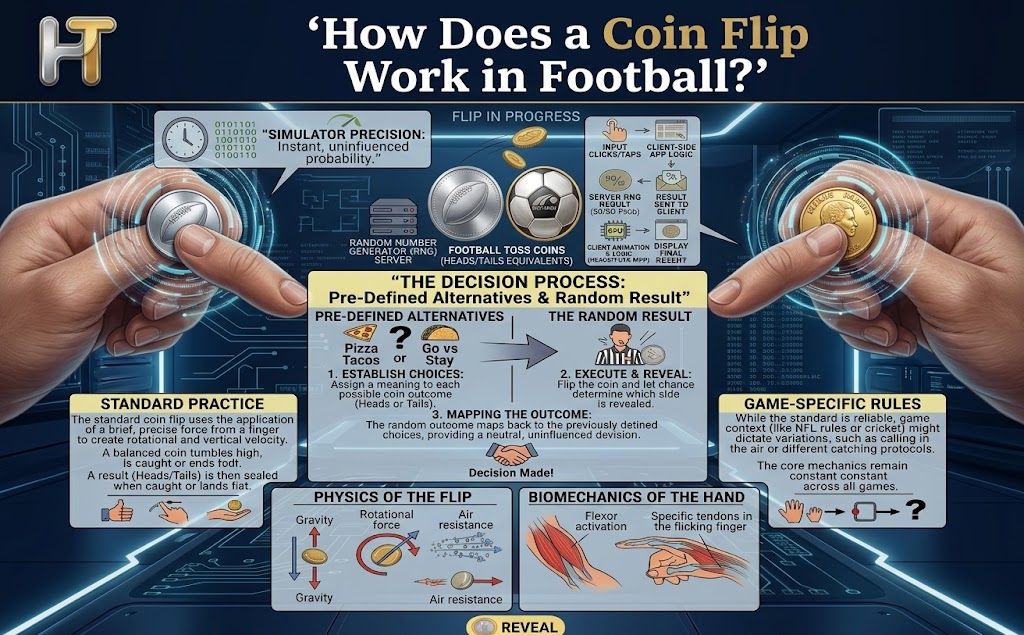
In football, a coin toss decides who gets first choice before the match. A captain calls heads or tails, the winner picks, and the other side gets what’s left. The exact rules differ by league, and they can change by season, so check the current rulebook.
NFL. According to an NFL club’s rules guide, the visiting captain calls the toss while the referee flips. If the call is right, that captain chooses to kick, receive, or pick a goal to defend. If it’s wrong, the home captain chooses. Overtime uses its own toss. In the playoffs, the winner can kick, receive, defer, or pick a goal, per NBC Sports. Both teams normally get a possession. Playoff periods are 15 minutes, and regular-season overtime is 10 minutes, where a tie is possible. These are the rules as of October 2026 based on those sources. See the official NFL rulebook page.
Soccer. Under Law 8 of the IFAB Laws of the Game, the referee tosses the coin. The winning team chooses which goal to attack in the first half, or whether to take the kick-off. The other team gets the other option.
How Does a Coin Flip Work in Probability Theory and Statistics?
In probability, a coin flip is the classic example of a Bernoulli trial: one test with two outcomes and a fixed chance. In statistics, it shows why more flips give a clearer picture.
In probability theory
A fair flip is a Bernoulli trial: two outcomes, independent flips, and P(heads) = 1/2. The sample space (the list of all possible outcomes) is just {heads, tails}.
In statistics
Statisticians talk about sample size, meaning how many flips you look at. Small samples can look wild. I ran 10,000 sets of 10 flips: only about 65.5% had between 4 and 6 heads, and the rest were more lopsided. Exact math says 65.6%.
Bigger samples settle down. In separate batches (seed 7), I got 7 heads in 10 flips (70%), then 55% with 100 flips, 52.9% with 1,000, and 49.9% with 10,000. This is the law of large numbers: with more flips, the share of heads tends to get closer to 50%. If you want fast tests, a random number generator works for this.
How Does a Coin Flip Work With Two Coins?
With two coins, there are four equally likely outcomes. Two heads and two tails are each 25%, and one of each is 50%.
| Outcome | Probability | My 10,000 tosses |
| HH (two heads) | 25% | 2,608 |
| TT (two tails) | 25% | 2,439 |
| HT or TH (one of each) | 50% | 4,953 |
Why is “one of each” more likely? Because there are two ways to get it: heads then tails, or tails then heads. Two heads has only one way. The chance of at least one head is 75%. Want to run this yourself? Try a multiple coin flip tool or a dice roller.
Try a Coin Flip Simulator Online Free
A good coin flip simulator online free should check four boxes:
- Instant result. No waiting, no ads before the flip.
- No sign-up. You shouldn’t need an account to toss a coin.
- Flip history. You can see what came up earlier.
- Many flips. A bonus: running a big batch at once.
Our tool does single flips and runs of 1 to 10,000,000, and it shows the tails percentage. See how it works on the How It Works page.
Common Myths About Coin Flips
The biggest myth: after five heads, tails is “due.” It isn’t. That’s the gambler’s fallacy, and the coin has no memory. Five heads in a row has a 1 in 32 chance (3.1%), but the next flip is still 50/50.
In my main run, a flip followed at least five heads in a row 378 times, and the next flip was heads 197 times, about 52%. Read more in coin flip streaks explained.
Is an online coin flip really random?
Almost, but not in the strictest sense. Most online flips use pseudo-random numbers, which come from a formula, not physical chance. The numbers are close enough to random that you’d never spot a pattern in everyday use. For security work, MDN recommends crypto.getRandomValues() over Math.random().
How does a virtual coin flip decide heads or tails?
It picks a random number between 0 and 1. A number below 0.5 gives heads, and 0.5 or above gives tails. The spinning animation is built around that answer and can’t change it. Each result is independent of the last.
What are the odds of flipping heads 3 times in a row?
One in 8, or 12.5%. You multiply 1/2 three times. I tested it in code: 1,252 of 10,000 tries came up three heads, which is 12.5%. The same odds apply to three tails, and to any one set sequence of three flips.
Is a coin flip simulator as fair as a real coin?
For everyday use, yes. A real coin leans slightly toward the side it started on, by about 51% to 49% in theory, a small lean you won’t notice in one flip. A simulator has no physical bias, but its fairness depends on the random number generator behind it.
What does heads or tails mean in football?
It’s the pregame coin toss. One captain calls heads or tails while the referee flips. The winner chooses first, such as kicking or receiving in the NFL, or which goal to attack or whether to kick off in soccer. League rules can change.
What are the odds with two coins?
Two heads is 25%, two tails is 25%, and one of each is 50%. That’s because there are four equally likely outcomes: HH, HT, TH and TT. At least one head is 75%. My 10,000-toss test matched those odds closely.

Related Articles
Why Is It Called Heads or Tails? 7 Surprising Facts
Why is it called heads or tails? Because a coin’s two sides were pictured as opposite ends of a body: the front shows a head, usually…

Lucky Penny Heads or Tails? 7 Surprising Beliefs
Lucky penny heads or tails? Heads. According to the popular superstition, a penny found heads up is lucky and worth picking up, while a tails-up penny…

Spin a Coin: Ultimate 2026 Guide + Free Flip Tool
When you spin a coin on its edge, it often lands more on one side than the other, so spinning is usually less fair than flipping.…
Need a Quick Decision?
Flip a coin and let chance decide — instantly, honestly, and for free.
Flip a Coin