
Why Is a Coin Toss 50/50? A fair coin has a 50% chance of landing on heads or tails.
 Updated November 11, 2026
12 min read
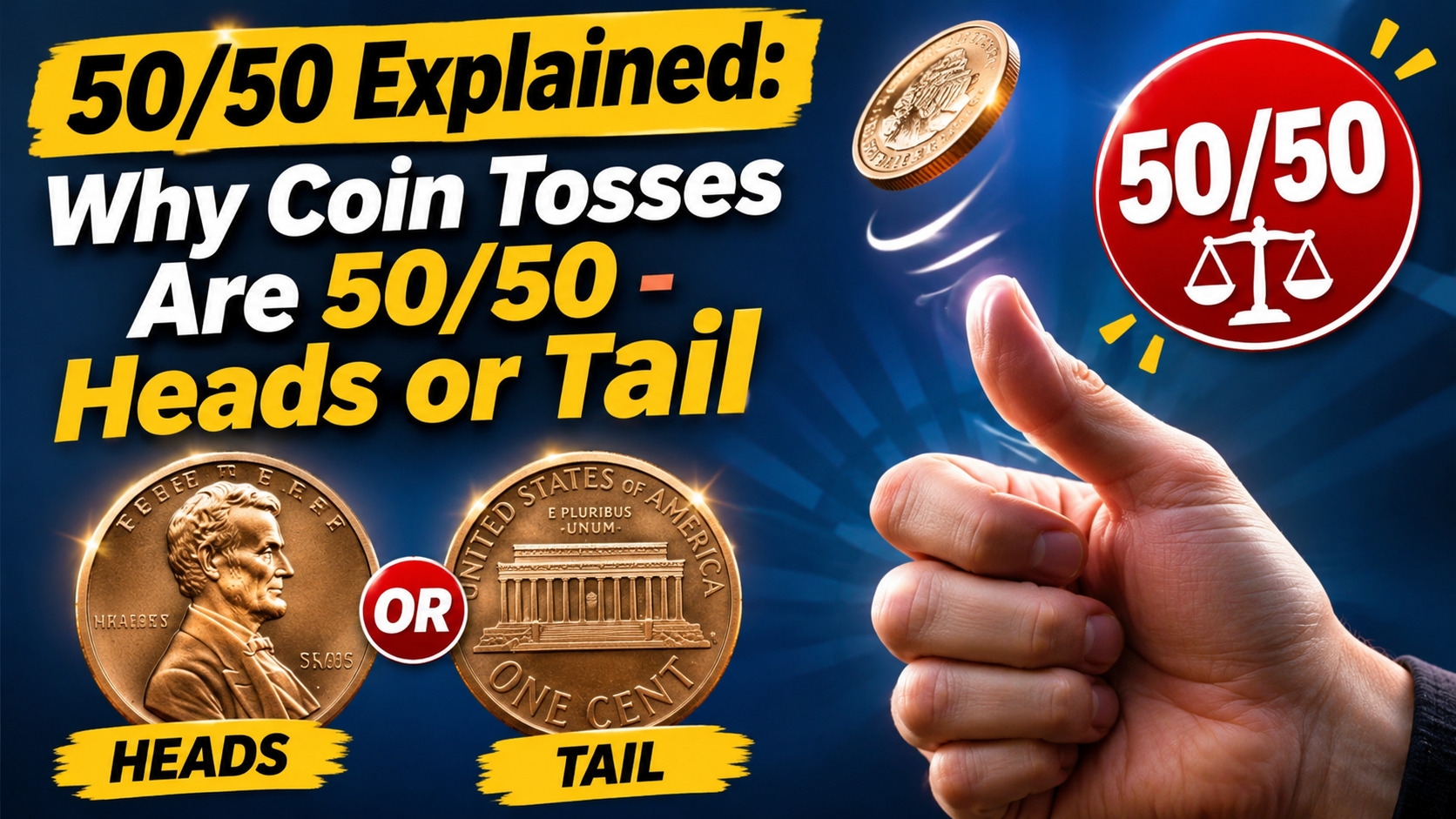
Why Is a Coin Toss 50/50? A fair coin has a 50% chance of landing on heads and a 50% chance of landing on tails. This guide explains coin toss probability, heads or tails odds, the math behind a fair coin flip, and why real-world results may differ from expectations.
You will find out why a fair coin has equal chances , why actual flips almost never come out exactly 50/50 , why the preceding flip matters , and how internet programs generate random results . There’s a tiny experiment you can run yourself along the road. The fastest method to try it is to try our online coin flip simulator at Flip-a-Coin.us, a free tool where you can flip as many times as you like.
No advanced math required. A step-by-step procedure for dividing one integer by another.
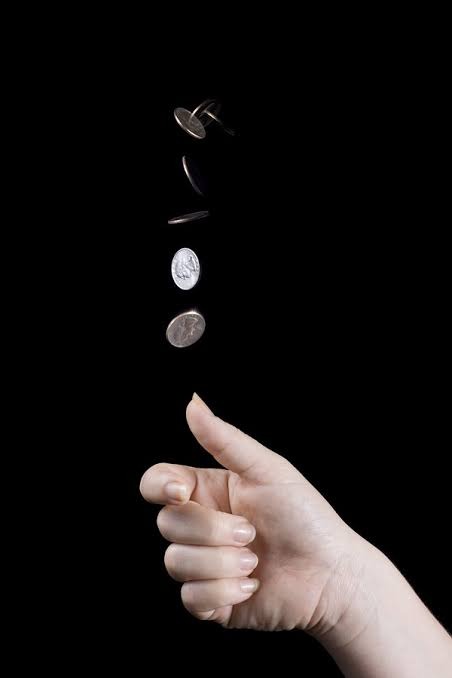
What does 50/50 heads or tails mean?
A 50/50 coin flip has two possible outcomes , heads and tails , and each one has an equal chance of happening . 50 percent for heads and 50 percent for tails . It is about the chance before the flip, not what will happen over the next few tosses.
The key word is opportunity. If you flipped a fair coin thousands of times you would expect to get heads roughly half the time . But there is nothing to make the results alternate or even out in the near run.
It’s about the gap between what we expect and what we get. Expectation says “5 heads in 10 flips or so.” The coin is totally fair, but reality may give you 7 heads and 3 tails.
Why is it 50/50 heads or tails?
Short answer: A fair coin has two possible outcomes, heads or tails. Either side has probability 1/2 or 50% since the two are equally likely .
That is the mathematical explanation of the likelihood of a fair coin. The formula is usually:
Probability = Number of favorable outcomes ÷ Total possible outcomes
There are two options : heads or tails . But only one of them is good for us : heads . So the chance is 1 ÷ 2 = 0.5 , or 50 % . Tails works in the same way.
This also solves the original question of why a fair coin has a 50/50 chance: the number comes from counting equally likely outcomes, not from any particular rule regarding coins. The two probability sum to 1, as one scenario must occur. You can play with coin flip probability in different cases for further practice with the concept.
Why is a coin toss 50/50?
A coin flip is 50/50 because the coin is symmetrical, it is balanced, and little changes in force and spin make the outcome uncontrollable.
That is the scientific explanation of heads and tails probability . It contains four ingredients :
Symmetries. A fair coin is a flat disk with two faces, thus there is nothing about its shape that favors one side.
Weight distribution. A good coin is manufactured so that neither side has a tendency to land down.
The initial state. Each flip has a slightly varied force, angle, and spin.
Sensitivity. The coin is spinning in the air for a long time, thus very small changes in the throw result in various landings.
In principle, a flip obeys regular physics, and technologies have been created that make a coin land the same way every time. A human hand cannot make such an accurate throw repeatedly . This is why a regular flip is like a fair , random choice .
Heads and tails – is it really 50/50?
In principle, absolutely. That is common. In a limited number of true flips the split is frequently unequal. The 50/50 rule is about what happens a lot of times not what happens every time you flip.
This is the difference between theoretical probability (what the math says, 50%) and experimental probability (what you actually count). It also explains why coin tosses do not always result in exactly 50% heads.
Make 10 flips. Getting 7 heads and 3 tails is entirely normal: roughly 12% of the time we get exactly 7 heads. Even the perfect 5-and-5 split only happens around 25% of the time. Now flip 10,000 times. The result is usually much nearer to 50%. This is because of the law of large numbers , as you increase the number of flips the percentage of heads will tend to stabilize around the predicted value.
number of throws
Typical deviation from 50% (approximately 95% of the time)
up to over 30 percentage points
100 approx. 10 pts 1,000 approx. 3 pts 10,000 approx. 1 pts
Try it yourself, flip 10 times and write down the heads. Then flip 100 times and compare the percentages. The second outcome will be nearer to 50%. If you want to get a better understanding of coin toss statistics, running a few batches of flips is the quickest approach to get a feel for it. Khan Academy also has free classes on the principles of probability.
Fair, biased and real coins: Is a coin toss really 50/50?
A fair coin is 50/50. Perfect. Real coins are very close yet slight physical characteristics can tip the chances by a tiny percentage.
On a genuine coin a few things can matter:
- Uneven weight: Engraving, wear or damage might alter the balance very little.
- Coin design: Rims and deep decorations affect how a coin spins and lands.
- Flipping technique: A crisp end-over-end spin is distinct from a flat spin that wobbles.
- The initial position: research on hand-flipped coins established a slight bias, roughly 51%, for the coin to land on the side it started on.
So, how good is the 50/50 coin flip? Very accurate for daily use. A difference of roughly one percentage point when deciding who gets the last piece of pizza is way too little to make any difference.
Is it always a 50/50 chance of heads or tails?
No, not all times. Depends on the coin. A fair coin is 50-50. A biased coin is not . A trick coin that is weighted might come up heads 60% of the time and tails 40% of the time. Yes a coin can be biased , but normal coins flipped routinely are close enough to fair that no one needs to worry .
One more thing, flipping a coin is not the same as spinning it on its edge. A spinning coin can show substantial asymmetry because slight changes in rim and weight become increasingly important when the coin is spinning slowly. The 50/50 rule works well for flipped coins and solves the question of whether a fair coin is always 50/50: yes by definition, but real coins are only approximately fair. In a coin flip, is heads more frequent than tails? No, for a fair coin.
Fair coin 50/50 probability explained with examples
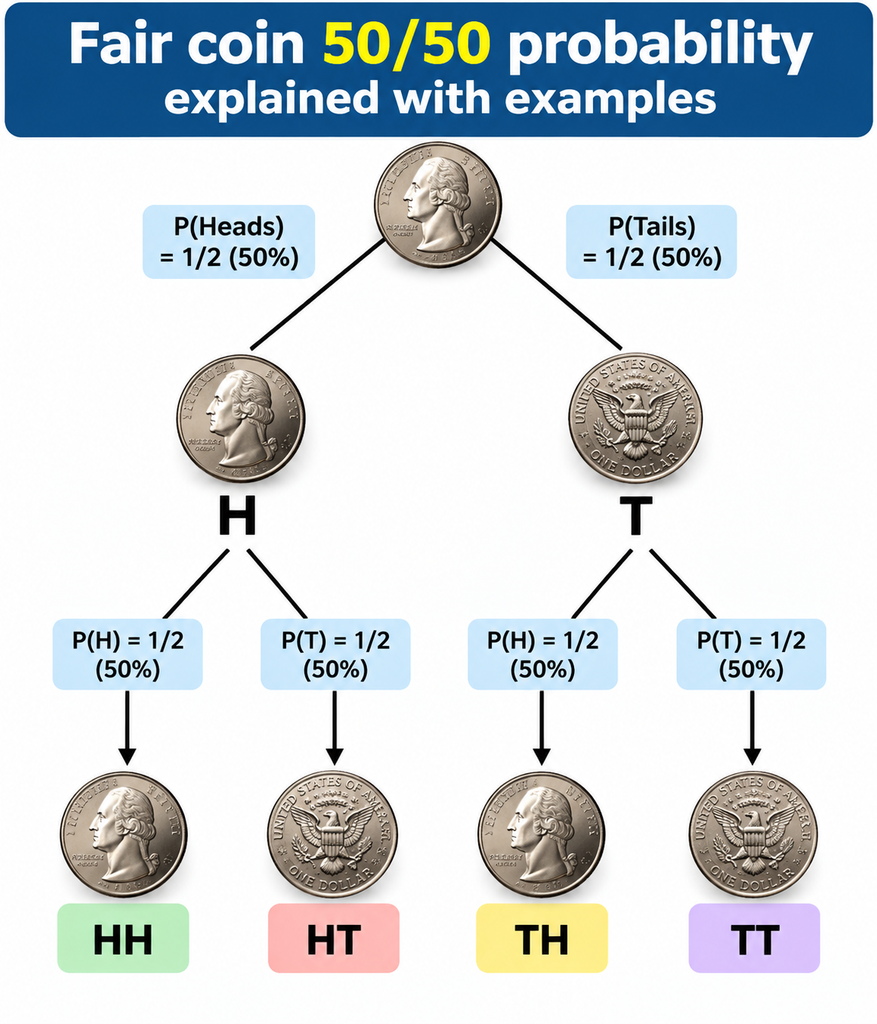
You can compound the probabilities of flips together, and each flip of a fair coin has a 50% probability of coming up heads and a 50% chance of coming up tails.
One flip: heads = 1/2 tails = 1/2
Two tosses: four equally likely outcomes, each occurring 25% of the time.
Result Probability HH (2 heads)
1/4 = 25% HT 1/4 = 25% TH 1/4 = 25% TT (two tails)
1/4 = 25%
HT and TH are both 1 head and 1 tail, hence the chance of “exactly one head” is 50% even if each flip is still 50/50.
A coin toss for a sport: the referee tosses a coin before a football kickoff so both captains have an equal choice. The coin is fair , therefore no team has an advantage . therefore the coin toss is taken as neutral .
Does the previous flip influence the next flip?
No. The coin flips are independent, therefore the previous results do not influence the probability of the following flip. A coin does not have memory.
And that is why we say the coin flip results are independent occurrences, because the coin, the physics and the probabilities are precisely the same at the beginning of every flip.
Now the usual question. Is a coin flip still 50/50 after 5 heads in a row? Yes. The following flip is still 50/50 heads/tails. A lot of people think this is foolish and the mistake has a name: the gambler’s fallacy, the idea that a streak makes the opposite outcome “due.”
The confusion is the result of combining two different queries. The probability of tossing five heads in a row is 1 in 32 (3.1%). But that is a statement about the whole of the sequence before you start it. If five heads have already happened , then there is just one flip left . The chance of heads on that flip is just 1/2 . There is no schedule for randomness to even itself out. Britannica offers a solid explanation of probability concepts if you want to learn deeper .
How do internet coin flip simulators work?
The Internet has an online coin flip simulator . Software generates a random value and then maps that value to heads or tails with equal possibilities . What you get is instant, and there is no tangible coin.
Here is the normal process:
Press the flip button.
A random number generator will create a value, say 0 or 1.
The program assigns the value 0 for heads and 1 for tails.
The outcome is shown on screen, generally with a coin motion.
Is that random enough? Most software utilizes pseudo-random number generators. These are based on a mathematical formula, and give results that look random and pass statistical testing. Real randomness occurs from unpredictable physical factors such as electrical noise. So can a coin flip ever be genuinely random? A physical flip is random in practice; a digital flip is random by design.
Are coinflips online truly fair? Yes, for games, schools, and everyday decisions. The honest limit is that a pseudo-random tool is only as good as its design, and for high-security needs such as encryption, specialized random sources are employed. On the technical side, NIST has published literature on random number generation, and you can see how random generators function in practice by running a random heads or tails generator like Flip-a-Coin.us, which is a free tool for experimentation. You can also check out probability theory on Wikipedia for background.
Conclusion
It’s 50/50 heads or tails because a fair coin has two equally likely outcomes, and the probability calculation gives each side a value of 1/2. That number derives from the simple process of counting, enhanced by the symmetry of the coin and the natural variance of the coin’s flipping.
Real results do change. 10 flips can easily provide you 7 heads, and modest physical biases, but with several flips the proportions grow close to equal. Each flip is independent, thus prior outcomes do not influence future results. Online programs perform the same thing with random number generators.
Try our free online coin flip tool at https://flip-a-coin.us/ and learn about probability through real trials or execute coin flip experiments with friends or classmates.
About the author
About the author: [Include a brief bio that adds math, teaching, or statistics experience to support E-E-A-T.]
SEO Information
- Meta Title: Heads or Tails 50 50 Explained: Why Coin Toss is Fair
- Meta description: Heads or tails 50/50 explained: why a fair coin has equal probabilities, are actual and online coin flips really 50/50 and what the arithmetic says. Download Trial
- URL slug: /heads-or-tails-50-50-meaning/
- Image alt texts: coin toss heads or tails 50 50 explained coin flip probability chart online coin flip simulator why real coin flips are not exactly 50 50
- Schema to add: FAQPage, Article, WebPage, BreadcrumbList, HowTo (“how to calculate coin flip probability”) • SoftwareApplication only if the tool is the primary content of the page and is a calculator or app
Why is it 50/50 heads or tails?
A fair coin can land two ways . Heads or tails . Both are equally likely . Using the probability calculation, 1 successful outcome out of 2 total outcomes is 1/2, or 50% for each side. The coin is symmetrical, therefore each side has no benefit, and the probabilities are equal.
Is it always a 50/50 coin flip?
Yes, for a fair coin, the probability of heads and tails is 1/2. The starting side, the weight, the design of a real coin can change the chances by as much as a percentage point. For day-to-day judgments, those disparities are too slight to matter, hence a coin flip is considered 50/50
Can we foresee a coin toss?
No, not reliably. A regular coin flip is sensitive to small changes in force, angle and spin and no human can replicate a toss exactly. Past outcomes don’t assist either, since each flip is autonomous. A run of heads doesn make tails more likely on the next flip.
Is heads more probable than tails?
No, for a fair coin. 50% chance for heads and 50% chance for tails. The biases of real coins can be extremely modest, e.g. a small bias for the side that is facing up at the start, but it is not more than a percent. For typical use, neither side is more probable.
What are the odds of getting heads?
The chance of the coin coming up Heads on one flip of a fair coin is 1/2, or 50 % . There are 2 outcomes, equally likely, and heads is one of them. The likelihood is the same for each flip, irrespective of the preceding results.
What is the probability of getting exactly 50 heads in 100 coin flips?
Nope. If you toss 50 heads is the predicted . But the actual amount fluctuates . The odds of getting exactly 50 heads in 100 flips is only approximately 8%. Results are about 40-60 heads about 96% of the time so results tend to cluster around 50 but aren’t always reaching it.
Are online coin tosses random?
For the most part, yeah. Online coin flip tools use random number algorithms to pick heads or tails with equal possibilities, and each result is independent of the previous one. Most are pseudo-random, meaning they follow a formula, but the results are statistically unpredictable, which is definitely good enough for games, schools and rapid choices.
Do coins recall the previous flips?
Nope. A coin is merely a piece of metal with no memory, therefore prior flips cannot influence later ones. Each flip is a new probability event, with the same 50/50 chance. It’s the gambler’s fallacy, our brains are wired to see patterns. So people tend to think otherwise.

Related Articles

Is Heads or Tails More Likely? 7 Proven Facts
Is heads or tails more likely? No. On a fair coin, heads and tails each have a 50% chance, so neither wins more over time. The…
Is Heads or Tails Good Luck? 7 Surprising Truths
Is heads or tails good luck? No. On a fair coin, heads and tails each land about 50% of the time, so neither side is luckier,…
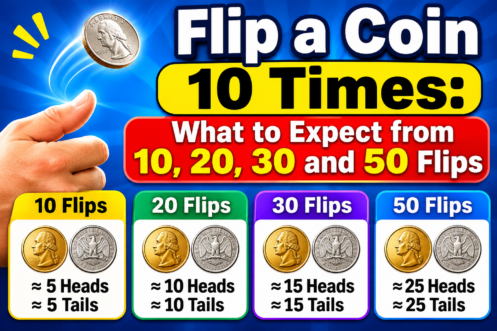
Flip a Coin 10 Times: What to Expect from 10, 20, 30 and 50 Flips
If you flip a coin 10 times, you’ll most often land on about 5 heads, but anything from 3 to 7 heads is completely normal. That…
Need a Quick Decision?
Flip a coin and let chance decide — instantly, honestly, and for free.
Flip a Coin