
Does Heads Make Tails More Likely? The Truth About Coin Flip Streaks
 11 min read

Does Heads Make Tails More Likely? The Truth About Coin Flip Streaks..You flip a coin and get heads four times in a row. Surely tails is coming next, right?
Nope. Does heads make tails more likely? No, never. The coin doesn’t know what it just did, and it doesn’t care. Every flip starts fresh, with the same 50/50 chance as the one before.
If that feels wrong, you’re in good company. Almost everyone feels the pull of “tails is due,” even people who know the math. So this guide goes after the feeling as well as the facts: why it’s so convincing, what’s actually true about streaks, and how to test it yourself in about five minutes. If you’d like to follow along with real flips, any online coin flip tool will do, like the free one at Flip-a-Coin.us.
Does Heads Make Tails More Likely?
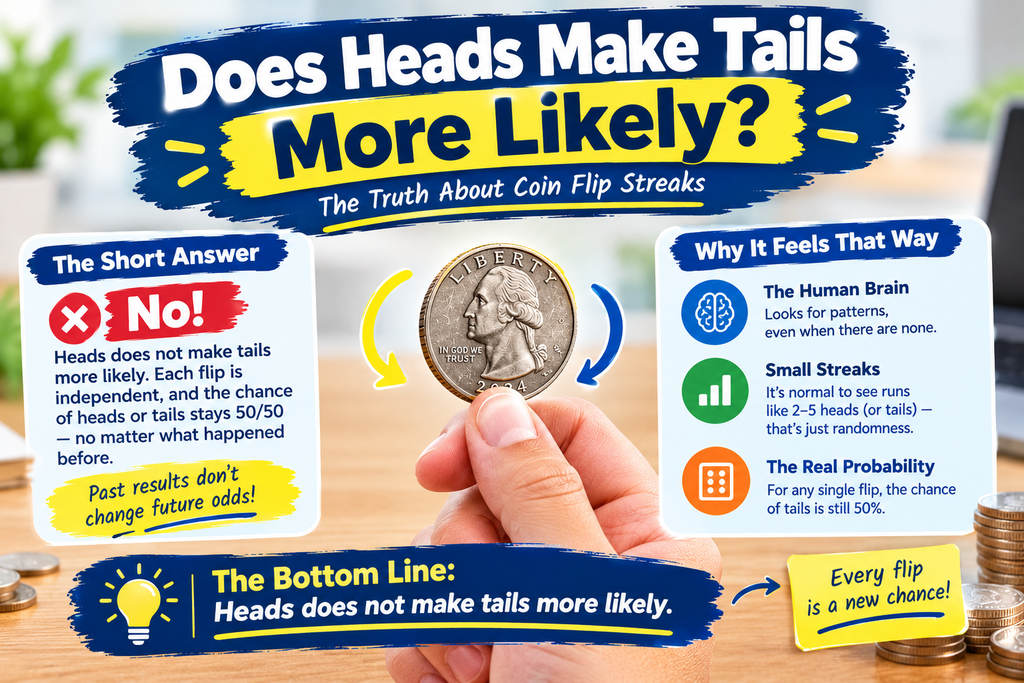
Short answer: No. Heads does not make tails more likely. Each coin flip is independent, so after any streak the next flip is still 50% heads and 50% tails.
That answer assumes a fair coin and flips that don’t influence each other, which is exactly how coins behave in real life. Heads is 1/2 on every flip. Tails is 1/2 on every flip. What happened a moment ago doesn’t get a vote.
Why does it feel like it should? We’ll get to that. First, let’s put a number on the thing people actually worry about: the five-in-a-row.
Does Heads Make Tails More Likely After 5 Flips? Are Tails Due After a Heads Streak?
This is where the confusion lives, so let’s slow down. Five heads in a row from the start has a probability of (1/2)⁵ = 1/32, or 3.125%. That sounds rare, and it is. But that number describes the whole five-flip sequence before anything happens.
Once five heads are already on the table, the question changes. Now you’re asking about one flip. Just one. And it’s 50/50.
Here’s a trick that helps. After five heads, there are only two ways the next flip can go: HHHHHH or HHHHHT. As complete sequences, each one has a probability of 1/64. They’re exactly equally likely. The coin has no preference for finishing the streak, and no urge to break it.
This belief has a name: the gambler’s fallacy. It’s the hunch that a streak makes the opposite result “due,” and it’s one of the most studied mistakes in probability. You can read more about the gambler’s fallacy if you want the full background. We also dig into the numbers in our guide to 5 heads in a row probability.
So is a coin flip still 50/50 after 5 heads? Yes. Every time.
Does a Coin Remember Previous Results?
No. A coin is a small disc of metal. It doesn’t have a brain, a notebook, or a feeling of owing you one.
When you flip, the result comes from physics in the moment: how hard your thumb pushed, how the coin spun, how it landed. None of that carries over from the last flip, which is why a coin can’t remember past flips. Every toss starts a new probability event from scratch.
Think about shuffling a deck of cards. You wouldn’t expect the deck to remember the last shuffle. A coin works the same way. If you want the broader picture of when a flip is and isn’t 50/50, our guide on whether a coin flip is always 50/50 covers it.
Coin Toss Independence Explained
Independence is the idea doing all the work here. Two events are independent when one result doesn’t change the chances of the other. In plain words: knowing how flip one went tells you nothing about flip two.
There’s a handy rule that comes with it. When events are independent, you find the chance of all of them happening by multiplying. Two heads in a row is 1/2 × 1/2 = 1/4. That multiplication only works because the flips don’t affect each other.
So are consecutive coin flips independent? Yes, for a fair coin. Look at how the sequences line up:
| Sequence | Probability |
| HHHHH | 1/32 |
| HTHHT | 1/32 |
| HHHHHH | 1/64 |
| HHHHHT | 1/64 |
Every exact sequence of five flips is equally likely. The streak HHHHH feels special only because we spot the pattern. Our guide to coin flip probability goes through more examples like these, and Khan Academy has free lessons on probability basics if you want to practice independence on other problems.
Coin Flip Streaks: Are They Random? Coin Flip Streak Probability Explained
Streaks are completely normal. In fact, a sequence with no streaks would look suspicious. Real random flips are clumpy, and that surprises beginners.
Here’s how quickly the odds of a streak stack up as you keep flipping.
| Number of flips | Chance of a run of 5+ heads somewhere |
| 5 | 3.125% |
| 10 | about 11% |
| 20 | about 25% |
| 100 | roughly 80% |
So how likely is a streak of 5 heads in 20 flips? About one in four. Not weird at all. And there’s a rough rule of thumb for the longest run you’d expect: roughly log base 2 of the number of flips, which is about 6 in 100 flips.
Why do streaks happen? Because there are just so many places for one to start. Flip enough times and some run of heads has to turn up somewhere. A single set of five flips is unlikely to be all heads, but a long sequence gives the streak dozens of chances.
Meanwhile, human brains expect short sequences to alternate, like HTHTH. We think “random” means “evenly mixed,” so a clump looks fishy. It isn’t. If you’d like to see this for yourself, a random coin toss tool lets you flip a few hundred times and scan for clumps.
Can Heads Predict Tails?
No. Heads can’t predict tails any more than yesterday’s weather can predict a coin. Each flip is independent, and nothing about the last result gives you an edge.
Probability is about how often things happen over many tries. Prediction is a guess about one specific try. They’re different jobs. A fair coin gives you 50% for each side, and that’s all the information there is.
Some people say, “But the law of large numbers says it evens out!” Not quite. The law of large numbers says the percentage of heads settles near 50% over thousands of flips. It doesn’t say tails has to catch up. The coin never “corrects” earlier flips. Later flips just pile on and dilute them, until the early streak barely matters. You can read about the law of large numbers for the formal version.
There is one honest exception. A very long streak, like 20 heads in a row, happens about once in 1,048,576 tries with a fair coin. If you see something like that, it’s reasonable to suspect the coin is biased. But that’s a clue about the coin, not a sign that tails is owed.
Coin Toss Previous Result Effect: Real Coins and Online Flips

Is there any “previous result effect” at all? For real coins, not in the way people mean. Studies of hand-flipped coins found a small tendency, about 51%, for a coin to land on the side it started on. That’s about how the coin sits in your hand when you flip, not about what happened last time, and it’s far too small to matter for everyday decisions.
Online flips are different again. A tool like Flip-a-Coin.us uses a random number generator, picks a value, and shows heads or tails. Most are pseudo-random, meaning they follow a formula designed to produce unpredictable-looking results. True randomness comes from physical sources like electrical noise. Either way, each result is independent of the last, so there’s no previous result effect to worry about. For the technical side, the National Institute of Standards and Technology publishes material on random number generation.
If you want to see it in action, a heads or tails generator shows streaks appearing and vanishing with no memory involved, and a coin toss simulator lets you repeat flips quickly. For deeper math, Wolfram MathWorld has a page on coin tossing.
Try a Simple Streak Experiment
Reading is fine, but this is more convincing when you see it yourself. Here’s a five-minute coin flip experiment:
- Flip a coin 100 times and write down every result in order.
- Each time you see three heads in a row, mark what the next flip was.
- Count how many were heads and how many were tails.
You’ll probably end up with only a handful of cases, so the split may look lopsided. That’s fine. Repeat it a few times, or flip more, and the next flip after a streak lands tails about half the time. Not more. Not less. That’s what independence looks like in real data, and it’s the answer to “does heads make tails more likely” in your own handwriting. Britannica has a good overview of probability theory for anyone who wants to read further.
Conclusion
Heads never makes tails more likely. Every flip of a fair coin is independent, so the next one is 50/50 no matter how long the streak. The 1/32 chance of five heads belongs to the whole sequence before it begins, not to the flip that comes after. Streaks are normal, coins have no memory, and the only time a long run should make you suspicious is when it’s so long that the coin itself might be biased.
The best way to believe it is to watch it happen. Try our free online coin flip tool at https://flip-a-coin.us/ and see streaks for yourself. If you’re curious about the numbers behind longer runs, our guides on 10 heads in a row probability and the heads in a row probability chart go further, and for a look at the neighboring question of fairness, there’s our article on coin toss statistics.
Does heads make tails more likely?
No. Each coin flip is independent, so heads does not change the chance of tails on the next flip. A fair coin gives 50% heads and 50% tails every time, whatever happened before. Believing otherwise is called the gambler’s fallacy, and it is one of the most common probability mistakes.
Are tails due after a heads streak?
No. A heads streak does not make tails due. The coin has no memory, so the next flip is still 50% tails. The chance of five heads in a row is 1/32, but that describes the whole sequence in advance, not the next single flip after it.
Does a coin remember previous results?
No. A coin is a piece of metal with no way to track earlier flips. Every toss starts a fresh probability event with the same chances, and the result depends on how the coin is flipped at that moment. People feel otherwise because our brains look for patterns.
Are consecutive coin flips independent?
Yes, for a fair coin. Independent events are events where one result does not change the chances of another. Getting HHHHH does not make tails more likely on the sixth flip, and getting TTTTT does not make heads certain. Each flip has the same 50/50 chances.
Are coin flip streaks random?
Yes. Streaks are a normal part of random sequences. In 20 flips, a run of five or more heads shows up about 25% of the time, and in 100 flips it happens roughly 80% of the time. Long random sequences are clumpy, not evenly mixed.
Can heads predict tails?
No. Probability describes how often outcomes happen over many flips, not what a single flip will do. After heads, the next flip is still 50% heads and 50% tails. No pattern of earlier flips lets you reliably predict the next result on a fair coin.
What is the gambler’s fallacy?
The gambler’s fallacy is the mistaken belief that after a streak, the opposite result is more likely to come next. With coin flips, it sounds like “five heads, so tails is due.” Because each flip is independent, the chances stay at 50/50, and past results never create a debt.
Is a coin flip still 50/50 after 5 heads?
Yes. The probability of getting five heads in a row is 1/32, or 3.125%, but that covers the whole sequence before it starts. Once five heads have landed, only one flip remains, and its chance of heads is still 1/2. The coin does not owe you tails.

Related Articles

Coin Flip GIF: 5 Free Ways to Get Animations, Sounds and Images
The safest way to get a coin flip gif is to use a free online flipper or a CC0 / public-domain animation, then save it as…

Flip a Coin 100 Times: Ultimate 2026 Guide + Free Simulator
Flip a coin 100 times and you’ll usually see about 50 heads and 50 tails, but anything from roughly 40 to 60 heads is normal. You…

Heads and Tails Coin Flip: The Ultimate 2026 Guide
A heads and tails coin flip is the quickest fair way to settle a decision between two options. You toss a coin, one side lands up,…
Need a Quick Decision?
Flip a coin and let chance decide — instantly, honestly, and for free.
Flip a Coin