
10 Heads in a Row Probability: Formula, Percentage & Odds
 Updated November 11, 2026
10 min read
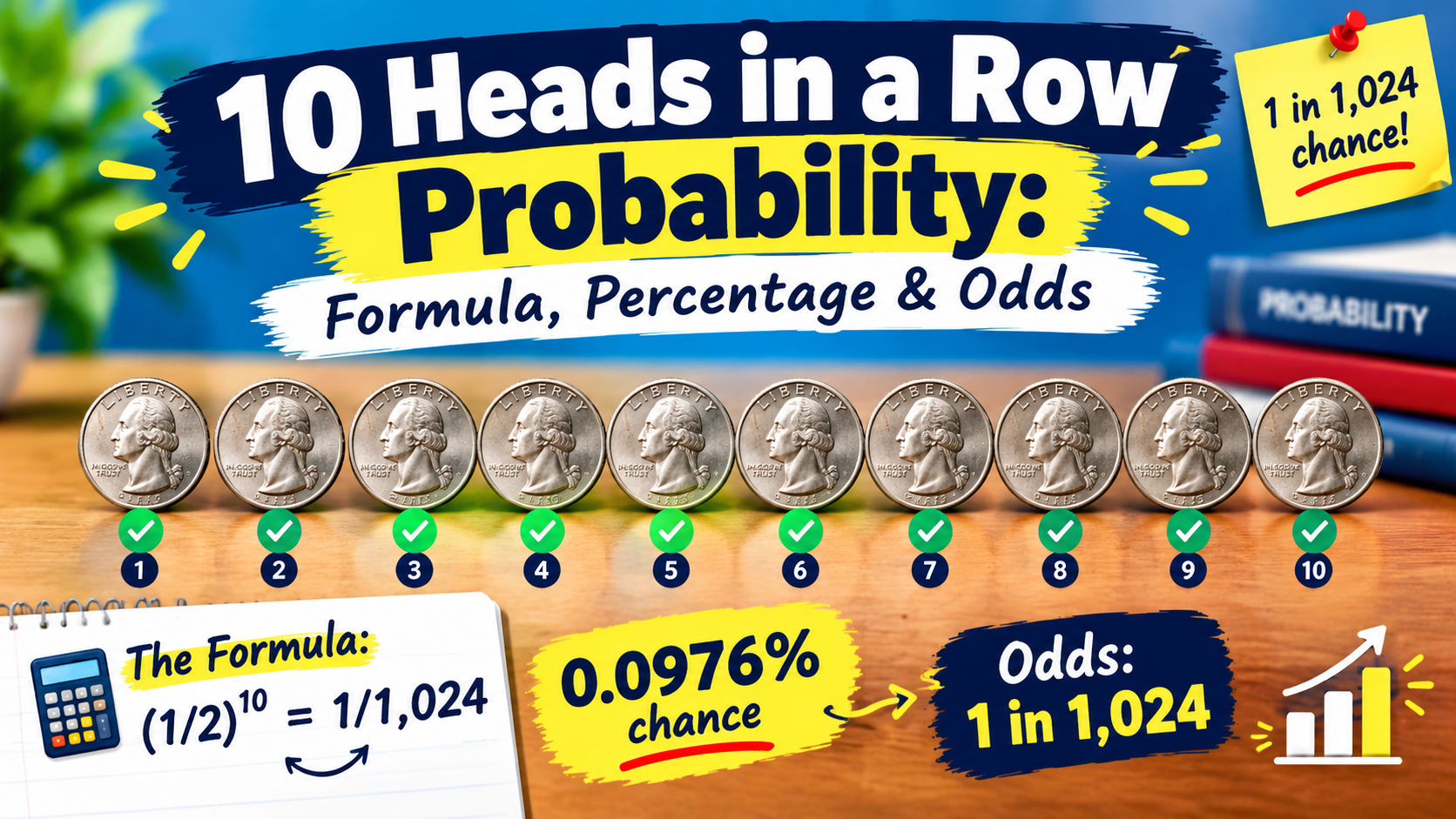
10 Heads in a Row Probability: Formula, Percentage & Odds..People look this up because streaks feel like they mean something. Maybe you flipped a coin to settle who pays for lunch, heads came up again and again, and somewhere around the seventh one you started eyeing the coin suspiciously. Most of the time the coin is fine. Our brains are just bad at judging chance.
This page walks through where the 1,024 comes from, how to turn it into a percentage, and the one formula you need. We’ll also look at how rare ten heads really is, and why rare doesn’t mean impossible. If you want to flip along while you read, the coin tool at https://flip-a-coin.us/ is handy for that.
You don’t need serious maths. If you can multiply 2 by itself, you’re set.
What Is the Probability of Getting 10 Heads in a Row?
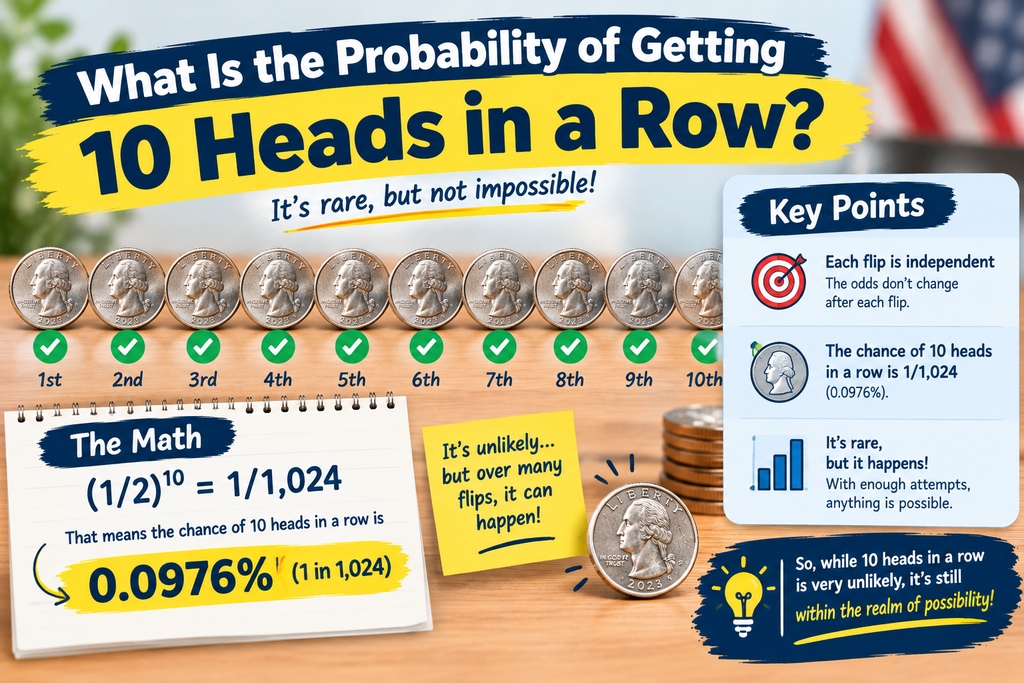
With a fair coin and independent flips, the chance of ten heads in a row is (1/2)^10, or 1/1,024. Ten flips can land in 1,024 equally likely ways, and exactly one of them is all heads.
Two assumptions are hiding in that answer. The coin is fair, so heads and tails get 50% each. And the flips are independent, which just means flip three has no influence on flip four.
To see the 1,024, imagine writing out every possible result. One flip gives two outcomes, heads or tails. Two flips give four: HH, HT, TH, TT. Three flips give eight, and the list keeps doubling until ten flips give 2^10 = 1,024 sequences. Mathematicians call that full list the sample space.
Only one line on it reads HHHHHHHHHH. That’s your 1 in 1,024.
10 Heads in a Row Probability Percentage Explained
Divide 1 by 1,024 and you get 0.0009765625. Multiply by 100 and the percentage is 0.09765625%, a bit under one-tenth of one percent.
Written out:
1 ÷ 1,024 = 0.0009765625
0.0009765625 × 100 = 0.09765625%
It’s small because every extra flip halves your chance. Difficulty doesn’t pile up gently here, it multiplies. Three snapshots show how fast it drops:
| Heads in a row | Fraction | Percentage |
| 1 | 1/2 | 50% |
| 5 | 1/32 | 3.125% |
| 10 | 1/1,024 | 0.09765625% |
Between five and ten there are only five extra flips, yet the chance falls 32 times over. That’s what repeated halving does.
The Formula Behind 10 Heads in a Row Probability
The formula is P = (1/2)^n, where n is the number of heads you want in a row. For ten heads that’s (1/2)^10 = 1/1,024. You multiply because the flips are independent, and when several independent things all have to happen, their chances multiply.
Think of a chain with ten links. You need heads on the first flip and the second and the third, right up to the tenth. One tails snaps the chain. Half of a half is a quarter, half of a quarter is an eighth, and ten halvings in you’re standing at 1/1,024.
The steps:
- Write the chance of heads on a single flip: 1/2.
- Decide how many heads in a row you want: 10.
- Raise 1/2 to that power: (1/2)^10.
- Work it out as 1 ÷ 2^10, which is 1 ÷ 1,024.
- Convert if you want a percentage: 0.0009765625, or 0.09765625%.
If you’ve come across binomial probability, the same thing looks like this: P(X = 10) = C(10, 10) × (1/2)^10 × (1/2)^0. C(10, 10) is 1, and anything to the power of 0 is 1, so you land on 1/1,024 again. The binomial form really earns its keep on messier questions, like exactly 7 heads in 10 flips.
If you’d like the single-flip basics first, see our page on heads or tails probability.
How Rare Are 10 Heads in a Row?
For one person flipping ten times, it’s rare at about 0.098%. But rare isn’t impossible. Give 1,024 people ten flips each and you’d expect one all-heads result on average, with roughly a 63% chance that at least one person gets it.
Picture a school hall with 1,024 students, each flipping a coin ten times. On average one of them hits ten heads. Some days it’s nobody, some days it’s three kids, because chance is lumpy. Overall, though, it’s a better-than-even bet that somebody manages it. So when a friend swears they once flipped ten heads in a row, you can believe them. You just never hear from the other thousand people who didn’t.
For scale, ten heads in a row is slightly more likely than rolling four sixes in a row on a standard die, which is 1 in 1,296.
One thing surprises almost everyone: every exact sequence is equally rare. HTHTTHHTHT looks like nothing special, yet its chance is also 1/1,024. We only notice all heads because it’s a pattern we have a name for.
Streaks can also hide in longer runs. The chance of a run of 10 or more heads showing up somewhere is roughly 4% across 100 flips and roughly 38% across 1,000 flips. Those two figures are approximate, but they show what a bit of patience does.
And the coin itself matters. If a biased coin lands heads 60% of the time, ten in a row is 0.6^10, about 0.6%. That’s more than six times as likely as with a fair coin. So a streak that looks suspicious occasionally is.
10 Heads in a Row Probability Chart and Comparison With Other Streaks
Each extra head cuts the probability in half: 50% for one, 3.125% for five, 0.09765625% for ten. That shrinking pattern is called exponential decay, and it’s why long streaks all but vanish.
Here’s the chart from one head to ten:
| Heads in a row | Fraction | Percentage |
| 1 | 1/2 | 50% |
| 2 | 1/4 | 25% |
| 3 | 1/8 | 12.5% |
| 4 | 1/16 | 6.25% |
| 5 | 1/32 | 3.125% |
| 6 | 1/64 | 1.5625% |
| 7 | 1/128 | 0.78125% |
| 8 | 1/256 | 0.390625% |
| 9 | 1/512 | 0.1953125% |
| 10 | 1/1,024 | 0.09765625% |
Every row is exactly half the one above. Now a wider view with longer streaks:
| Streak length | Fraction | Percentage |
| 5 heads | 1/32 | 3.125% |
| 10 heads | 1/1,024 | 0.09765625% |
| 15 heads | 1/32,768 | 0.00305% |
| 20 heads | 1/1,048,576 | 0.000095% |
Going from 5 to 10 heads makes your chance 32 times smaller. Going from 10 to 20 makes it about 1,000 times smaller. We cover the shorter streak on its own page: 5 heads in a row.
10 Consecutive Heads Probability Calculator
A streak calculator takes the number of heads you want, raises 1/2 to that power, and shows the result as a fraction and a percentage. It’s the formula above, just done for you.
Type in 10 and it computes (1/2)^10, returning 1/1,024 and 0.09765625%. Type in 15 and you get 1/32,768. There’s no secret sauce, so you can always check the answer by hand.
Where calculators really help is with awkward numbers. Nobody wants to work out 2^37 on paper, and a tool won’t slip up on the arithmetic when you’re comparing a lot of streak lengths.
What no calculator can do is tell you the next flip. It describes chances over many flips, never one particular result.
If you’d rather watch streaks happen than calculate them, the free coin flipper at https://flip-a-coin.us/ lets you flip as often as you like and hunt for runs yourself.
Probability of 10 Straight Coin Flips Being Heads
If you’ve already flipped nine heads, the tenth flip is still 50% heads. The coin has no memory. The 1/1,024 figure describes the whole streak before you begin, not the last flip partway through it.
Say your friend has just landed nine heads. Surely tails is due? No. Surely heads is hot? Also no. The tenth flip is a fresh 50/50, exactly like the first one was.
So why is the full streak 1/1,024 when the last step is only 1/2? They answer different questions. One asks about all ten flips before anyone has touched the coin. The other asks about a single flip after nine are already done. Once those nine heads have landed, they aren’t uncertain any more, and only the last flip is left to happen.
You can try this yourself. Flip a coin ten times, jot down the result, and repeat that 100 times. You’ll expect about 0.1 all-heads sets, so zero is the likely outcome and one would be a lucky day. Sets with six, seven or eight heads will turn up plenty.
How long until a ten-head streak appears? On average, about 2,046 flips, from the formula 2^(n+1) − 2. It’s only an average, though. Some people get there in a couple of hundred flips and others need thousands.
Can You Predict 10 Heads in a Row?
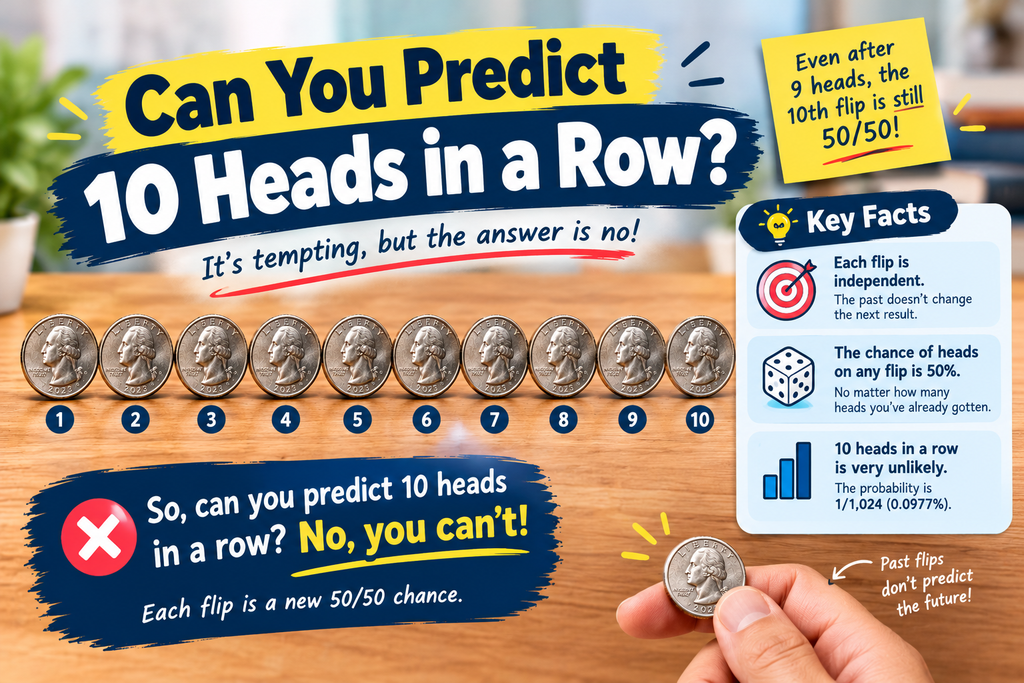
No. You can calculate how likely a streak is, but you can’t predict when it will happen. Each flip is independent, so earlier results tell you nothing about later ones.
Think of a weather forecast. A 30% chance of rain doesn’t promise anything about tomorrow. It describes how often it rains on days like this one. Probability talks about patterns over many tries, not the very next one.
The belief that a streak has to “even out” soon is the gambler’s fallacy. Over thousands of flips, the share of heads does settle near 50%, but not because the coin corrects itself. New flips simply water down the early run.
Ten tails is no different, by the way. Ten heads in a row and ten tails in a row both have a probability of 1/1,024. Our page on 10 tails in a row covers that side. And if you want a steady supply of fair flips to experiment with, a random coin flip generator will do the job.
Conclusion
Ten heads in a row on a fair coin is 1/1,024, or 0.09765625%, and the formula is (1/2)^10. For one set of ten flips, that’s rare. Spread across lots of people or lots of flips, it shows up more often than you’d think, which is why everyone seems to know someone with a streak story.
The part worth remembering is independence. A streak doesn’t change the coin. Whether you’ve just flipped nine heads or none, the next flip is always 50/50.
Try the free coin flip tool at https://flip-a-coin.us/ to explore different probability outcomes.
How likely is 10 heads in a row?
With a fair coin, it’s 1 in 1,024, or about 0.098%. That’s rare enough that most people will never see it in a single set of ten flips. It’s far from impossible, though, because an enormous number of coins get flipped around the world every day.
What is the percentage chance of getting 10 heads consecutively?
It’s 0.09765625%. You get there by dividing 1 by 1,024 to reach 0.0009765625, then multiplying by 100. For everyday use, rounding it to roughly 0.1% is fine, which is just under one-tenth of one percent.
Is getting 10 heads in a row rare?
On a single try, yes: about 1 in 1,024. Across many tries it’s much less surprising. If 1,024 people each flip ten times, there’s roughly a 63% chance that at least one of them gets all heads.
What is the formula for 10 heads in a row?
The formula is P = (1/2)^10. Each flip has a 1/2 chance of heads, and since flips are independent, you multiply those chances together to get 1/1,024. The binomial version, C(10, 10) × (1/2)^10, gives exactly the same answer.
How many coin flips are needed to get a 10-head streak?
On average, about 2,046 flips, using 2^(n+1) − 2 with n = 10. That’s only an average. Some people see a ten-head run within a few hundred flips, while others flip several thousand times before one finally shows up.
Can a coin flip calculator predict future flips?
No. A calculator works out probabilities, like 1/1,024 for ten heads, but every flip is independent and random. Nothing in the past results can tell you what comes next. On a fair coin, the next flip is always 50/50.
Does getting 9 heads make the 10th flip more likely to be tails?
No. After nine heads, the tenth flip is still 50% heads and 50% tails. The coin doesn’t remember what happened before. Feeling that tails is “due” is the gambler’s fallacy, which mistakes the rarity of the whole streak for a pull on the next flip.
What’s the difference between probability and odds?
Probability compares the wanted outcome to all outcomes: 1 in 1,024. Odds compare the wanted outcome to the unwanted ones. So ten heads in a row has a probability of 1/1,024, but the odds against it are 1,023 to 1.

Related Articles

Is Heads or Tails More Likely? 7 Proven Facts
Is heads or tails more likely? No. On a fair coin, heads and tails each have a 50% chance, so neither wins more over time. The…

Is Heads or Tails Good Luck? 7 Surprising Truths
Is heads or tails good luck? No. On a fair coin, heads and tails each land about 50% of the time, so neither side is luckier,…

Flip a Coin 10 Times: What to Expect from 10, 20, 30 and 50 Flips
If you flip a coin 10 times, you’ll most often land on about 5 heads, but anything from 3 to 7 heads is completely normal. That…
Need a Quick Decision?
Flip a coin and let chance decide — instantly, honestly, and for free.
Flip a Coin