
5 Heads in a Row Probability: How to Calculate Coin Toss Odds
 Updated November 11, 2026
11 min read
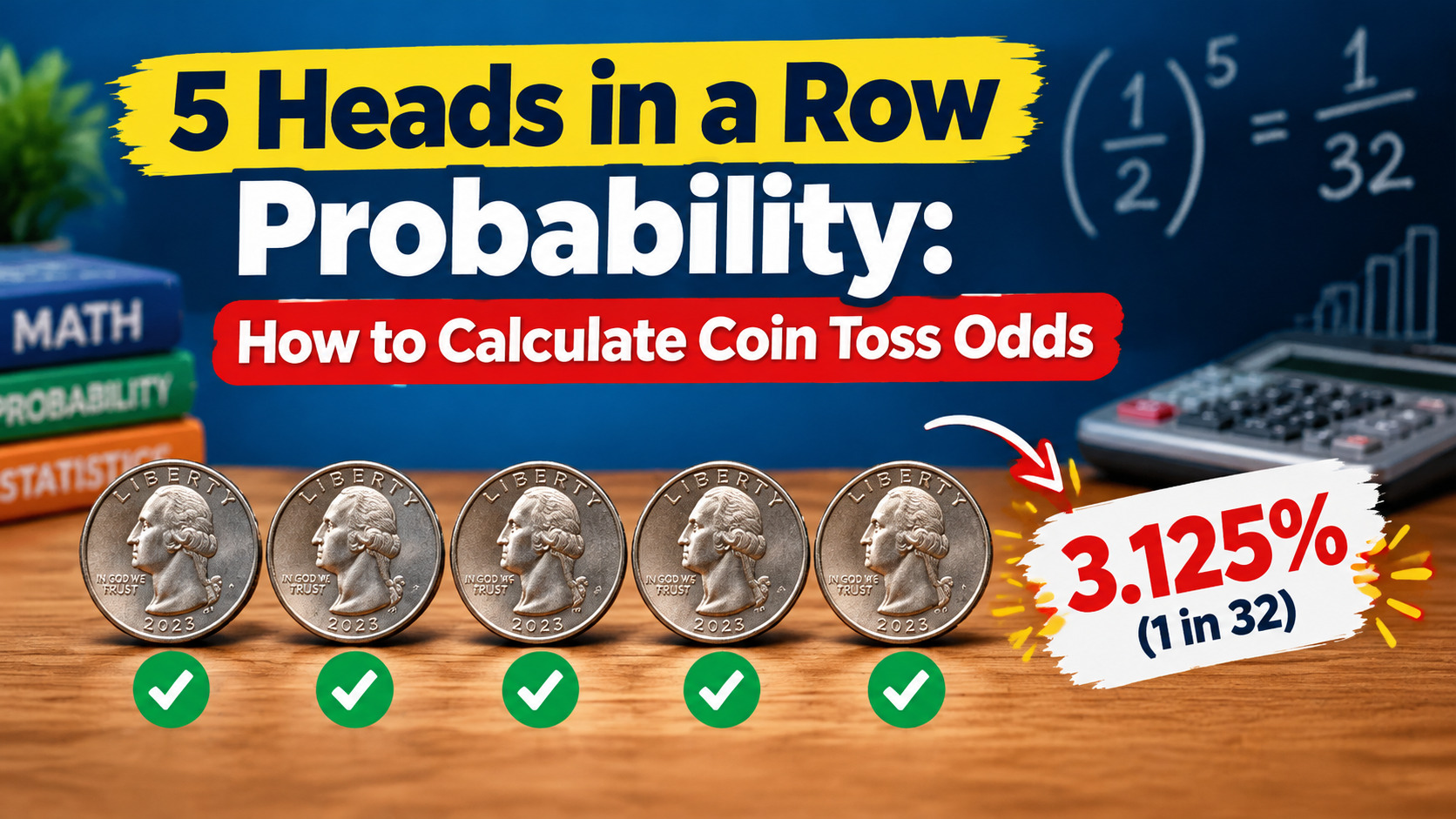
5 Heads in a Row Probability: How to Calculate Coin Toss Odds.Imagine tossing a coin five times and it comes up heads every single time. Suspiciously scarce or more frequent than you might think?
The chances of 5 heads in a row are 1 in 32, or 3.125%. It’s low enough to feel like something exceptional, and high enough that it happens to somebody, somewhere, all the time. If you just saw a coin do it and you’re wondering if it was rigged, the quick answer is: probably not.
This tutorial will show you where the 1 in 32 originates from, how to transform it into a percentage, how to work out any streak yourself and why five heads never makes tails “due”. If you want to use it as you’re reading, you can toss a coin online at a free site like Flip-a-Coin.us and see how streaks appear in actual random coin tosses.
What Are the Chances of Getting 5 Heads in a Row?
Quick answer: The probability of flipping 5 heads in a succession on a fair coin is 1/32. 3.125% or 1 in roughly 32. Each flip has a 1/2 chance of heads and it’s the product of five distinct flips: (1/2) x (1/2) x (1/2) x (1/2) x (1/2) = 1/32.
Some words about the setup. A fair coin can only land two ways, heads or tails, each with a probability of 50%. In the flips, the result of one flip is independent of the next. Under those two assumptions, the probability of a single head is 1/2 and the probability of five consecutive heads is derived by multiplying.
That’s also the chance of flipping exactly 5 heads in 5 flips. All 5 have to be heads. No tails anywhere. If you’d want to review the foundations, Khan Academy has free classes on the fundamentals of probability.
5 Heads in a Row Percentage
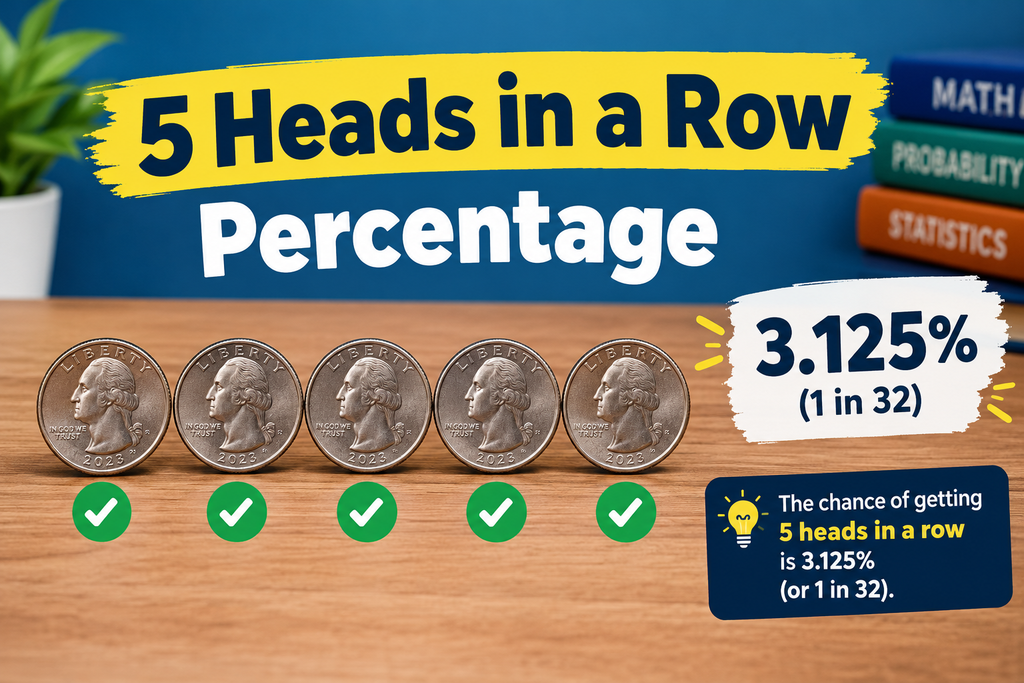
To change a fraction into a percentage, you have to do two things, divide, then multiply by 100.
1 ÷ 32 = 0.03125
0.03125 × 100 = 3.125%
So the likelihood percentage of 5 heads in a row is 3.125%. You might see this number written a few different ways, but all signify the same thing: 1/32, (0.03125), or a 3.125% chance. That’s the one to remember if you want the probability % for 5 heads in a row.
3.125% is a little more than 3 chances in 100. Just to put it in context. Not usual on the first try, but not impossible.
Why Is the Chance of 5 Heads in a Row 1 in 32?
The best way to see it is to create the streak one flip at a time. Every additional head you require, halves the likelihood.
| Heads in a row | Probability | Percentage |
| 1 | 1/2 | 50% |
| 2 | 1/4 | 25% |
| 3 | 1/8 | 12.5% |
| 4 | 1/16 | 6.25% |
| 5 | 1/32 | 3.125% |
These figures are cumulative. It ‘s not the chance of one flip, it ‘s the possibility that all the flips so far are heads. Each row.
Here’s another spin on it. Five flips can come out in 2 ^ 5 = 32 different sequences. Each one is equally likely. One of these is HHHHH, thus the likelihood is one in thirty-two. And here’s the part that surprises people: a messy-looking sequence, like HTHHT, is just as rare as HHHHH. Each exact sequence has probability 1/32. The streak only draws our attention because it has a shape.
A word about words. The odds are “1 in 32.” Strict betting odds are a different story. There’s one way it can happen and 31 ways it can not happen, thus the odds against are 31 to 1. This is the event people are generally talking about if you look up 5 heads in a row odds 1 in 32. Both are the same event.
How to Calculate the Probability of 5 Heads in a Row
There’s one formula that covers all streaks:
P = (1/2)^n
Here, the likelihood of getting heads on one flip is 1/2, and n is the number of heads you want in a row. That’s the complete task for a run of n heads on a fair coin. It’s the usual formula for the likelihood of successive coin flips.
Try it out in 4 steps:
- Write down the probability of heads in one flip: 1/2.
- Choose the length of the streak: n = 5.
- Raise 1/2 to that power: (1/2)^5 equals 1/32.
- Calculate the percentage: 1/32 x 100 = 3.125%.
Now, stretch it. The chance of getting 3 heads in a row is (1/2)^3 = 1/8 or 12.5%. For 10 heads in a row, (1/2)¹⁰ equals 1/1,024 or around 0.1%. The number shrinks swiftly and the pattern is always the same. See our heads or tails probability overview for more on how heads and tails stack up.
Probability Calculator for Consecutive Heads
A 5 heads in a row probability calculator is basically this formula dressed up in a nice face. You enter in how long the streak is. In this case it is 5. The calculator takes 1/2 to that power and gives you the answer in fraction and percent form. And change the number, you can instantaneously view 3, 7 or 12 heads.
Calculators are useful because they: They corroborate your own calculations, they allow you to compare a lot of streak lengths in a short amount of time, and they make the “each extra heads halves the chance” idea feel true. You can perform the same thing with any standard calculator, by inputting 0.5, raising it to the 5th power, and then multiplying by 100.
A calculator will tell you the odds of a streak. You can observe the streaks occur with a flipping tool. A virtual coin-flipper like Flip-a-Coin.us is a fun way to flip a coin online as many times as you want, track your own streaks and compare them to the 1-in-32 number. It’s a flip and test tool, not a prediction tool. There is no calculation or simulator that can tell you what the next flip will be.
Probability, Chance & Odds of 5 Heads in a Row with a Fair Coin
These three terms are used in the same way, however they are a little different:
| Term | What it is like | Value |
| Probability of 5 heads | Favorable outcomes for any result | 1/32 |
| Probability (or percent) | Written as a percent | 3.125% |
| Odds | Favorable outcomes versus negative outcomes | 31 against 1 |
So the odds of 5 heads on a fair coin are 31 to 1 against. The likelihood of 5 heads on a fair coin is 1/32 the chance is 3.125%.
A couple more facts from the same mathematics. Any exact five-flip sequence, HHHHH, HTHHT, or anything else, is 1/32. The probability of flipping 5 of the same side (HHHHH or TTTTT) is 2/32 = 6.25%. And if the coin was weighed, the number changes. Heads comes up 60% of the time. Then 5 heads in a row is 0.6 5 = 7.776%, a substantial increase over 3.125%. You would apply the same formula but with 0.6 instead of 0.5.
Is Five Heads in a Row Unusual?
It’s uncommon, but not very rare. And the rarity of it is determined by how many chances you give it.
It’s 3.125% for one shot. But suppose that a class of 32 students each toss a coin five times. Now, each student has a 1 in 32 chance. So you would expect around one kid to get five heads. The probability of at least one student doing so is roughly 64%. In a group of 100 people, that increases to roughly 96%.
The same reasoning applies within a long sequence of flips, as a streak might start at practically any point. The probability that somewhere in the sequence there is a run of 5 or more heads is around 11% in 10 flips, about 25% in 20 flips, and about 80% in 100 flips. If you want to look into this sort of stuff, coin toss statistics are a fantastic place to start.
Here is an experiment you can do. Flip a coin 5 times and see whether you get all heads. Do that again 50 times but this time with a coin or a coin flip simulator. You should expect around one or two all-heads rounds, but your actual amount may vary. The lesson is that wandering: brief experiments are noisy and the results settle at 3.125% as you gather more data. So certainly, unusual is not impossible.
Does Getting 5 Heads Mean the Next Flip Will Be Heads?

No. One of the most prevalent confusions in probability is this. After 5 heads it seems like tails is coming but each flip is an independent event. A coin doesn’t remember anything from a minute ago.
The key is this. The 1/32 number is for the entire five-flip sequence before you even begin. If 5 heads have come up, then there is just one flip remaining and its likelihood of heads is just 1/2. The following flip is still 50/50 heads/tails.
The gambler’s fallacy is when you feel like a run of results means the opposite result is “due”. Randomness doesn’t balance out on a timetable. Over thousands of flips the proportion of heads tends to settle near half, but short sections might look highly unequal. If you want to read more about the 50/50 idea, see our guide explaining the 50/50 chance and for the math behind independent events, Britannica has an article on probability theory. One caveat: a really severe run, like 20 heads in a row, can be a clue that the coin is biased, because that happens roughly once in a million trials on a fair coin.
Note about the numbers on this page: they are mathematical expectations for a fair coin and independent flips. Real experiments will be different, If you want to learn about the study of randomness, the National Institute of Standards and Technology publishes research on randomness and probability. Wolfram MathWorld has mathematical probability formulas for coin tossing.
Conclusion
The formula underlying this is simple (1/2)^5. With a fair coin, the probability of flipping 5 heads in a row is 1/32 or 3.125%. One try is an uncommon event, but after many tries it is common: a class of 32 will normally offer a streak, and a long run of flips will nearly always have at least one. Whatever streak you see, the next flip is still 50/50. A coin never recalls what it did.
The greatest way to make this stick, is to witness it done. Try our free online coin flip tool at https://flip-a-coin.us/ and check streak probability with real random flips.
What Are the Odds That We Get 5 Heads in a Row?
The probability of flipping 5 heads in a row with a fair coin is 1/32, or 3.125%. You do this by multiplying the 1/2 likelihood of heads by itself five times: (1/2)^5. Since each flip is independent, the probability is the same for any five sets of consecutive flips.
What Are the Chances of Flipping 5 Heads in a Row?
The odds are 1 in 32, or 3.125 percent. In strict betting terms the odds against are 31 to 1, because there is one winning sequence out of 32 and 31 that don’t work. Both ways of phrasing it refer to the same event on a fair coin.
What Is the Probability of Getting 5 Heads in a Row?
Chance of 3.125%. It is found by dividing 1 by 32 that equals 0.03125 and multiplied by 100. The same percentage for 5 tails in a row, on a fair coin, because heads and tails are each 50%.
Is 5 Heads in a Row Unlikely?
It is unusual, although not extremely so. The odds for one set of five flips are a mere 3.125%. However, with 32 people flipping 5 times each, around 64% of the time at least one person gets all heads. If you flip 100 times, about 80% of the time you will get a run of 5 or more heads.
How to Calculate the Likelihood of 5 Heads in a Row?
Multiply the chance of heads, 1/2, by itself as many times as there are flips in the streak. The calculation is P = (1/2)ⁿ, thus five in a row is (1/2)⁵ = 1/32, or 3.125 percent. For a biased coin, replace 1/2 with the coin’s own chance of heads.
Does a 5 Heads in a Row Probability Calculator Forecast Future Coin Flips?
No. But a calculator simply tells you the odds of a streak, e.g. 1/32 for five heads. A simulator generates random flips so you may test the result yourself. The flips are independent and random, thus neither tool is able to tell you what the following flip is going to be.
What Are the Odds of 5 Heads on a Fair Coin? Biased Coin?
It grows up. A fair coin yields 3.125%. But a biased coin takes its own chance of heads in the formula. 5 heads in a row is 0.6 ^ 5 or 7.776%. That’s a lot better than a fair coin. If the coin comes up heads 60% of the time.
Does 5 Heads Make the Next Tail More Likely?
Nah. Each flip is autonomous. Previous results do not affect the following one. Each flip has a 50% chance of a head and 50% chance of a tail. This is called the gambler’s fallacy, the belief that tails is due, and it is one of the most common errors about probability.

Related Articles

Is Heads or Tails More Likely? 7 Proven Facts
Is heads or tails more likely? No. On a fair coin, heads and tails each have a 50% chance, so neither wins more over time. The…

Is Heads or Tails Good Luck? 7 Surprising Truths
Is heads or tails good luck? No. On a fair coin, heads and tails each land about 50% of the time, so neither side is luckier,…

Flip a Coin 10 Times: What to Expect from 10, 20, 30 and 50 Flips
If you flip a coin 10 times, you’ll most often land on about 5 heads, but anything from 3 to 7 heads is completely normal. That…
Need a Quick Decision?
Flip a coin and let chance decide — instantly, honestly, and for free.
Flip a Coin