
Coin Flip Probability: Easy Formula, Chart & 4 Examples
 Updated November 11, 2026
10 min read
In this article
- What Is the Probability of a Coin Landing on Heads?
- Coin Flip Possible Outcomes: Heads and Tails
- Coin Flip Probability Formula and Equation
- Coin Flip Probability Chart
- Coin Flip Tree Diagram
- 3 Coin Flip Probability
- Simultaneous Coin Flip Probability
- If I Flip a Coin 4 Times, What Is the Probability?
- Binomial Distribution and Coin Flip Distribution
- Is Real Coin Flip Probability Exactly 50/50?
- Coin Flip Probability Worksheet
- Final Word
Ask ten people about coin flip probability and nine will say “fifty-fifty” without blinking. They’re right. A fair coin lands on heads 1/2 of the time (that’s 50%), and tails gets the other half. The fun starts when you flip it twice, or three times, or four, and the answers stop being obvious.
So here’s a plain walk through coin flip probability. We’ll count outcomes, build a chart, sketch a tree, and finish with five questions you can try on a friend. You don’t need anything fancier than fractions. If you can split a pizza, you can do this.
The short version of coin flip probability
- One flip: heads is 1/2 (50%) and tails is 1/2 (50%). That’s the coin flip probability everything else grows from.
- Outcomes: n flips give 2ⁿ possible outcomes. 2 flips = 4, 3 flips = 8, 4 flips = 16.
- Formula: favorable outcomes ÷ total outcomes.
- Flips are independent, so earlier results never change the next one.
What Is the Probability of a Coin Landing on Heads?
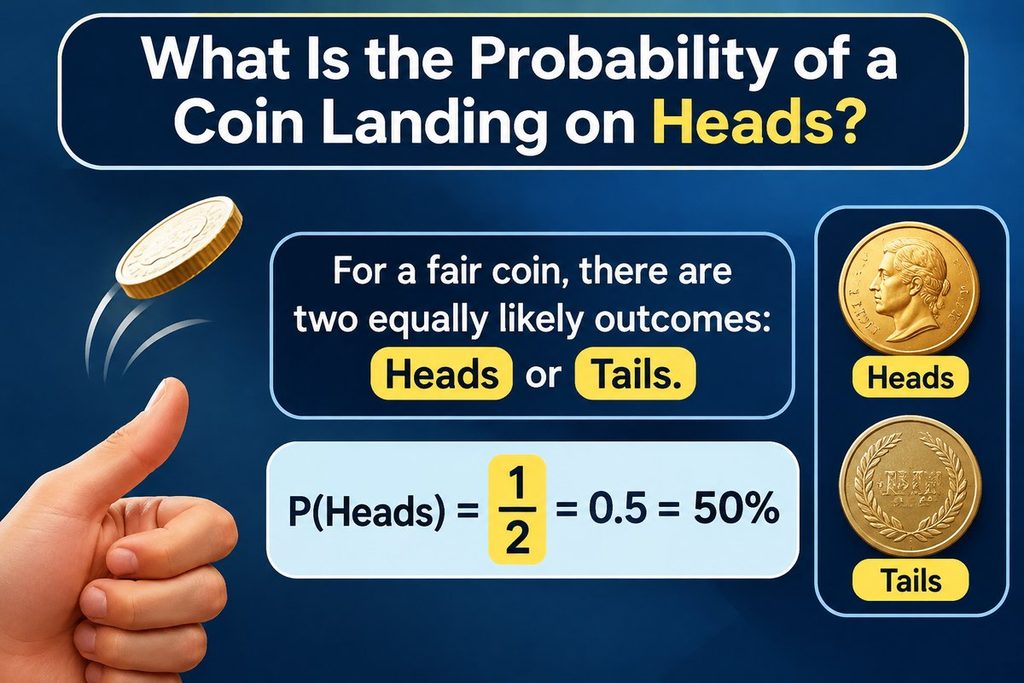
One half. Write it as 1/2, 0.5 or 50%, whichever your teacher likes best. The coin has two sides and neither one is special, so the coin flip probability of heads and tails is exactly the same.
You’ll also hear people ask about the odds of a coin flip. Same idea, different packaging. Probability puts one result against all results (1 out of 2). Odds put one result against the other (1 to 1). Even odds, 50% each. Nobody has an edge on a fair coin, which is exactly why we use one to settle who washes the dishes.
Want to try it? The coin flip page will flip as often as you like, and if you’d rather toss a real coin, our guide on how to flip a coin shows the thumb technique.
Coin Flip Possible Outcomes: Heads and Tails
Start by counting, because every coin flip probability question is really a counting question in disguise. One flip, two outcomes. Two flips, four. Each new flip doubles the pile, so n flips give you 2ⁿ outcomes.
- 1 flip: 2 outcomes (H, T)
- 2 flips: 4 outcomes (HH, HT, TH, TT)
- 3 flips: 8 outcomes (HHH, HHT, HTH, HTT, THH, THT, TTH, TTT)
- 4 flips: 16 outcomes (2 × 2 × 2 × 2)
The full list has a proper name, the sample space, and writing it out is the best habit you can build. Skip it and you’ll fall into the usual trap: treating HT and TH as the same thing. They aren’t. Same ingredients, different order, two separate outcomes. That matters in every coin flip probability problem you’ll meet.
Coin Flip Probability Formula and Equation
Good news: the coin flip probability formula is the one you half-remember from school. Favorable outcomes over total outcomes. One head out of two outcomes is 1 ÷ 2 = 0.5. Done.
Two extra tools cover everything else. The first is the multiplication rule. Flips are independent, so to get a specific sequence you multiply. Heads then heads is 1/2 × 1/2 = 1/4.
The second is the binomial formula, the coin flip probability equation for “exactly k heads in n flips”:
P(X = k) = \binom{n}{k} \times 0.5^{n}
C(n, k) is the number of ways to choose which flips come up heads. The 0.5ⁿ part is the chance of any single sequence.
Example 1. Exactly 2 heads in 4 flips. C(4, 2) = 6 and 0.5⁴ = 1/16, so 6/16 = 0.375, or 37.5%. If you’re curious where the formula comes from, the binomial distribution page goes deep.
Coin Flip Probability Chart
Sometimes you just want to see it. A coin flip probability chart lists every possible head count, how many ways it can happen, and the chance of it. Three flips first (8 outcomes in total):
| Number of heads | Ways it can happen | Probability |
| 0 | 1 | 1/8 = 12.5% |
| 1 | 3 | 3/8 = 37.5% |
| 2 | 3 | 3/8 = 37.5% |
| 3 | 1 | 1/8 = 12.5% |
Now four flips (16 outcomes):
| Number of heads | Ways it can happen | Probability |
| 0 | 1 | 1/16 = 6.25% |
| 1 | 4 | 4/16 = 25% |
| 2 | 6 | 6/16 = 37.5% |
| 3 | 4 | 4/16 = 25% |
| 4 | 1 | 1/16 = 6.25% |
Notice the shape? The middle rows are crowded and the ends are lonely. Add up the probability column in any coin flip probability chart and you should get 100%. If you don’t, a row is wrong, which makes it a free error check. Want numbers from real flips instead of theory? Try the flipping a coin simulator.
[IMAGE 1: chart of 4 flips. Alt text: coin flip probability chart showing the chance of 0 to 4 heads in 4 flips]
Coin Flip Tree Diagram
If charts feel too tidy, draw a tree. A coin flip tree diagram shows every flip as a fork: heads up, tails down, each branch worth 1/2. Here’s a coin flip probability tree diagram for 2 flips, built the usual tree diagram way:
- Put a single dot on the left.
- Draw two branches for flip one, H and T, each labelled 1/2.
- From the end of each branch, draw two more for flip two, again H and T, each 1/2.
- Read each path left to right: HH, HT, TH, TT.
- Multiply along the path. Every ending is 1/2 × 1/2 = 1/4.
Four endings, 1/4 each, adding up to 1. This is the picture that usually makes it click for anyone who keeps asking why there are four outcomes and not three. A good coin flip probability diagram answers that without a word.
[IMAGE 2: tree diagram. Alt text: coin flip probability tree diagram for two flips with branches labelled 1/2]
Three flips? One more layer, 8 paths, 1/8 each.
3 Coin Flip Probability
Three flips, 8 outcomes, all equally likely. So any 3 coin flip probability question comes down to how many of the 8 you’re after. Each single outcome is 1/8, or 12.5%.
Example 2. Three heads in a row (HHH): one outcome out of 8, so 12.5%. Multiplying gets you there too: 1/2 × 1/2 × 1/2 = 1/8.
Example 3. Exactly two heads. HHT, HTH, THH. That’s 3/8, or 37.5%.
Now a favourite trick. What about at least one head? Counting seven outcomes is annoying, so count the one that fails instead: TTT, at 1/8. That gives 1 − 1/8 = 7/8, or 87.5%. “One minus the opposite” will save you hours of coin flip probability homework. Want longer streaks? The article on the odds of heads in a row picks up from here.
Simultaneous Coin Flip Probability
Tossing coins at the same moment changes nothing. The coins don’t know about each other, so simultaneous coin flip probability works exactly like flipping one coin several times.
Two coins give the same four outcomes: HH, HT, TH, TT. Three coins give the eight from before. The one thing that trips people up is identical-looking coins. HT and TH look the same on the table, so people count 3 outcomes. It’s still 4, which is why one head and one tail is 2/4, or 50%, and not 1/3. To watch small batches play out, the flip a coin 5 times page is a fun place to start.
If I Flip a Coin 4 Times, What Is the Probability?
Sixteen outcomes, each 1/16, or 6.25%. That’s your whole toolkit for four flips.
Example 4. At least one head? Only TTTT fails, so 1 − 1/16 = 15/16, which is 93.75%. A few more answers from the chart:
- Exactly 2 heads: 6/16 = 37.5%
- Exactly 1 head: 4/16 = 25%
- All four heads: 1/16 = 6.25%
Look at that first bullet again. Even the most likely result, 2 heads, turns up only a bit more than a third of the time. So if your four flips come out HHHT, nothing’s wrong with the coin. That’s just coin flip probability doing its thing. For a much bigger sample, try flipping a coin 100 times and watch the average settle.
Binomial Distribution and Coin Flip Distribution
The coin flip distribution is a fancy way of asking: across all the results, how are the head counts spread out? It’s called binomial because every flip has just two outcomes.
You’ve already seen small ones in the charts above. Few heads, rare. Lots of heads, rare. Somewhere in the middle, common. Flip more and the coin flip probability distribution smooths out into a bell curve sitting over half the flips.
The expected number of heads is n × 0.5, so 5 in 10 flips and 50 in 100. Expected doesn’t mean guaranteed, though. With 10 flips, exactly 5 heads shows up only about 24.6% of the time (252 ÷ 1,024). What gets better with more flips isn’t the exact count. It’s the spread, which shrinks compared with the total.
[IMAGE 3: distribution graph. Alt text: coin flip probability distribution bar chart showing the bell shape for 10 flips]
Is Real Coin Flip Probability Exactly 50/50?
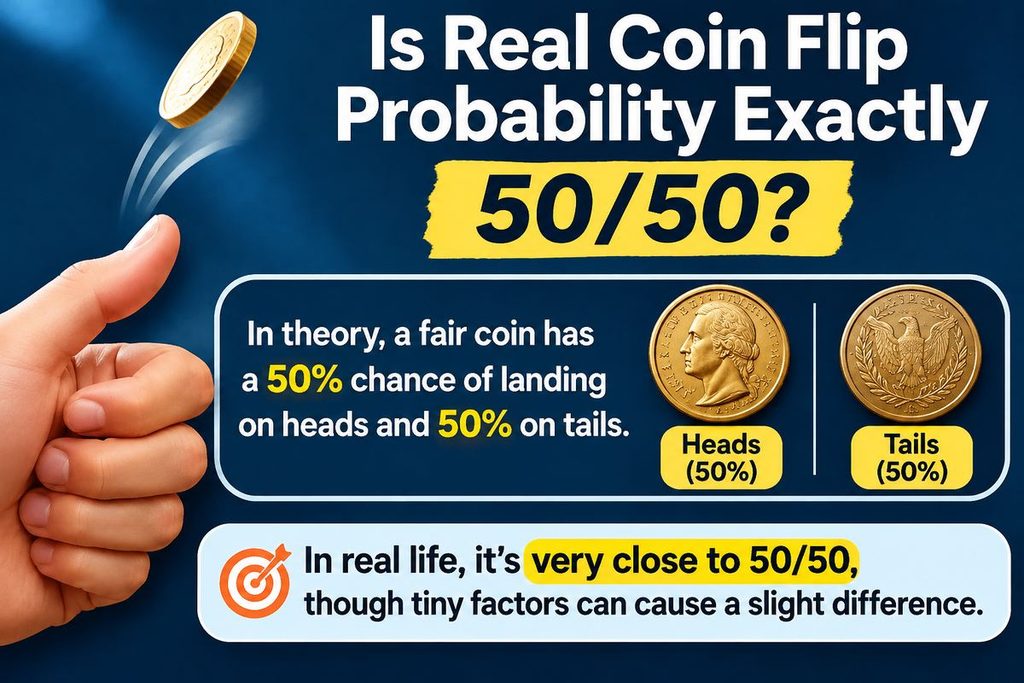
Very nearly. A big 2023 experiment, with more than 350,000 hand flips, found that coins landed on the side they started on about 50.8% of the time. You can read the paper on arXiv, and do check the figures there before you quote them.
That’s a tiny nudge. For homework or for picking a restaurant, real-world coin flip probability is 50%, full stop. I get into the physics in is a coin flip 50/50. And if you want to dodge physics completely, the free flip a coin online tool here uses a random number instead, the same idea we explain on the online heads or tails page.
Coin Flip Probability Worksheet
Time to try it yourself. Here’s a quick coin flip probability worksheet with five questions. Cover the answers, give each one a go, then check. [INSERT MY EXPERIENCE: add one line about how you use these questions with kids or students.]
- What is the probability of flipping heads on one fair coin?
- How many outcomes are there when you flip a coin 5 times?
- What is the probability of getting two tails in 2 flips?
- What is the probability of exactly 1 head in 3 flips?
- What is the probability of at least one tail in 3 flips?
Answers:
- 1/2, or 50%.
- 2⁵ = 32 outcomes.
- 1/2 × 1/2 = 1/4, or 25%.
- HTT, THT, TTH, so 3/8 = 37.5%.
- 1 − P(HHH) = 1 − 1/8 = 7/8, or 87.5%.
Five minutes with a coin flip probability worksheet like this does more than rereading the theory. For how a toss is set up, see the heads or tails coin toss rules, and for more practice try the Khan Academy probability library.
Final Word
Coin flip probability really boils down to four moves: list the outcomes, count the ones you want, divide, and remember that flips never affect each other. Now go see it happen. Pop over to Flip-A-Coin.us and flip a coin online for free, then check your results against the coin flip probability charts above.
What are the odds of a coin flip?
The odds of a coin flip are 1:1, which means even odds. The probability of heads is 1/2 (50%) and the probability of tails is 1/2 (50%). Neither side has an advantage on a fair coin.
What is the probability of a coin landing on heads?
It’s 1/2, or 0.5, or 50%. That’s the same coin flip probability as tails. Past flips don’t change it, because every flip is independent of the one before.
What is the coin flip probability formula?
The basic coin flip probability formula is favorable outcomes divided by total outcomes. For exactly k heads in n flips, use C(n, k) × 0.5ⁿ. For example, 2 heads in 4 flips is 6 × 1/16 = 37.5%.
What are the possible outcomes of 3 coin flips?
Three flips have 8 possible outcomes: HHH, HHT, HTH, HTT, THH, THT, TTH and TTT. Each one has a probability of 1/8, or 12.5%. The count comes from 2 × 2 × 2.
If I flip a coin 4 times, what is the probability of at least one head?
It’s 15/16, or 93.75%. There are 16 outcomes, and only TTTT has no heads. So you take 1 − 1/16 = 15/16. The same “one minus the opposite” idea works for any number of flips.
What is a coin flip tree diagram?
It’s a branching chart where each flip splits into heads and tails. Every branch is labelled 1/2, and multiplying along a path gives the probability of that exact sequence.
Is coin flip probability the same every time?
Yes. Coin flip probability stays at 1/2 for heads no matter what came before. A streak like HHHH doesn’t make tails “due”. Flips are independent, so the coin has no memory.
What is the binomial distribution for coin flips?
It’s the pattern showing how likely each number of heads is across n flips. Middle values are most likely and extremes are rare. With more flips, it looks like a bell curve centred on half heads.

Related Articles

Is Heads or Tails More Likely? 7 Proven Facts
Is heads or tails more likely? No. On a fair coin, heads and tails each have a 50% chance, so neither wins more over time. The…

Is Heads or Tails Good Luck? 7 Surprising Truths
Is heads or tails good luck? No. On a fair coin, heads and tails each land about 50% of the time, so neither side is luckier,…

Flip a Coin 10 Times: What to Expect from 10, 20, 30 and 50 Flips
If you flip a coin 10 times, you’ll most often land on about 5 heads, but anything from 3 to 7 heads is completely normal. That…
Need a Quick Decision?
Flip a coin and let chance decide — instantly, honestly, and for free.
Flip a Coin