
Heads or Tails Coin Toss Rules: Simple Guide to Coin Flipping, Probability & Online Generators
 Updated October 21, 2026
10 min read
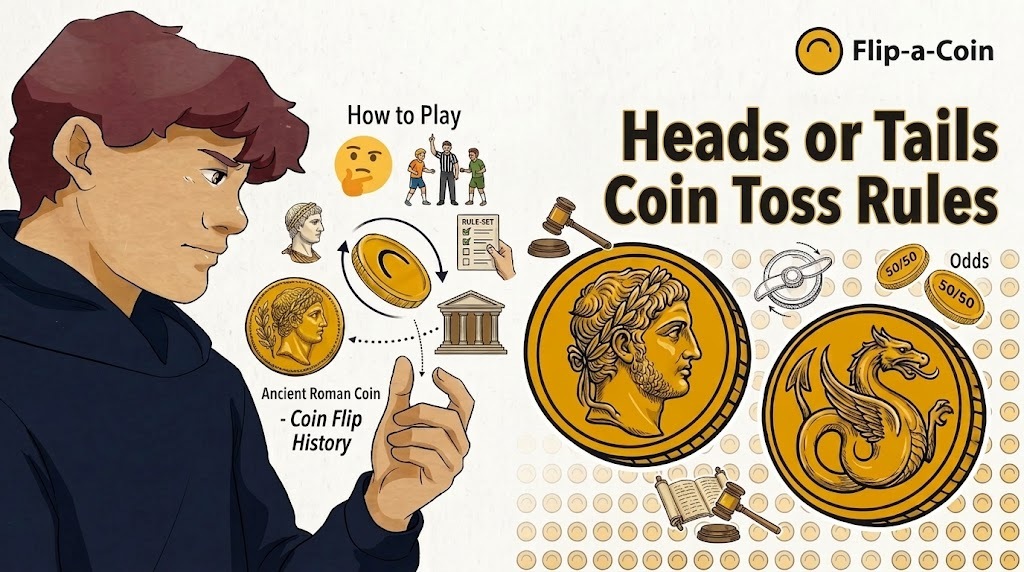
Choosing between two options is sometimes harder than it seems. A simple coin toss has been helping people make quick, fair decisions for hundreds of years. Whether you are settling who goes first in a game, picking a snack, or starting a football match, the heads or tails coin toss rules are easy to learn and the same almost everywhere.
In a coin toss, “heads” is the side that usually shows a portrait, and “tails” is the opposite side. People flip coins because the result is quick, neutral, and hard to argue with.
This guide covers how to flip a coin, how to play heads or tails with kids and groups, the real chances of winning, whether anyone can predict the outcome, and how a free online generator can replace a physical coin when you do not have one.
What Are Heads and Tails in a Coin Toss?
Every coin has two faces. The heads side (the obverse) typically carries the portrait of a person, such as a ruler or national figure. The tails side (the reverse) shows something else, like a building, an animal, or a number. The names are a tradition rather than a rule: some coins have no head at all, but players still call the sides heads and tails.
The practice is old. Ancient Romans played a version they called “navia aut caput,” meaning “ship or head,” because Roman coins often showed a ship on one side and a head on the other. You can read more about how coins developed in Britannica’s overview of coins.
Coins are used because they have exactly two sides, which makes them perfect for two-option choices. You see them in daily life when friends decide who pays for coffee, when siblings pick who gets the front seat, and when referees begin a match.
Definition: Heads or tails is a simple chance-based game where a coin is flipped and the side facing upward decides the result.
No coin in your pocket? Any online coin flip tool can do the same job in a second.
Heads or Tails Coin Toss Rules Explained Simply
What Are Heads or Tails Rules?
A heads or tails game requires players to select one side of a coin. After the coin is flipped and lands, the side facing upward determines the winner.
Basic rules:
- Choose heads or tails before the flip.
- Flip the coin into the air.
- Let the coin rotate naturally.
- Wait until it lands and stops moving.
- The side facing upward is the winning side.
Two extra points keep things fair. First, the call must be made before the coin leaves the hand. Second, if the coin rolls away, falls off a table, or lands on its edge, the flip does not count and you flip again.
How to Play Heads or Tails Game
The game scales easily from two people to a whole room. These instructions work well for kids and beginners.
Two-Player Version
One player chooses heads and the other automatically gets tails. One person flips, and the other watches the landing.
Example: Player A selects heads. Player B selects tails. The coin lands on tails. Player B wins.
Group Version
Everyone in the group secretly decides heads or tails (a hand on the head for heads, a hand on the hip for tails works well). After the flip, players who guessed wrong sit down. Keep flipping until one player is left standing.
Tournament Version
Pair players off. Each pair flips once, and winners move on to the next round, just like a bracket. With eight players, you need three rounds to find a champion.
Tips for Kids
- Let children take turns flipping so everyone feels involved.
- Agree on the rules before starting, so there are no arguments afterwards.
- Keep score on paper to practice counting and tallying.
This free coin toss tool works for kids’ games, too.
Heads or Tails Classroom Activity Rules
Teachers can use coin flipping to introduce probability concepts in a simple and interactive way. Because the game needs almost no setup, it fits into a few minutes of any lesson.
Ways to use it in class:
- Probability lessons: Ask students to predict how many heads will appear in 10 flips, then test it.
- Math experiments: Have each student flip 20 times and record results. Combine the class data into one chart and compare it with the expected 50%.
- Student participation: Use a flip to decide who answers next, which keeps turns fair.
- Random selection: Assign heads to one group and tails to another when splitting the class into teams.
Simple rules for the classroom: every student records results honestly, no one changes a call after the flip, and every flip is counted, including the ones that seem boring.
If you do not have enough coins, projecting an online generator on the board lets the entire class flip together. For more ideas, see these educational probability activities.
What Is the Chance of Winning Heads or Tails?
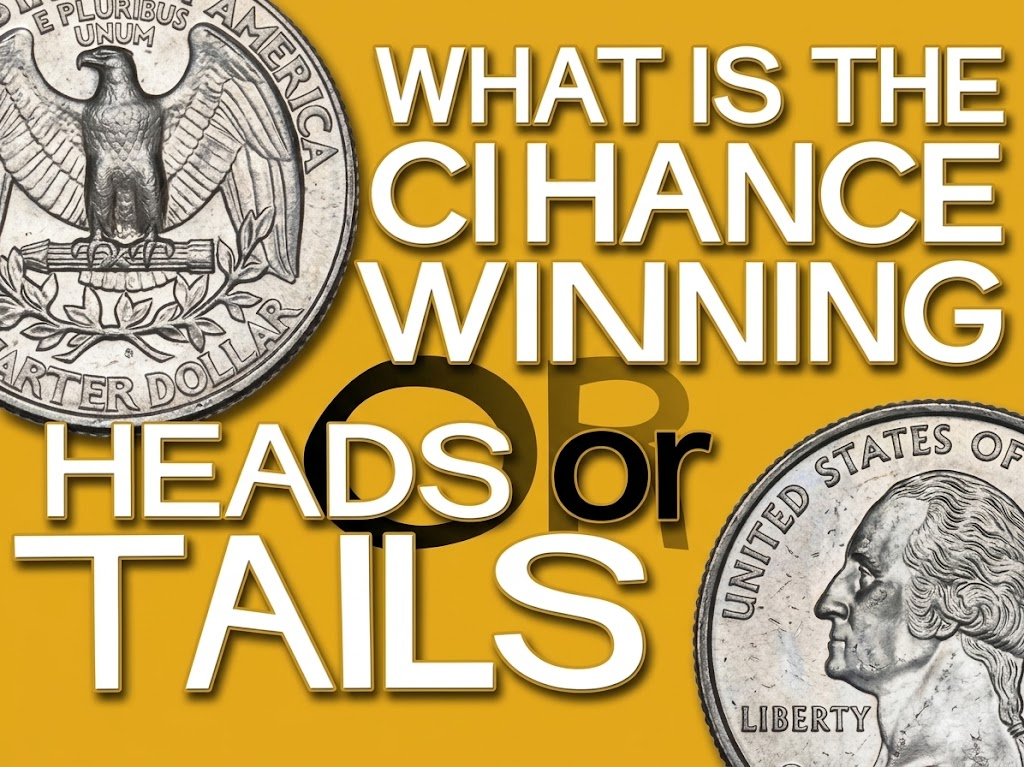
A fair coin gives both heads and tails a 50% chance of appearing.
| Choice | Probability |
| Heads | 50% |
| Tails | 50% |
This works because a fair coin has two equally likely outcomes, and only one of them is the side you chose. Each flip is independent, which means a flip is not influenced by any flip before it.
In real life, a physical coin can be very slightly unbalanced. Researchers who studied hand-flipped coins found a tiny tendency for the coin to land on the same side it started on, but the effect is far too small to notice in everyday play.
Why Streaks Happen
Seeing five heads in a row feels strange, but streaks are a normal part of randomness. In 100 flips, a run of five or six of the same side is actually quite likely. The average still moves toward 50% as the number of flips grows, but it does not “correct” itself after a streak.
If you would like to learn more about probability, Khan Academy has free lessons for all ages.
Can You Predict Heads or Tails?
No prediction method can guarantee the result of a fair coin toss. Three things explain why:
- The outcome is random. Tiny differences in force, angle, and spin decide the result, and nobody can control them reliably.
- Previous flips do not affect future flips. After four tails, the next flip is still 50/50.
- Humans see patterns that are not there. This is sometimes called the gambler’s fallacy: the belief that a streak means the opposite result is “due.” It is not.
Trained magicians can control a flip with practice, which is a good reason to agree on the rules, and who flips, before a toss that matters. For a fair, hands-off result, a random digital method removes that concern. RANDOM.ORG explains how random coin flipping methods work if you want the technical background.
How Does a Free Heads or Tails Generator Work?
Instead of carrying a physical coin, users can use an online heads or tails generator like Flip-A-Coin.us to get an instant random result. A generator uses a random selection process to pick heads or tails with equal chances, then displays the result with a coin animation. You can read more on our How It Works page.
You can flip a coin online in these simple steps:
- Open the page on your phone, tablet, or computer.
- Click or tap the coin.
- Read the result.
What makes an online random heads or tails picker useful:
- Random selection: each result is independent of the last.
- Instant results: no waiting for a coin to land or searching under the couch.
- Mobile-friendly: it works on any screen size.
- No registration needed: open it and use it.
Physical Coin Flip vs Online Coin Flip Generator
| Feature | Physical Coin | Online Generator |
| Requires coin | Yes | No |
| Speed | Slow | Instant |
| Accessibility | Limited | Anywhere |
| Multiple flips | Manual | Automatic |
A physical coin still has its charm, especially for kids learning the game, and nothing beats the feel of a real toss. An online tool is better when you need many flips quickly, when you are on a call with remote friends, or when no one has change.
Common Coin Toss Mistakes
- Changing choices after the flip. The call must come first. Switching afterwards makes the result meaningless.
- Using damaged coins. A bent or heavily worn coin may not spin evenly. Use a clean, flat coin.
- Not deciding rules first. Agree on who flips, how high, and what happens if the coin lands on its edge or rolls off.
- Assuming patterns predict results. A streak says nothing about the next flip.
Fun Ways to Use Heads or Tails
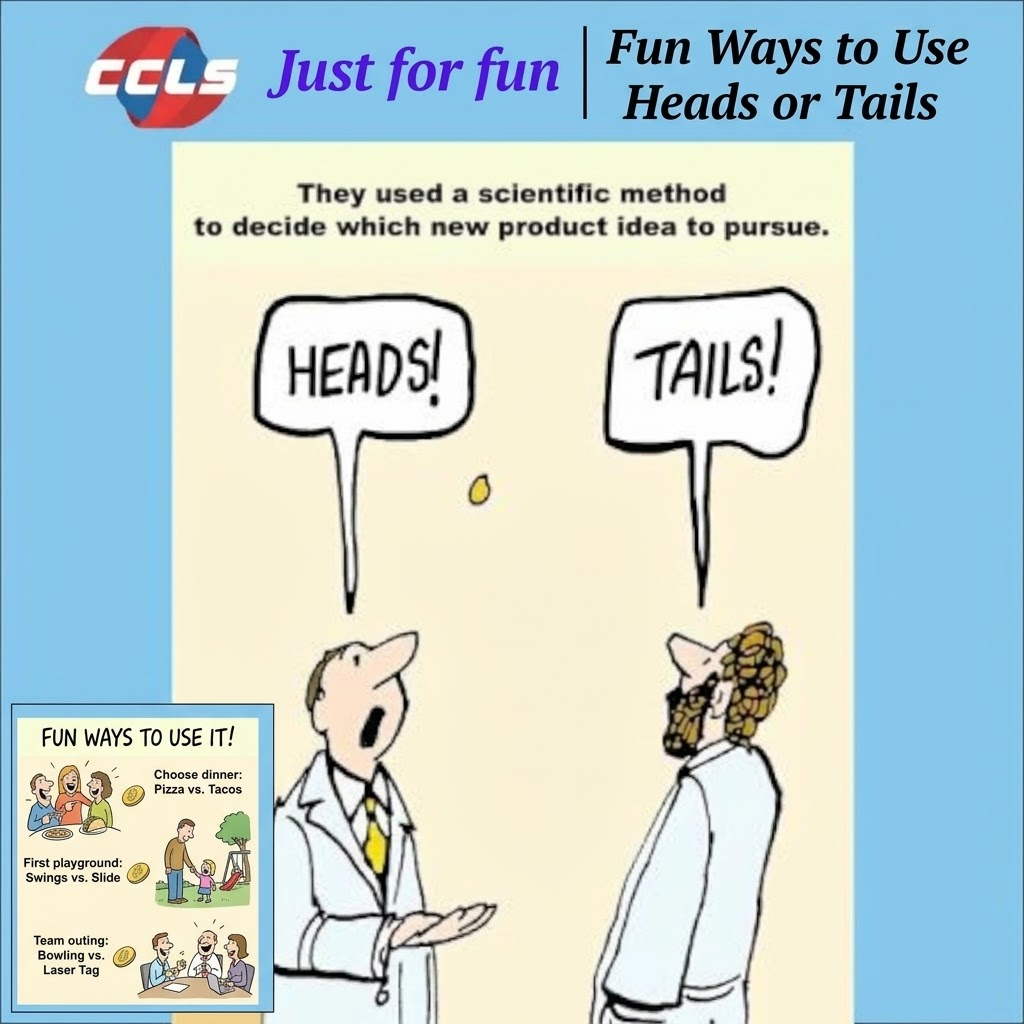
- Classroom games: pick a student helper or split teams.
- Family decisions: choose a movie, a restaurant, or who does the dishes.
- Sports choices: decide kickoff, serve, or which side of the field to defend.
- Party games: play the “stand up, sit down” elimination game with a big group.
- Random selections: break a tie when two good options look equal.
Need more than one flip? Run multiple flips at once with our coin flip tool.
Final Thoughts
The rules of heads or tails are simple: call it, flip it, and accept what lands. Understanding that each flip is a fresh 50/50 chance helps you enjoy the game and avoid common mistakes.
When you want a quick, fair answer without a coin, Flip-A-Coin.us is ready whenever you are.
What are the basic rules of heads or tails?
A player chooses heads or tails before the coin is flipped. After the coin lands, the visible side determines the winner.
Is heads or tails really 50/50?
Yes, a fair coin has two possible outcomes, giving heads and tails an equal probability of 50% each.
Can you predict the result of a coin toss?
No. A fair coin toss is random, and previous results cannot accurately predict future flips.
How does a heads or tails generator work?
An online generator uses a random selection process to choose between heads and tails instantly.
Where can I flip a coin online?
You can use Flip-A-Coin.us to get a quick random heads or tails result without needing a physical coin. Visit our coin toss page for more options.
How do you play heads or tails with kids?
One child picks heads and the other takes tails. A grown-up or a third child flips the coin, and whoever called the side facing up wins the round. Keep score on paper so kids can practice counting.
Is a coin flip really random?
For everyday purposes, yes. Tiny differences in force, spin, and angle make the result impossible to control or predict by hand. A digital generator reaches the same goal with a random selection process instead of physics.
Does getting heads several times in a row make tails more likely?
No. Every flip is independent, so the chance stays 50% each time. Believing a streak must “balance out” is called the gambler’s fallacy.
What happens if the coin lands on its edge or rolls away?
The flip does not count. Agree on this before you start, then flip again.
Can teachers use heads or tails in class?
Yes. It is an easy way to teach probability, run math experiments, choose volunteers, and split students into teams. Having students record their results and compare them with the expected 50% makes the lesson stick.
Is an online coin flip as fair as a real coin?
A well-built online generator gives heads and tails equal chances on every flip, and it avoids problems like worn, bent, or uneven coins.
Do I need a coin or an account to use Flip-A-Coin.us?
No. You can open the page on your phone or computer and get a free heads or tails result right away, with no physical coin and no registration needed. Have more questions? Visit our FAQ page.

Related Articles
Why Is It Called Heads or Tails? 7 Surprising Facts
Why is it called heads or tails? Because a coin’s two sides were pictured as opposite ends of a body: the front shows a head, usually…

Lucky Penny Heads or Tails? 7 Surprising Beliefs
Lucky penny heads or tails? Heads. According to the popular superstition, a penny found heads up is lucky and worth picking up, while a tails-up penny…

Spin a Coin: Ultimate 2026 Guide + Free Flip Tool
When you spin a coin on its edge, it often lands more on one side than the other, so spinning is usually less fair than flipping.…
Need a Quick Decision?
Flip a coin and let chance decide — instantly, honestly, and for free.
Flip a Coin