
Heads or Tails Meaning: How to Play, Coin Flip History, 4 Rules and Odds
 Updated November 15, 2026
12 min read
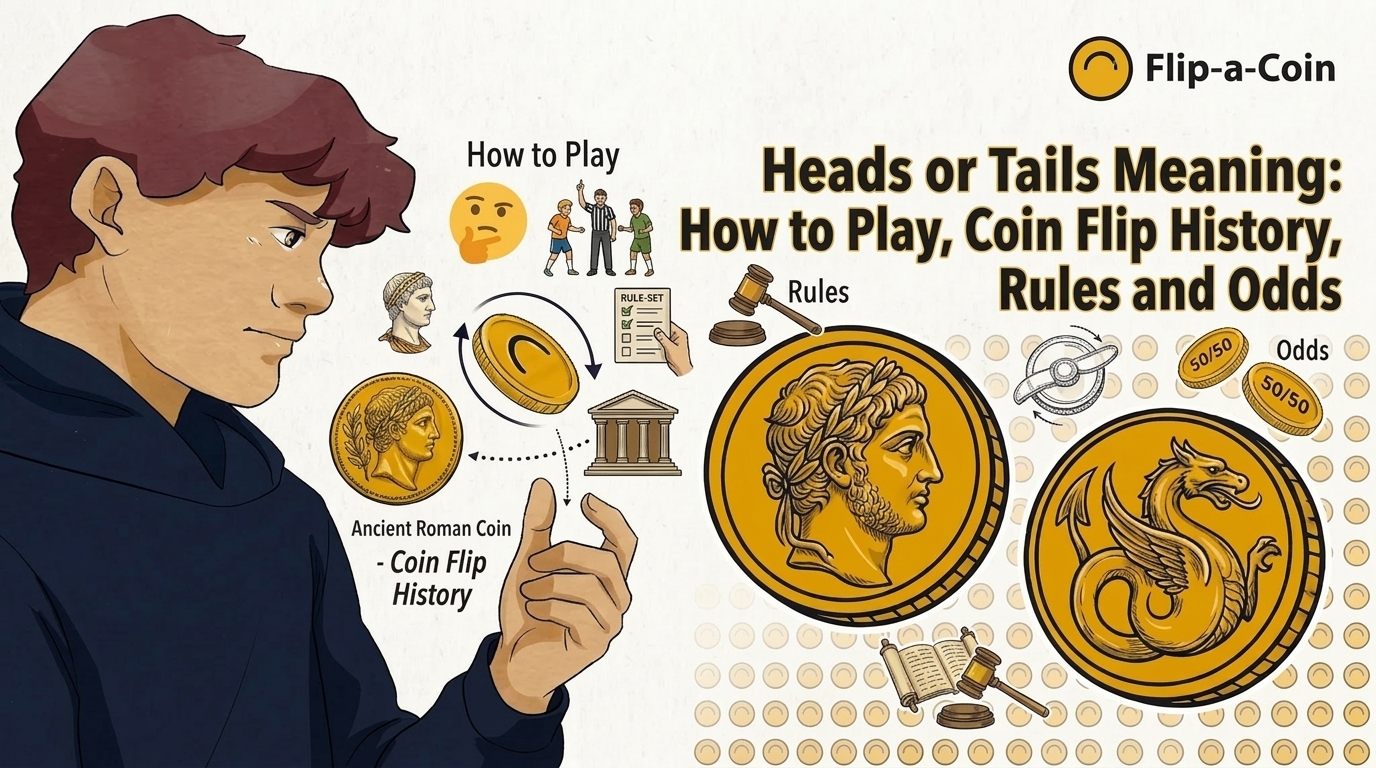
Nearly everyone has played heads or tails at some point in life. One of the simplest ways to make a decision in the world is a coin toss. Whether it is determining who is going to start a game, settling a conflict, making a quick choice or simply just having fun.
But have you ever pondered what heads or tails really means, why the other side is called heads, and how this simple game became so popular?
Heads or tails meaning coin flip refers to the two potential results when a coin is flipped in the air. One side of the coin is called heads, often because it shows the face of a person or an important person. The other side is termed tails and usually has a distinct symbol, design or value.
But now you can just use a physical coin or an online coin flip tool and instantly get a random heads or tails answer without having a real coin.
A coin flip is so basic, yet it links history, math, language and human choice. In this article, we will explain the full definition of heads or tails, the history behind the phrase, the difference between both sides of a coin, and how coin flipping works.
What Is Heads or Tails?
Heads or tails (sometimes called Odds or Evens) is a phrase used to choose between two equally likely outcomes, such as the two sides of a coin. If you toss a coin in the air, it often lands on either the heads side or the tails side. You can read more about the history of coin flipping on Wikipedia.
Heads or tails is a method of flipping a coin in which a person anticipates which side of a coin will be facing upwards when it lands. The side with a face or picture is commonly termed heads while the other side is called tails.
The probability of a coin flip can help to explain why each side should have an equal chance of occurring in a fair coin toss, and can be useful for people who want to understand the way that random coin results function.
Educational resources are available to assist explain how chances and possible outcomes are calculated. For more information, see basic probability lessons on Khan Academy.
Importance of Coin Flip Heads or Tails
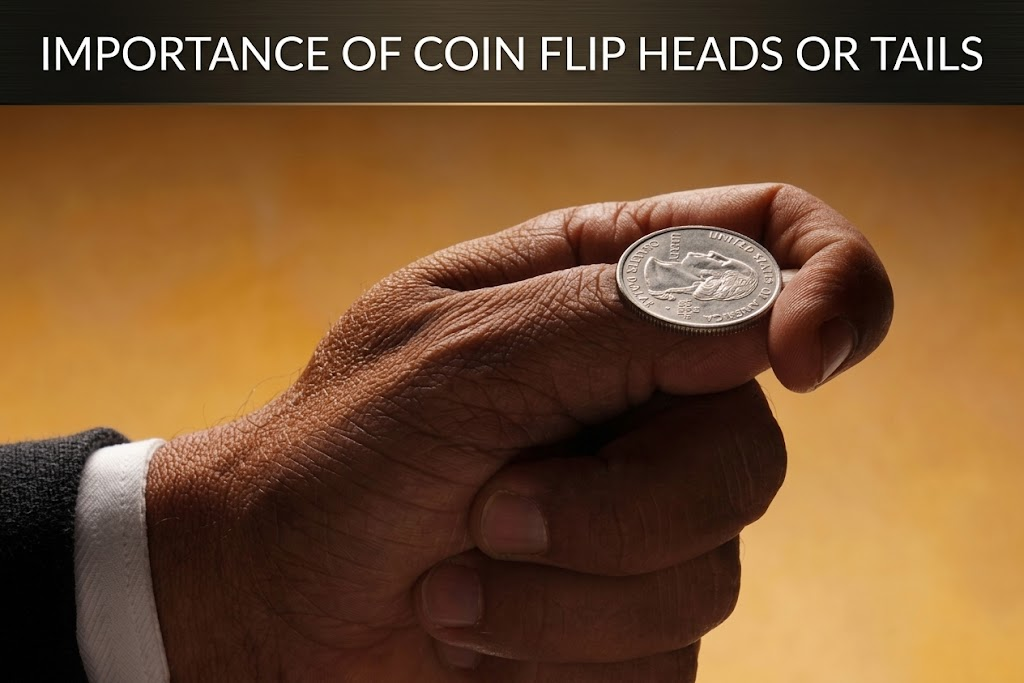
The simplest explanation of the most popular heads or tails meaning coin flip is simply this: a random choice between two choices.
Normally, you choose a side before you flip the coin:
- Choosing heads means picking the portrait side.
- When you call tails, you are calling the other side.
- The side that is visible when the coin comes to rest determines the result.
For instance: Two pals want to choose who will select the next game. One guy calls heads. The other flips the coin and it lands face up. The winner is the individual who picked heads.
Coin flipping is a popular decision making tool because it removes the personal judgments and gives a plain random choice.
If you want immediate random results you can use our random coin flip generator to replicate a real coin toss online.
What Is The Heads Side Of a Coin?
The heads side of a coin is the side that commonly shows a person’s face, portrait, or notable national figure.
This side is technically called the obverse of a coin.
The Heads side could have:
- Presidents of the United States
- Kings or queens
- Historical figures
- National symbols
Ancient coins commonly showed kings, because coinage were a tool to show authority and identification.
Museum collections, such as the British Museum’s online collection, offer detailed examples of historical currency designs for anyone who wants to know more about ancient currencies and how early civilizations used them.
What Is the Meaning of the Tails Side of a Coin?
The side of a coin opposite the heads side is the tails side.
This usually involves:
- Animals
- Structures
- Plant cover
- State emblem
- Figures
- Special designs
The reverse side is also known as the tails side.
Heads and tails seem distinct, yet in the coin toss both are equally important as either result could influence the outcome.
The coins of each country are minted with different artwork, symbolism, themes, etc. Official coin designs reflect history and culture.
Why Heads or Tails?
A lot of people ask: Why heads and tails? Why not heads and butts?
The solution is in classic coin designs.
Many of the first coins had the image of a king or some notable person on the front. People started calling this side “heads,” because the image depicted a person’s head.
The other side was called “tails.”
Today, these words are far more accessible for regular people than technical jargon like:
- Obv.
- Reverse up
That is why people all throughout the world still use the simple expression “heads or tails.”
Rules and Meaning of Heads or Tails Game
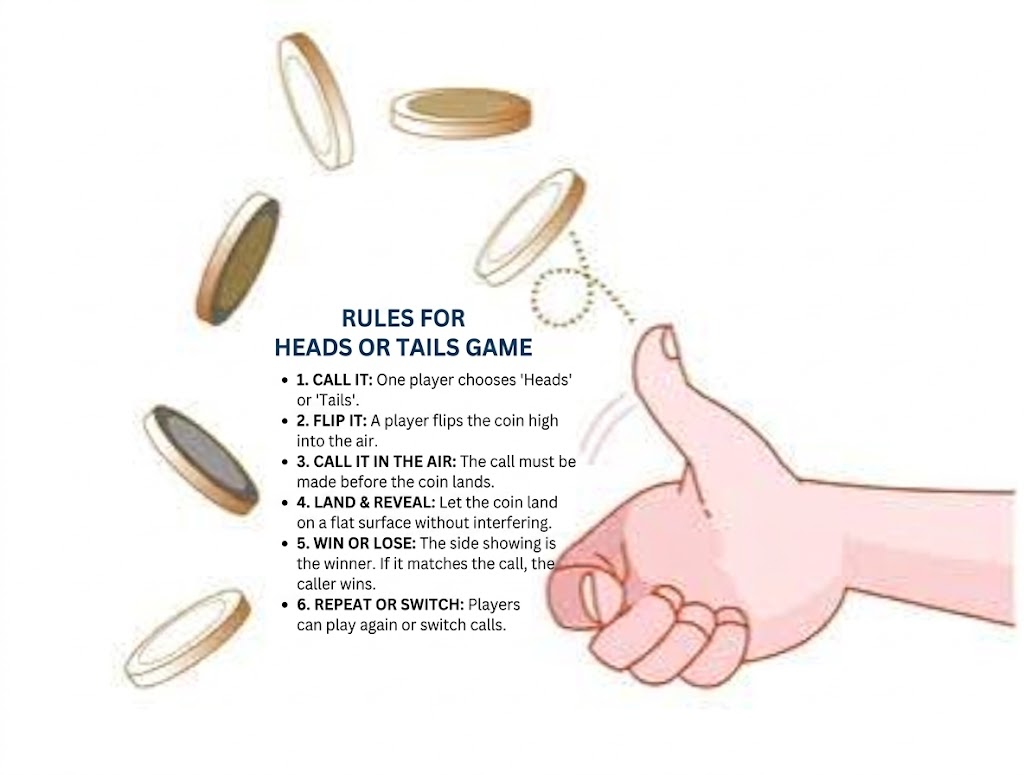
The meaning of heads or tails game refers to a basic game of guessing in which participants guess the result of a toss of a coin.
Here are the rules:
Step 1: Pick heads or tails.
Step 2: Flip the coin.
Step 3: Wait for it to come down.
Step 4: Check the winner.
Heads or tails is often used in:
- Sports choices
- Games for children
- Experiments in the classroom
- Random picks
Want to try it right now? Use our free coin toss tool.
Difference Between Head & Tail
| Article | Heads | Tails |
| Position of the coin | Front face | Back face |
| Common image | Face or person | Design / Symbol |
| Technical name | Obverse | Reverse |
| Purpose | One possible outcome | One possible outcome |
The only variation between heads and tails is the artwork on either side of the coin.
Heads typically means:
- Face of a human being
- A figure from the past
- Authority or identity
Tails is often an archetype of:
- Icons
- Items
- National designs
A coin flip is the consequence of equal contributions from both sides.
Why Do We Use Coin Tosses to Make Decisions?
People flip coins because it is an efficient and easy approach to select something fairly. Toss a coin. This takes human opinion out of the equation and lets random chance decide between two possibilities.
A lot of people believe in the coin toss. There is an equal chance of either side of a fair coin showing up after the toss.
Usages include:
- Choosing the starting team
- Sports judgments
- Minor dispute resolution
- Random choice
Coin flips are also utilized in experiments and probability studies since it is an easy example of a random event.
For those who want to understand how chances and probable outcomes function, knowing about basic probability will help explain why random events have varied probabilities.
Probability of a Coin Flip: Is It Really 50/50 for Heads and Tails?
One thing people often ask regarding coin flipping is if heads and tails are really equally likely.
The chances of a fair coin coming up heads or tails are the same. So that means each side has approximately a 50% chance of showing up. See how our coin flip works for more details.
But a single coin flip will not yield an equal result every time.
For example:
- A coin can land heads five times in a row.
- Another coin might flip tails multiple times.
- A few quick flips could look a little uneven.
Over a significant number of flips, results normally tend to get more even.
It’s something to do with the concepts of probability. You repeat an experiment to see what you expect to see over time.
When You Toss a Coin, You Can Get Two Possible Outcomes
A regular coin toss has two possible outcomes:
- Heads up
- Tails up
Each outcome is a probable outcome of the toss.
If you flip two coins, the number of alternative outcomes goes up:
- Heads and heads
- Tails and heads
- Heads and tails
- Tails and tails
Understanding the risks allows people to learn how to do simple probability calculations. You can test different combinations yourself by running multiple flips with our coin flip tool.
What Does an Online Coin Flip Do?
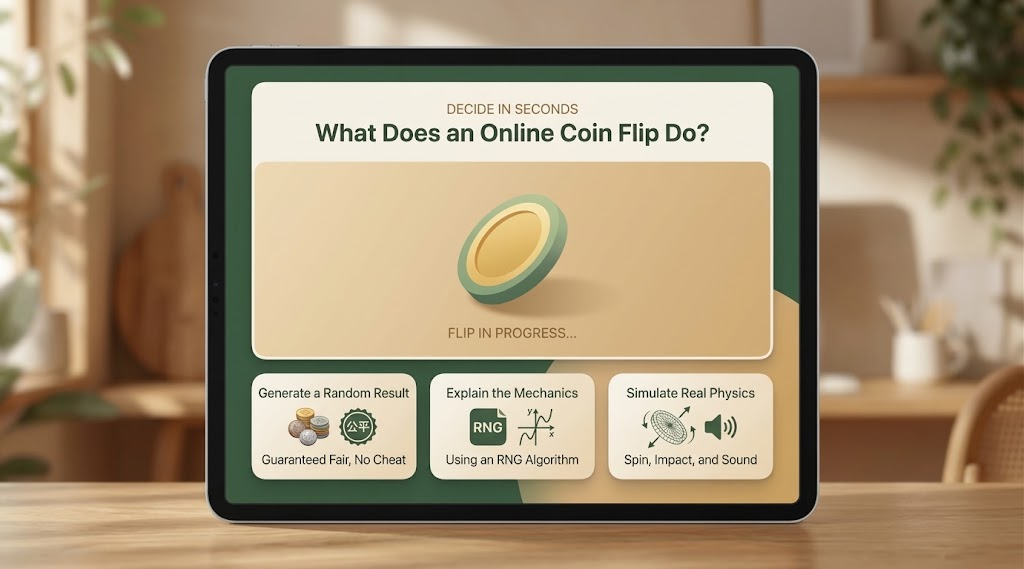
Today many people use digital coin flippers instead of physical coins.
Get a quick random heads or tails result with this online coin flip. It uses a computer-based random number generation mechanism to determine one outcome.
There isn’t a tangible coin going through the air, but internet technologies are designed to mimic the same feeling.
When people utilize online coin toss:
- No coin available.
- They want a quick decision.
- They want to test the probability.
- They want an easy random result.
You could try an online coin toss generator.
Are Internet Coin Flips Really Random?
Most online coin flippers employ random number generation algorithms to get heads or tails results.
These systems provide outcomes on the basis of algorithms that simulate randomness. They don’t have a real currency, but they provide a similar experience for the average user.
The quality of the randomization depends on the technology utilized by the tool. You can read how our random coin flip works and what randomness source it uses.
“Couldn’t Make Heads or Tails of It” Meaning
The expression “cannot make heads or tails of it” suggests someone cannot understand, figure out, or make sense of anything. See the dictionary entry for make heads or tails of on Merriam-Webster.
Example: I read and re-read the directions and still couldn’t make heads or tails of them.
That suggests the directions were confused.
This term is based on the fact that heads and tails are two obviously distinguishable sides of a coin. If a person cannot tell the difference between either side they cannot understand what they are looking at.
This expression is in common use for:
- Confusing data
- Difficult to explain
- Difficult scenarios
Rules for Heads or Tails Game
Heads or tails remains a popular game because it’s easy to learn and doesn’t require any additional equipment.
The basic technique is as follows:
- One person picks heads or tails.
- Someone else flips the coin.
- The coin falls.
- The side that is visible is the winner.
Coin toss games are often employed in sports, competitions, and casual decisions because they offer a rapid way to select between two options. Play it now with our heads or tails game.
What Does Heads or Tails Mean?
Besides coin flipping, heads and tails are representatives of decisions, ambiguity, chance and decision making.
The tossed coin is a frequent image among writers and artists to symbolize crucial choices or uncertain events.
A coin toss could represent:
- Chancing it
- Taking a hard choice
- Dealing with uncertainty
- Leaving it up to fate
Now, a coin toss is a cultural icon of situations when individuals have to choose between two choices.
Abstract
Heads or tails is one of the simplest and most recognizable methods of making a random choice. A coin toss has only two possible outcomes, but it links history, mathematics, language and human decision-making.
The heads side usually displays a portrait or important individual, whilst the tails side has another emblem or design. Both sides build a simple method that has been utilized by people for generations.
What is heads or tails?
Heads or tails is the name for the two potential results of a coin flip. The heads side generally has a person’s face, portrait or important figure, while the other side has another design, symbol or image. People flip coins to choose randomly between two possibilities.
What do heads or tails mean when you flip a coin?
A coin flip results in heads or tails, which is a simple way to express the result of tossing a coin. A person chooses heads or tails, then the coin is flipped. The result depends on which side of the coin is facing up when it lands.
What is the other side of a coin called heads?
The heads side of a coin is normally the side which has a person’s face, portrait, or significant national figure. It is also known as the obverse of a coin.
What is the side of a coin called tails?
The tails side of a coin is the reverse side of the heads side. It is also known as the tail and generally has symbols, animals, buildings, numerals or other motifs.
Why is it tails and heads?
It is termed heads and tails because many of the first coins included the head of a monarch or an important person on one side. The opposite side was called tails because it was the other side of the coin.
Is it really a 50/50 heads or tails?
Flip a fair coin and you have around a 50/50 chance of heads or tails. But a run of heads can occur on a single flip, such as flipping heads numerous times in a succession.
Over a large number of flips the results frequently approach an equal balance.
What does “couldn’t make heads or tails of it” mean?
Couldn’t make heads or tails of it” is an idiom that means you were unable to understand something. It means you can’t comprehend, determine, or organize things.
Example: “I read the report twice; I could not make sense of it.
What is the game heads or tails?
Heads or tails is a basic guessing game where you try to anticipate which side of a flipped coin will show up. Players choose heads or tails, the coin is tossed and the person who guessed correctly wins.
Can I toss a coin on the net?
Yes, you can flip a coin on the internet using a digital coin flipper. This online coin flip tool produces heads or tails randomly and instantly. It is a helpful tool when you don’t have a physical coin with you.
Is the front of a coin always heads?
Not always. The portrait side is sometimes called “heads” by people, however official coin terminology might be different from country to country.
The obverse is normally the heads side; however, the particular design is specified by the official specifications for the coin.
Heads or tails? What is the difference?
Heads and tails are only the two designs on either side of a coin.
Heads usually has a picture or face, whereas tails normally has a symbol, image or other design. In a fair coin toss, both sides are equally probable.
Still have questions? Visit our FAQ page for more answers.

Related Articles
Why Is It Called Heads or Tails? 7 Surprising Facts
Why is it called heads or tails? Because a coin’s two sides were pictured as opposite ends of a body: the front shows a head, usually…
Lucky Penny Heads or Tails? 7 Surprising Beliefs
Lucky penny heads or tails? Heads. According to the popular superstition, a penny found heads up is lucky and worth picking up, while a tails-up penny…

Spin a Coin: Ultimate 2026 Guide + Free Flip Tool
When you spin a coin on its edge, it often lands more on one side than the other, so spinning is usually less fair than flipping.…
Need a Quick Decision?
Flip a coin and let chance decide — instantly, honestly, and for free.
Flip a Coin