
Flip Multiple Coins at Once: Ultimate 2026 Guide
 Updated November 11, 2026
10 min read

In this article
- How Do You Flip Multiple Coins at Once?
- How to Flip Multiple Coins at Once Online (Step by Step)
- Flip 2 Coins: The Four Outcomes
- Flip 3 Coins: Eight Outcomes and the Odds
- Flip 4 Coins: Sixteen Outcomes
- Flip 5 Coins and 10 Coins: What to Expect
- How to Read Your Results When You Flip Multiple Coins at Once
- Does It Matter If You Flip Multiple Coins at Once or One After Another?
- A Fair 4-Way Coin Flip With Two Coins
- What About a 3-Sided or 4-Sided Coin?
- Two-Headed Coin Flip: What It Is
- Flip Multiple Coins at Once in Games and Classrooms
Want to flip multiple coins at once? Toss them together, count the heads, count the tails, and you’re done. The interesting bit is what the odds do as you add coins: two coins can land in four ways, three coins in eight, and every extra coin doubles the count. This guide walks through how to flip multiple coins at once with real coins or a simulator, then goes through the odds for 2, 3, 4, 5 and 10 coins.
If you’d rather just do it, our free tool to flip multiple coins at once is a number box and one button.
How Do You Flip Multiple Coins at Once?
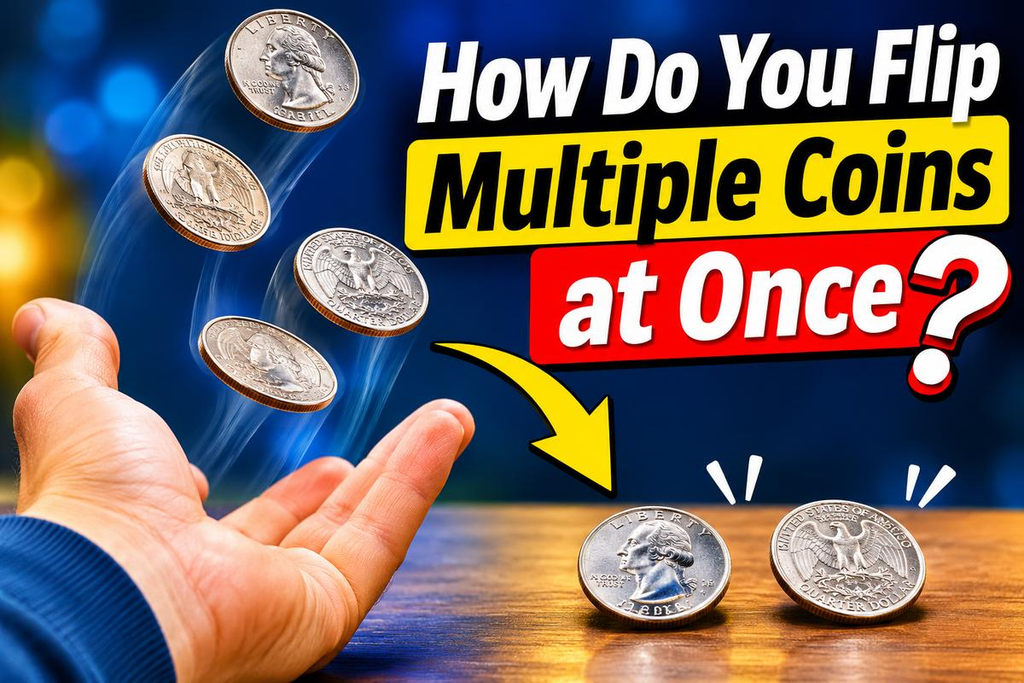
With real coins, it’s about as simple as it gets. Cup a few in your hands, give them a shake and let them fall on a table. Count the heads. Count the tails. Online you skip the shaking: type a number into Flip-A-Coin.us and press a button. However you flip multiple coins at once, you’re running the same experiment.
Why would anyone bother? Usually it’s homework, or a board game that needs a tie-break, or a stray thought like “how often would all five come up heads?” (not often, as it turns out). If you haven’t seen the odds for a single flip yet, our guide to you flip a coin what is p(heads) is a quick read and makes the rest of this page easier.
How to Flip Multiple Coins at Once Online (Step by Step)
On our site you can flip multiple coins at once in about ten seconds.
- Open the coin flip tool.
- Find the “Flip multiple times” section, just under the coin.
- Choose a preset or type your own number, say 2, 3, 5 or 10.
- Press Flip.
- Read the totals: heads, tails, percentages and the number of flips.
- Press Reset when you want a fresh run.
Two things worth knowing. The tool reports totals, not a coin-by-coin list, so if you care which coin did what, flip them one at a time. And it can run up to 10,000,000 flips in one go, which is overkill for this guide. It’s free, there’s no sign-up, and it works fine on a phone.
The randomness comes from your browser’s Web Crypto API, which is designed to produce strong, hard-to-predict random values. MDN explains it well and the W3C specification has the formal details. If you’re curious how we use it, there’s a short explanation on our how it works page.
Flip 2 Coins: The Four Outcomes
Start with two. When you flip multiple coins at once and use only two, there are four outcomes, and they’re equally likely: 1/4 each, or 25%.
| Coin 1 | Coin 2 | Chance |
| Heads | Heads | 1/4 |
| Heads | Tails | 1/4 |
| Tails | Heads | 1/4 |
| Tails | Tails | 1/4 |
That makes two heads a 1/4 shot, and two tails the same. One head lands at 1/2, because two different outcomes give it to you: heads-tails and tails-heads.
This is where most people slip. HT and TH both have one head, so they feel like the same thing. They aren’t. Count them separately and the maths works every time you flip multiple coins at once. If it still feels slippery, Khan Academy’s probability lessons are free and patient.
Flip 3 Coins: Eight Outcomes and the Odds
Three coins make 2 × 2 × 2 = 8 outcomes. This is how the heads count breaks down when you flip multiple coins at once with three.
| Heads | Ways it can happen | Chance |
| 0 | 1 | 1/8 (12.5%) |
| 1 | 3 | 3/8 (37.5%) |
| 2 | 3 | 3/8 (37.5%) |
| 3 | 1 | 1/8 (12.5%) |
Look at the middle: 3 and 3. One head or two heads happens far more often than none or all three. That 1, 3, 3, 1 pattern is a row of Pascal’s triangle, a tidy way of counting how many routes lead to each result.
If you landed here searching for a three coin flip, or how to flip a coin 3 times, it’s the same answer. Three coins together or one coin three times, the odds come out identical.
Flip 4 Coins: Sixteen Outcomes
Four coins give 2 × 2 × 2 × 2 = 16 outcomes. If you flip multiple coins at once with four, expect this.
| Heads | Ways it can happen | Chance |
| 0 | 1 | 1/16 (6.25%) |
| 1 | 4 | 4/16 (25%) |
| 2 | 6 | 6/16 (37.5%) |
| 3 | 4 | 4/16 (25%) |
| 4 | 1 | 1/16 (6.25%) |
Two heads leads the pack with 6 of 16. And yes, 1, 4, 6, 4, 1 is the next row of Pascal’s triangle. Anyone after a quick 4 coin flip answer can stop here: sixteen outcomes, and a one-in-sixteen chance that all four land heads.
Flip 5 Coins and 10 Coins: What to Expect
The middle gets more crowded as you add coins.
Five coins give 32 outcomes. Exactly 2 heads or exactly 3 heads each has a 10/32 chance, which is 31.25%. All heads, or all tails, is a measly 1/32, about 3.1%.
Ten coins give 1,024 outcomes. Exactly 5 heads can happen 252 ways, so the chance is 252/1,024, about 24.6%. All 10 heads is 1/1,024, roughly 0.1%. Somewhere between 4 and 6 heads happens 672 times out of 1,024, about 65.6%.
All of this is the binomial distribution at work, the standard model for counting heads in a set number of fair flips. When you flip multiple coins at once, the practical lesson is simple: the more coins, the more the results cluster near half heads.
How to Read Your Results When You Flip Multiple Coins at Once
Say you flip multiple coins at once, ten of them, and 7 come up heads. Suspicious? Not really. Seven or more heads shows up in 176 of the 1,024 outcomes, about 17%, so roughly one run in six. Eight or more is around 5.5%. All ten is the real long shot.
The lesson is that one run proves very little. Small runs bounce around. If you only flip multiple coins at once a handful of times, expect surprises. Do a few dozen runs and the totals begin to line up with the tables above.
Does It Matter If You Flip Multiple Coins at Once or One After Another?
Not at all. Ten coins at once is, mathematically, the same as one coin ten times, because each flip is independent. A coin doesn’t remember anything, and it can’t see its neighbours. Wikipedia’s page on independence in probability has the formal version.
So whether you flip multiple coins at once or keep reusing one coin, the odds are the same. Our how it works page shows how the tool deals with it.
A Fair 4-Way Coin Flip With Two Coins
Our favourite use of this idea is picking between four options. Flip multiple coins at once, two of them, and you get four equal outcomes, so you don’t need to throw anything away.
- Give your four options a number: 1, 2, 3 and 4.
- Flip two coins together, or one coin twice.
- Heads-heads means option 1.
- Heads-tails means option 2.
- Tails-heads means option 3.
- Tails-tails means option 4.
Every option has a 1/4 chance when you flip multiple coins at once like this, so nobody can say it’s rigged.
Say four friends can’t agree who gets the first turn in a board game. They fix the order above and flip two coins. Tails-heads. Option 3 goes first, and since the rule was set before the coins moved, there’s nothing to argue about. Our heads or tails page has more on the classic game.
What About a 3-Sided or 4-Sided Coin?
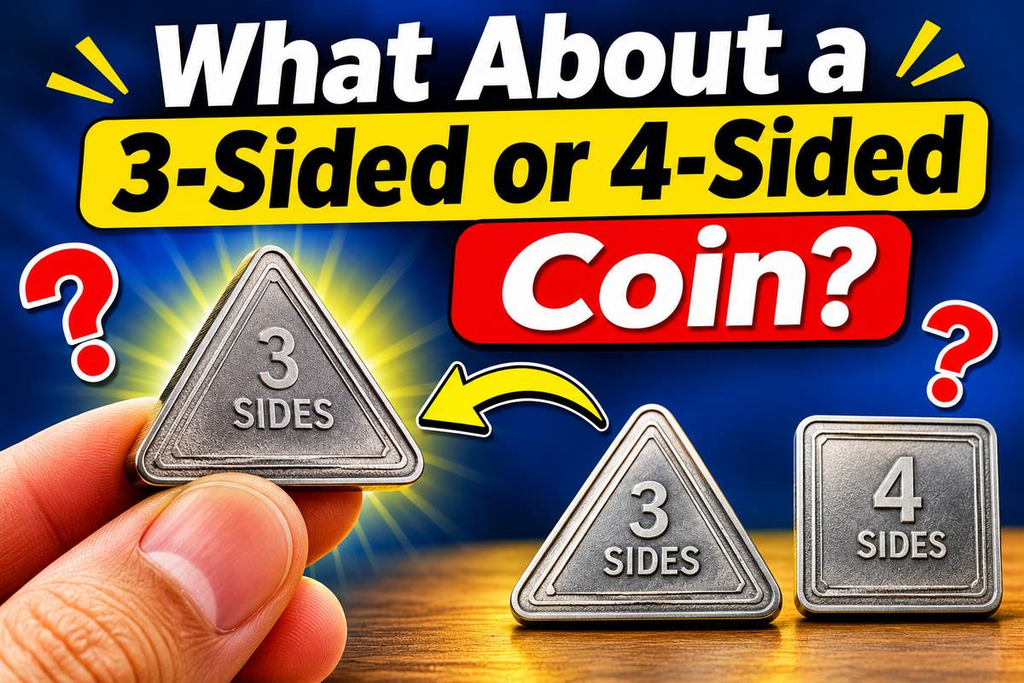
A normal coin has two sides, so it can’t hand you three or four outcomes by itself. People do search for three-sided and four-sided coins, but they aren’t standard objects. The usual workaround is to flip multiple coins at once, as in the two-coin method above.
Two-Headed Coin Flip: What It Is
A two-headed coin has heads on both faces, so it lands heads every time. The chance of heads is 1, or 100%. Magicians and teachers use them for tricks and demos. As a fair flip it’s useless, because there’s only one possible result.
Flip Multiple Coins at Once in Games and Classrooms
It’s a small thing, but it earns its keep. When you flip multiple coins at once, you get a cheap, fast way to play with chance.
- Classroom lessons. Teachers ask students to flip multiple coins at once, usually two or three, and log the results. Then the class compares its totals with the tables above.
- Probability homework. A question like “what’s the chance of exactly two heads from three coins?” is easy to test with a simulator.
- Games. Use two coins to choose one of four players, or flip a few to settle who goes first.
- Science projects. Compare a small run with a big one and watch the results bunch up.
If you want to flip a real coin properly, our guide on how to flip a coin shows an even toss. For the classic game there’s the heads and tails coin flip guide, and our coin toss page covers how people use a coin to settle things.
Common Mistakes When You Flip Multiple Coins at Once
Most wrong answers come from the same few slips.
- Expecting exactly half heads. With ten coins, exactly five heads happens only about 24.6% of the time.
- Treating HT and TH as one outcome. They’re two different outcomes that both give one head.
- Thinking a streak changes the next coin. After three heads, the next coin is still 50/50.
- Forgetting the tool shows totals. If you flip multiple coins at once online, you see heads and tails counts, not each coin’s order.
- Mixing up outcomes and coins. Two coins give four outcomes. Three coins give eight.
Final Thoughts
When you flip multiple coins at once, the maths is friendlier than it looks. Each coin is independent, two coins give four outcomes, three give eight, and more coins push the results towards half heads. Keep the tables handy, and remember that the order of the coins matters when you count outcomes.
Ready to flip multiple coins at once? Head to Flip-A-Coin.us, type a number and see how your results compare. Questions? Our FAQ has more answers, and you can meet the people behind the site on our about page.
How do I flip multiple coins at once?
Toss them together and count the heads and tails. Online, type a number into a flip tool and press Flip. To flip multiple coins at once this way, you need nothing else, because each coin has its own independent 50/50 chance.
What are the odds when I flip multiple coins at once, using two?
Two coins give four equally likely outcomes: HH, HT, TH and TT. Two heads is 1/4, one head is 1/2 and no heads is 1/4.
What are the odds when I flip multiple coins at once, using three?
Three coins give eight outcomes. The chance of 0, 1, 2 or 3 heads is 1/8, 3/8, 3/8 and 1/8. One or two heads is far more common than none or all three.
What are the odds of all heads when I flip multiple coins at once, using four?
Four coins give 16 outcomes, and only one of them is all heads, so the chance is 1/16, or 6.25%. All tails has the same chance. Two heads and two tails is the most common split, at 6/16, or 37.5%.
What are the odds of exactly 5 heads when I flip multiple coins at once, using ten?
Exactly 5 heads happens 252 times out of 1,024, about 24.6%. It’s the single most likely result, but it still turns up less than a quarter of the time.
Is it the same to flip multiple coins at once as to flip one coin many times?
Yes. Every flip is independent, so ten coins at once is mathematically the same as one coin ten times. The odds are identical.
Can I flip multiple coins at once online for free?
Yes. Our tool is free, needs no sign-up and works on any device. Use the “Flip multiple times” section, enter a number and read the heads and tails totals.
How do I choose between four options with coins?
Flip two coins together. Heads-heads is option 1, heads-tails is 2, tails-heads is 3 and tails-tails is 4. Each has a 1/4 chance, so there’s no re-flip.
What is a two-headed coin?
A two-headed coin has heads on both sides, so it always lands heads. It’s for tricks and demonstrations, and it’s no good if you want to flip multiple coins at once for a fair result.

Related Articles

Is Heads or Tails More Likely? 7 Proven Facts
Is heads or tails more likely? No. On a fair coin, heads and tails each have a 50% chance, so neither wins more over time. The…

Is Heads or Tails Good Luck? 7 Surprising Truths
Is heads or tails good luck? No. On a fair coin, heads and tails each land about 50% of the time, so neither side is luckier,…

Flip a Coin 10 Times: What to Expect from 10, 20, 30 and 50 Flips
If you flip a coin 10 times, you’ll most often land on about 5 heads, but anything from 3 to 7 heads is completely normal. That…
Need a Quick Decision?
Flip a coin and let chance decide — instantly, honestly, and for free.
Flip a Coin