
Probability of Tails on One Flip: Explained With Simple Examples
 Updated November 11, 2026
9 min read

Short answer: the probability of tails on one flip of a fair coin is 1 out of 2, or 50%. You’ve got two possible sides, heads and tails, and only one of them is tails.
That’s really the whole answer. But if you want to understand why it’s 50% and what that actually means in real life, keep reading. It’s simpler than most textbooks make it sound.
So, What Is the Probability of Tails on One Flip?
If someone asks you, “what is the probability of tails on one flip?” you can just say:
1/2 = 0.5 = 50%
All three mean the exact same thing.
We’re assuming here you’re using a normal, fair coin. One side heads, one side tails. No tricks, no double-tails joke coin, and we’re not counting that one-in-a-million time a coin lands on its edge.
For a fair coin, heads and tails have the exact same chance. So the chance of a tail on a single flip is identical to the chance of heads. People call that a 50/50 flip for a reason.
One thing to get straight right away: 50% doesn’t mean you’ll get one tails every two flips like clockwork. It means tails will show up about half the time if you kept flipping over and over. A single flip? It’s either tails or it isn’t. Unpredictable.
How Do You Figure Out the Probability?
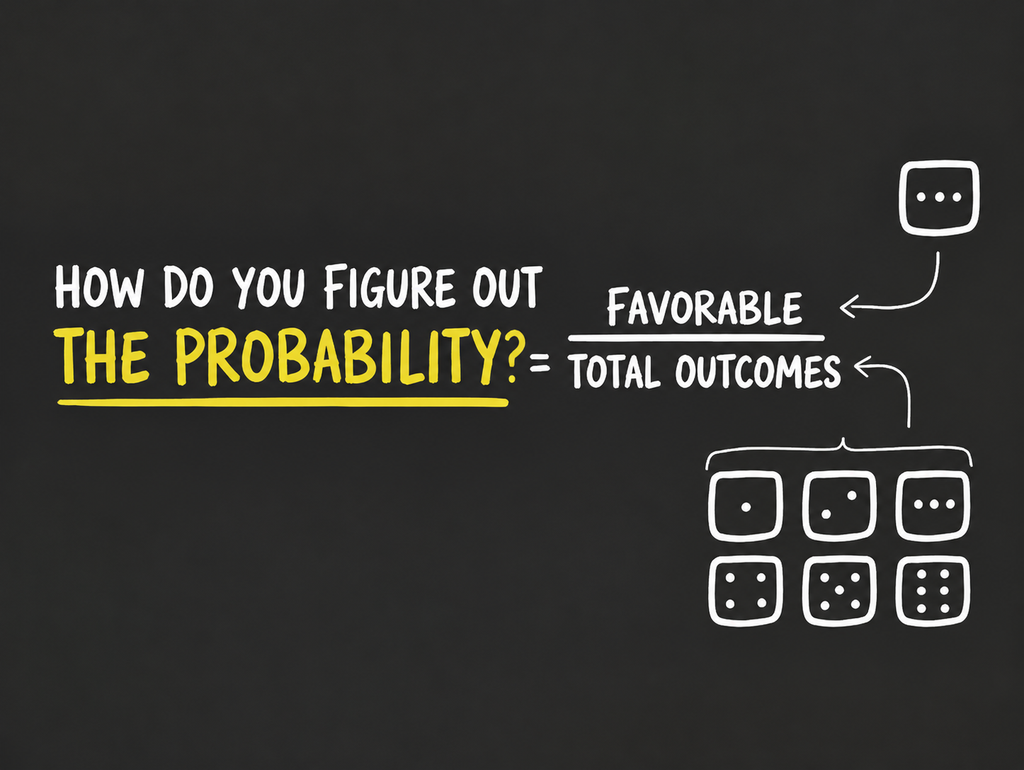
You don’t need fancy math for this. There’s one basic formula for this kind of simple probability:
Probability = what you want ÷ everything that could happen
Teachers usually word it as:
Number of favorable outcomes ÷ total number of equally likely outcomes
“Favorable” just means “the one you’re asking about.” Not good or lucky, just the one you care about.
Let’s do it for tails:
- What do you want? Tails.
How many ways can you get tails on one flip? Just one. There’s only one tails side. - What could happen in total?
Heads or tails. That’s two equally likely results. - Divide them.
1 ÷ 2 = 1/2.
So the probability of tails on one fair coin flip is 1/2.
It’s the same logic as pulling a marble out of a bag with one red and one blue marble. Want red? That’s 1 red out of 2 marbles. 1/2. Same idea.
Once you get that, you can answer almost any “one flip” or “one roll” question.
Why Is the Chance of Tails on One Coin Flip 50%?
Because there’s nowhere else for the chance to go.
Think about it. You have 100% total chance to split up. With a fair coin, you split it evenly:
Heads gets 50%
Tails gets 50%
Done. There are only two names in the hat, so to speak.
In math class they call the full list the “sample space.” For one coin it’s just:
{ Heads, Tails }
Since the coin is fair, both get an equal share.
This is why the chance of tails with a fair coin never changes whether you’re flipping for who goes first in a game, or settling who does the dishes. One flip, two sides, one tails. Always 1 in 2.
And yeah, if you hear someone say “probability of tails with a 50 50 coin” — that’s just another way of saying a fair coin. Answer’s still 50%.
Same Answer, Three Different Looks: Fraction, Decimal, Percent
This trips up beginners, but it shouldn’t. 1/2, 0.5, and 50% are just three outfits for the same number.
| You’ll see it as… | For tails it’s… | What it means |
| Fraction | 1/2 | 1 tails out of 2 sides |
| Decimal | 0.5 | half of 1 |
| Percent | 50% | 50 out of 100 |
How to switch between them:
Take 1 ÷ 2 and you get 0.5. Multiply 0.5 by 100 and you get 50%.
Which one should you use? Depends who you’re talking to. Math homework usually wants 1/2 because it shows your thinking. Everyday conversation? Just say 50%. If someone asks “what is the chance of tails on one flip as a percentage?” they want that 50%.
Wait, Aren’t Odds and Probability The Same Thing?
Nope. Close, but different. People mix them up all the time.
Probability is: what you want out of everything.
Odds are: what you want versus what you don’t want.
For tails on a fair coin:
Probability of tails: 1 out of 2, so 1/2 or 50%
Odds in favor of tails: 1 to 1, written as 1:1
See the difference? Probability looks at 1 tails vs. 2 total sides. Odds look at 1 tails side vs. 1 heads side.
So the odds of tails on one coin flip are 1 to 1. Same for heads. That’s what “even odds” means.
In normal talking, no one will correct you if you say “odds” when you mean “chance.” But if you’re doing math homework or looking at betting stuff, it matters. 1/2 is not the same way of writing 1:1, even though they describe the same fair coin.
Does the Last Flip Change the Next One?
This is the big one. And the answer is no.
If your coin is fair, the probability of tails on the next flip is always 50%. Doesn’t matter if you just got heads three times in a row. Doesn’t matter if you just got tails.
The coin doesn’t remember.
Say you flip:
Heads, Heads, Heads
It feels like tails is “due,” right? Like it has to even out. It doesn’t. The next flip is still:
50% heads, 50% tails.
That feeling has a name — the gambler’s fallacy. It’s that gut instinct that past random results force the next result to balance things out. They don’t.
Each flip starts over completely fresh. Past flips are done. They don’t push or pull the next one. So no, tails is never guaranteed just because heads showed up before. Can a coin flip be predicted from history? Not if the flips are truly independent.
Is It Always 50%? Well… Only If The Coin Is Fair
Everything above assumes a fair coin. That’s the key assumption.
Fair coin = heads and tails are equally likely.
Biased coin = one side is more likely to land than the other.
Could a real coin be a little biased? In theory, sure. If it was bent, shaved down, or weighted weirdly on one side, the chance of tails on one coin flip might not be exactly 50% anymore.
Say, just as a made-up math example, you had a weird coin where:
P(tails) = 60%, P(heads) = 40%
That’s possible on paper. But you wouldn’t know that unless someone told you in a textbook problem or you flipped that coin thousands of times and tracked it. If you want to see how that math works, read about a biased coin.
For 99.9% of everyday stuff — deciding teams, classroom demos, playing around on an online flipper — just treat a normal coin as fair. It’s close enough, and the math model of “two equally likely sides” is what you’re supposed to learn first.
Are heads and tails always equal? Only for a fair coin. For a biased coin, no.
Why You Can Still Get 5 Heads in a Row
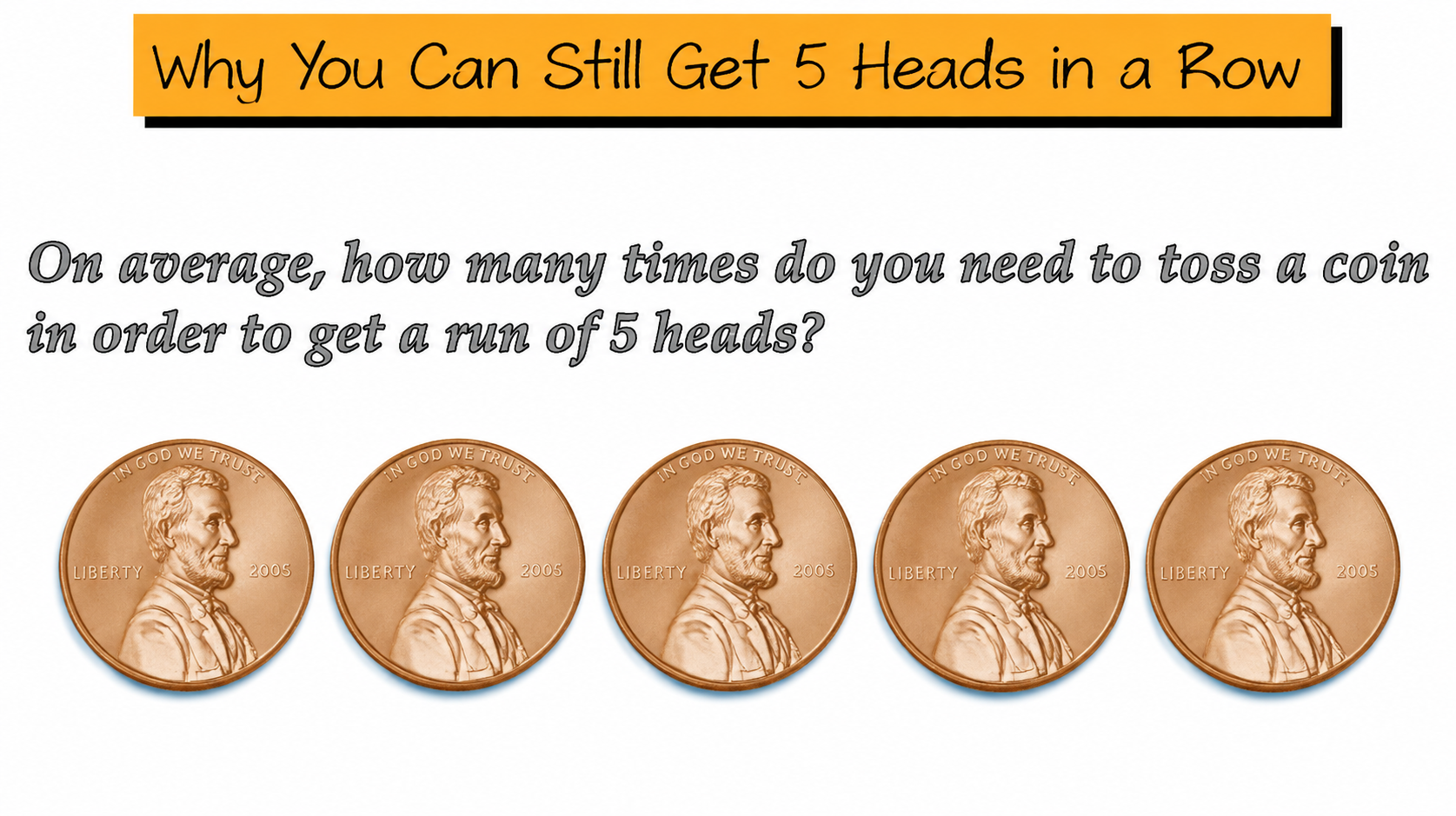
If it’s 50/50, how come you sometimes get H-H-H-H-H? Feels broken, right?
It’s not. That’s just how randomness works in small numbers.
Theoretical probability is what should happen in the long run: 50% tails.
Experimental probability is what actually happened when you tried it: tails you got ÷ flips you did.
Flip 10 times and get 3 tails? Your experimental result is 3/10 = 30%. That doesn’t mean the math is wrong. Ten flips is just too small a sample to be perfect.
Flip 1,000 times and you’ll probably see something like 490 or 510 tails — 49% or 51%. Much closer to 50%. The more independent flips you do, the more the weird early streaks get drowned out. Statisticians call that idea the law of large numbers.
Also, real randomness is lumpy. H-T-H-T-H-T perfectly alternating would actually be suspicious. Real random flips have streaks. H-H-H happens. T-T-T-T happens. That’s normal.
So don’t judge fairness off 10 flips. Judge the overall pattern over a lot of flips.
Try It Yourself in 30 Seconds
Best way to get this is to just do it. Go to the flipper on Flip a Coin at flip-a-coin.us.
Here’s a quick little test:
- Flip once. Heads or tails? Write it down.
- Do 10 flips total. How many tails did you get?
- Divide: tails ÷ 10. That’s your percentage for that run.
- Now keep going to 50 or 100 if you’re bored.
You’ll probably see one 10-flip run give you 70% tails, the next give you 30%. Then after 100, you’re suddenly sitting around 45-55%. That swing is exactly the difference between theory and real results.
This is a great one to do in class, too. Have everyone do 20 flips, then add up the whole room. The class total is almost always closer to 50% than most individual kids’ totals.
Bottom Line
For a normal fair coin, the probability of tails on one flip is always 1/2, or 50%. One tails side, two total sides. Simple division.
Just remember: 50% is the chance before you flip. It doesn’t promise what you’ll get, and it doesn’t change because you’re on a streak. Each toss is its own thing.
What is the probability of tails on one flip?
1/2, 0.5, or 50% for a fair coin. One tails outcome out of two possible outcomes.
What’s the chance of tails on one fair coin flip?
50%. Fair means equal chance for both sides, so tails gets half.
Are the odds of tails 1 to 1?
Yep. Odds in favor are 1:1 — one tails to one heads. Probability is still 1/2.
If I just got heads, am I guaranteed tails next?
No. Next flip is still 50/50. Previous flips don’t change it.
Can a coin have more than 50% chance of tails?
Only if it’s biased to favor tails. A fair coin is exactly 50% in theory.
How do I get that as a percentage?
Do 1 ÷ 2 = 0.5, then × 100 = 50%. It’s (what you want ÷ total) × 100.

Related Articles

Is Heads or Tails More Likely? 7 Proven Facts
Is heads or tails more likely? No. On a fair coin, heads and tails each have a 50% chance, so neither wins more over time. The…
Is Heads or Tails Good Luck? 7 Surprising Truths
Is heads or tails good luck? No. On a fair coin, heads and tails each land about 50% of the time, so neither side is luckier,…

Flip a Coin 10 Times: What to Expect from 10, 20, 30 and 50 Flips
If you flip a coin 10 times, you’ll most often land on about 5 heads, but anything from 3 to 7 heads is completely normal. That…
Need a Quick Decision?
Flip a coin and let chance decide — instantly, honestly, and for free.
Flip a Coin