
Is a Coin Flip 50/50? The Surprising Truth Explained
 Updated November 11, 2026
12 min read

In this article
- Is a Coin Flip Really 50/50
- Why Isn’t a Coin Flip 50/50? The Same-Side Bias
- Is a Coin Flip 50/50 or 51/49? Real Coins vs. Other Methods
- When You Flip a Coin, Is It Always 50/50?
- Is Google Flip a Coin Actually 50/50?
- Is an Online Coin Flip Fair?
- Does the Coin or the Way You Flip It Change the Odds?
- How to Make a Coin Toss Fairer
- When Is a 50/50 Coin Flip Good Enough?
- Final Word
Is a coin flip 50/50? Almost, but not perfectly. A real coin tends to land on the same side it started on about 50.8% of the time, so the true split is a hair away from even. For everyday choices that gap is far too small to matter, and a digital flip removes it completely.
Most of us grew up believing heads and tails are equal, and the maths on paper agrees. Real coins, real thumbs and real tables are messier than that. This guide walks through what researchers actually measured, why a coin flip isn’t always 50/50 in practice, and whether Google or an online flipper does any better.
Quick Answer
- In theory, a fair coin gives heads or tails 50% each.
- In real life, a hand-flipped coin lands on its starting side roughly 50.8% of the time (about 51/49).
- Past flips never change the next one, so “it’s due for tails” is a myth.
- A digital flip, like the free online coin flip on this site, has no wobble, so it’s about as close to 50/50 as you can get.
Is a Coin Flip Really 50/50
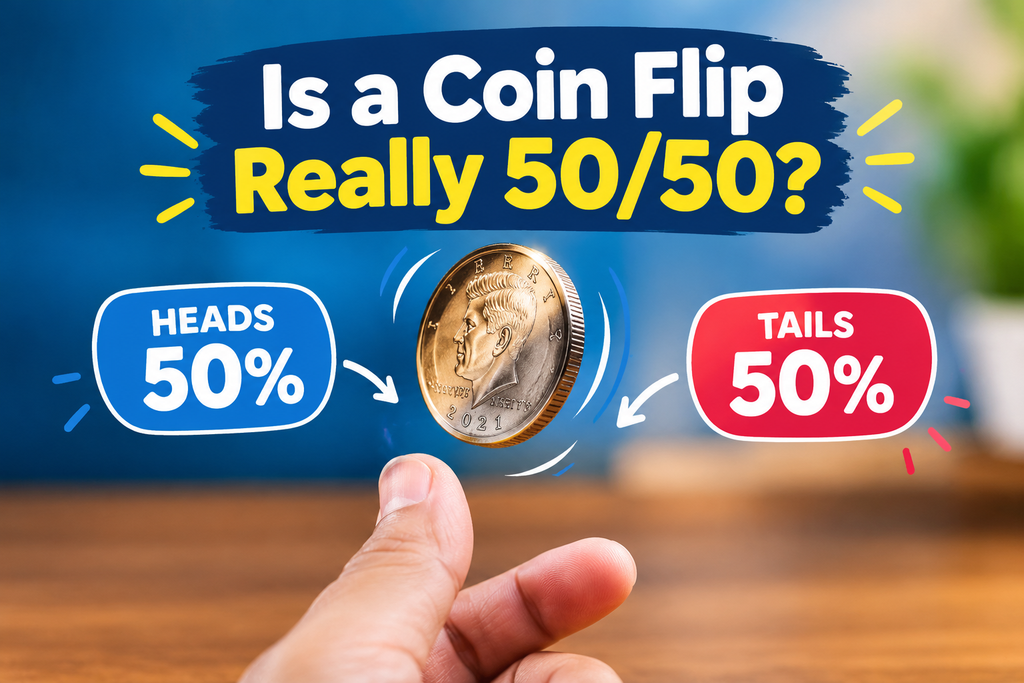
In theory, yes. A fair coin has two sides, each with an equal chance, so is a coin flip 50/50 on paper? Absolutely. Real life adds a few tiny twists.
The 50/50 idea assumes two things: the coin is perfectly balanced, and the flip itself has no preference for either side. Probability textbooks treat a coin as an ideal object. Nobody in a textbook ever has to catch a quarter that’s spinning slightly off-axis.
Take your pocket change. The two faces carry different designs, so one side is a touch heavier. The edges wear down. Even so, the weight difference is so small that it has almost no effect on how the coin lands. The bigger influence is the flip, and that’s where the interesting part starts.
Key takeaway: The 50/50 rule is a very good approximation, not a law of physics.
Why Isn’t a Coin Flip 50/50? The Same-Side Bias
A coin flip isn’t exactly 50/50 because of something researchers call same-side bias. The coin is slightly more likely to land the way it started. If heads is facing up when it leaves your thumb, heads gets a tiny edge.
This isn’t just a hunch. In 2007, mathematician Persi Diaconis, Susan Holmes and Richard Montgomery published a paper titled “Dynamical Bias in the Coin Toss”. They studied the physics of a tossed coin and showed that, because of the way it wobbles, it spends a little more time facing its starting side. Their estimate was about 51% for the starting side.
Why does that happen? A real flip isn’t a clean, perfect spin. Most coins wobble as they rotate, a movement called precession. Because the spin axis is rarely exactly horizontal, the coin spends slightly more of its flight with the starting face pointing up. Add up the whole flight and that small extra time becomes a small extra chance.
A theory is nice, but numbers are better. In 2023 a team led by František Bartoš ran a huge experiment, collecting 350,757 coin flips from dozens of people using different coins. Their result lined up with the theory: coins landed on the starting side about 50.8% of the time.
That’s the figure to remember. It’s not 60/40 and it’s not a rigged game. It’s a nudge of less than one percentage point.
Key takeaway: Same-side bias is real, measured and tiny.
Is a Coin Flip 50/50 or 51/49? Real Coins vs. Other Methods
So is a coin flip 50/50 or 51/49? For a hand flip, 51/49 is the better description, and only in favour of the starting side. The exact number depends on the method, as the table shows.
| Method | Rough chance | What’s going on |
| Perfect (ideal) coin | 50% / 50% | Textbook model, no wobble |
| Hand-flipped real coin | about 50.8% for the starting side | Same-side bias from wobble |
| Spun coin (on a table) | Can be noticeably uneven | Uneven edges and weight pull the coin one way |
| Landing on its edge | Extremely rare | Roughly 1 in 6,000 in one often-cited estimate for a US nickel |
| Digital coin flip | Very close to 50/50 | A random number picks the result, no physics involved |
Spinning deserves a quick warning. A coin spun on a table is a very different animal from a coin flipped in the air. Statisticians have shown that spinning can favour one side, because the heavier face makes the coin settle in a predictable direction. If fairness matters, flip it, don’t spin it.
Key takeaway: The method matters more than the coin.
When You Flip a Coin, Is It Always 50/50?
Yes, every single flip has the same chances, no matter what came before. A coin has no memory. That’s why, when you flip a coin, it’s always 50/50 in the sense that the next result never depends on the last one.
This is where people trip up. Say you flip heads four times in a row. It feels like tails is overdue. It isn’t. The fifth flip is still a fresh 50/50 (give or take that tiny same-side nudge). Believing otherwise has a name: the gambler’s fallacy.
Here’s a simple example. The chance of getting five heads in a row is 1 in 32, or about 3.1%. That sounds rare, and it is. But once you’ve already got four heads, the chance of a fifth is just 50%, because only one flip is left to decide.
So why do the totals even out over time? That’s the law of large numbers. Over thousands of flips the results settle near 50%. Over ten flips, they can look wild. Getting 7 heads out of 10 is completely normal, and it doesn’t mean your coin is broken.
[INSERT MY RESULT: add one line about a real test you ran, for example “I flipped a quarter 200 times and got ___ heads.”]
Key takeaway: Short streaks are normal. The long-run average is what gets close to 50/50.
Is Google Flip a Coin Actually 50/50?
Google’s coin flip is designed to be fair, and it should land very close to 50/50. Like almost every software coin flip, it relies on a computer-generated random number rather than a spinning object.
Here’s the plain-language version. Computers don’t toss anything. They use a pseudo-random number generator, which is a formula that produces numbers that look and behave random. If the number falls in one range, you get heads. If it falls in the other, you get tails. Google hasn’t published the exact details of its tool, so I can’t tell you precisely which generator it uses, but the general method is standard.
Is that “truly random”? Not in the strictest scientific sense, since the numbers come from a formula. For choosing who pays for lunch, though, it’s more than good enough. And because there’s no wobble, there’s no same-side bias either.
So is Google flip a coin actually 50/50? For every practical purpose, yes.
Key takeaway: A digital flip swaps physics for maths, and the maths is evenly balanced.
Is an Online Coin Flip Fair?
Yes. A well-built online coin flip is typically fairer than a thumb flip, because nothing physical can lean toward one side. A random number decides heads or tails, and the animation is just for show.
Think about everything that can go wrong with a real coin: the way you hold it, how hard you flick, whether it’s caught or lets it hit the floor. A flipper removes all of that. That’s the reason a free heads or tails flipper is a handy tool when two people need a neutral decision and nobody wants to argue about technique.
If you’d like to see how it works in practice, our guide to online heads or tails covers it step by step. And if you’re new to the basics, the flip a coin page explains how to get a clean result every time.
Is an online coin flip random? Close enough that you’d never notice a difference. Is it perfect? As with any software, it depends on how it’s built, but the odds are as close to 50/50 as you can realistically get.
Key takeaway: Digital flips remove human influence from the result.
Does the Coin or the Way You Flip It Change the Odds?
Yes, slightly. The coin itself matters very little, but the way you flip it can shift the odds by a small amount. Flip height, spin speed and how you catch it all play a part.
A few things are worth knowing:
- Coin design: Differences between the two faces are usually too small to matter in a normal flip.
- Flipping vs. spinning: Flipping is far fairer. Spinning on a flat surface is where real bias shows up.
- Catching vs. letting it land: If you catch it and look immediately, same-side bias is at its strongest. Letting it bounce and settle adds more randomness.
- Edge landings: Very rare on hard surfaces, a little more likely on thick coins or soft surfaces like carpet.
Wondering whether a coin app behaves like a real coin? The coin flip app page shows how a digital version stacks up, and the flipping a coin simulator lets you try hundreds of flips yourself.
Key takeaway: How you flip matters more than what you flip.
How to Make a Coin Toss Fairer
The fairest coin toss is one where the call is made before the flip, the coin is flipped high and the result is read only after it lands. A few simple habits cancel out almost all the bias.
- Call it in the air, not after. The caller picks heads or tails before the coin leaves the hand.
- Flip it high. More spins and more time in the air mean more randomness.
- Let it land. Don’t catch it. Let it hit the ground or the table.
- Don’t start with a fixed side. Whoever flips shouldn’t always start heads up. Mixing it up cancels same-side bias.
- Skip the spin. Use a flip, not a table spin.
- Use a digital flipper when it really matters. It takes the human out of the process.
Want the official-style version? The heads or tails coin toss rules cover how coin tosses are usually run.
Key takeaway: Fairness comes from the process, not the coin.
When Is a 50/50 Coin Flip Good Enough?

For nearly every everyday decision, a coin flip is good enough. A shift of less than one percentage point won’t change who gets the last slice of pizza. It only becomes a real conversation when the stakes and the number of repeats are both high.
Here’s the honest picture. Over a single flip, the same-side bias is invisible. You’d need thousands of flips to detect it, which is exactly why it took researchers hundreds of thousands of tosses to measure it. If you’re settling a game, picking a starting team or choosing between two restaurants, 50/50 is a perfectly fair way to describe it.
For tabletop games or classroom activities, try a heads or tails game with a digital coin and the question disappears. And if you like comparing the two outcomes, the head or tail page breaks down how each side behaves.
What about streaks? If you’re curious how likely a run really is, see our breakdown of the odds of heads in a row.
Key takeaway: The bias is real, but for normal life it simply doesn’t matter.
Final Word
So, is a coin flip 50/50? Close enough that you can keep using it to settle arguments, with a small asterisk for the starting side. If you want to take the physics out entirely, head over to Flip-A-Coin.us and flip a coin online for free. One click, no wobble, no arguments.
Is a coin flip actually 50/50?
Nearly. A fair coin is 50/50 in theory, but research shows a real hand flip lands on its starting side about 50.8% of the time. That tiny edge is called same-side bias, and it’s too small to affect everyday decisions.
Is a coin flip really 50 50?
For practical purposes, yes. The difference is under one percentage point. In a single toss you will never notice it, and only a huge number of flips could reveal the bias.
Is a coin flip 50/50 or 51/49?
A real hand-flipped coin is closer to 51/49, with the extra percentage going to whichever side started facing up. A digital coin flip gets very close to 50/50 because no physical motion is involved.
When you flip a coin, is it always 50/50?
Each flip has the same odds, regardless of earlier results, because a coin has no memory. Streaks happen by chance. Over many flips the totals drift toward 50% each, which is the law of large numbers at work.
Why isn’t a coin flip 50/50?
Because of same-side bias. A flipped coin wobbles as it spins, so it spends slightly more time facing its starting side. That small extra time gives that side about a 0.8% edge in the large 2023 study.
Why is a coin flip not 50/50 in real life?
Physics gets in the way. Wobble, spin axis, flip height and how you catch the coin all add small nudges. Perfect 50/50 only exists for an ideal coin in a textbook.
Is Google flip a coin actually 50 50?
It should be very close. Software coin flips use a random number generator instead of a spinning coin, so there’s no wobble and no same-side bias. For everyday use it’s fair.
Is a coin flip random?
A hand flip is random enough for ordinary decisions, though it isn’t perfectly unbiased. A digital flip uses a pseudo-random generator, which isn’t truly random in the strict sense but behaves evenly in practice.

Related Articles

Is Heads or Tails More Likely? 7 Proven Facts
Is heads or tails more likely? No. On a fair coin, heads and tails each have a 50% chance, so neither wins more over time. The…

Is Heads or Tails Good Luck? 7 Surprising Truths
Is heads or tails good luck? No. On a fair coin, heads and tails each land about 50% of the time, so neither side is luckier,…

Flip a Coin 10 Times: What to Expect from 10, 20, 30 and 50 Flips
If you flip a coin 10 times, you’ll most often land on about 5 heads, but anything from 3 to 7 heads is completely normal. That…
Need a Quick Decision?
Flip a coin and let chance decide — instantly, honestly, and for free.
Flip a Coin