
Outcomes in 3 Coin Flips: All 8 Listed
 Updated November 11, 2026
11 min read
In this article
- Key Takeaways About the Outcomes in 3 Coin Flips
- Outcomes in 3 Coin Flips: How Many Are There?
- List All Outcomes in 3 Coin Flips (All Possible Combinations)
- Tree Diagram for the Outcomes in 3 Coin Flips
- Outcomes in 3 Coin Flips: Why HH, HT, TH, TT Isn’t Enough
- Probability Table for the Outcomes in 3 Coin Flips
- Chart of the Outcomes in 3 Coin Flips: Heads and Tails Counts
- Outcomes in 3 Coin Flips: Three Coins at Once vs One Coin Three Times
- Worksheet Answers for the Outcomes in 3 Coin Flips
- How to Solve Any Question About the Outcomes in 3 Coin Flips
- Real-Life Examples of the Outcomes in 3 Coin Flips
- From 3 Flips to More: How Outcomes Grow
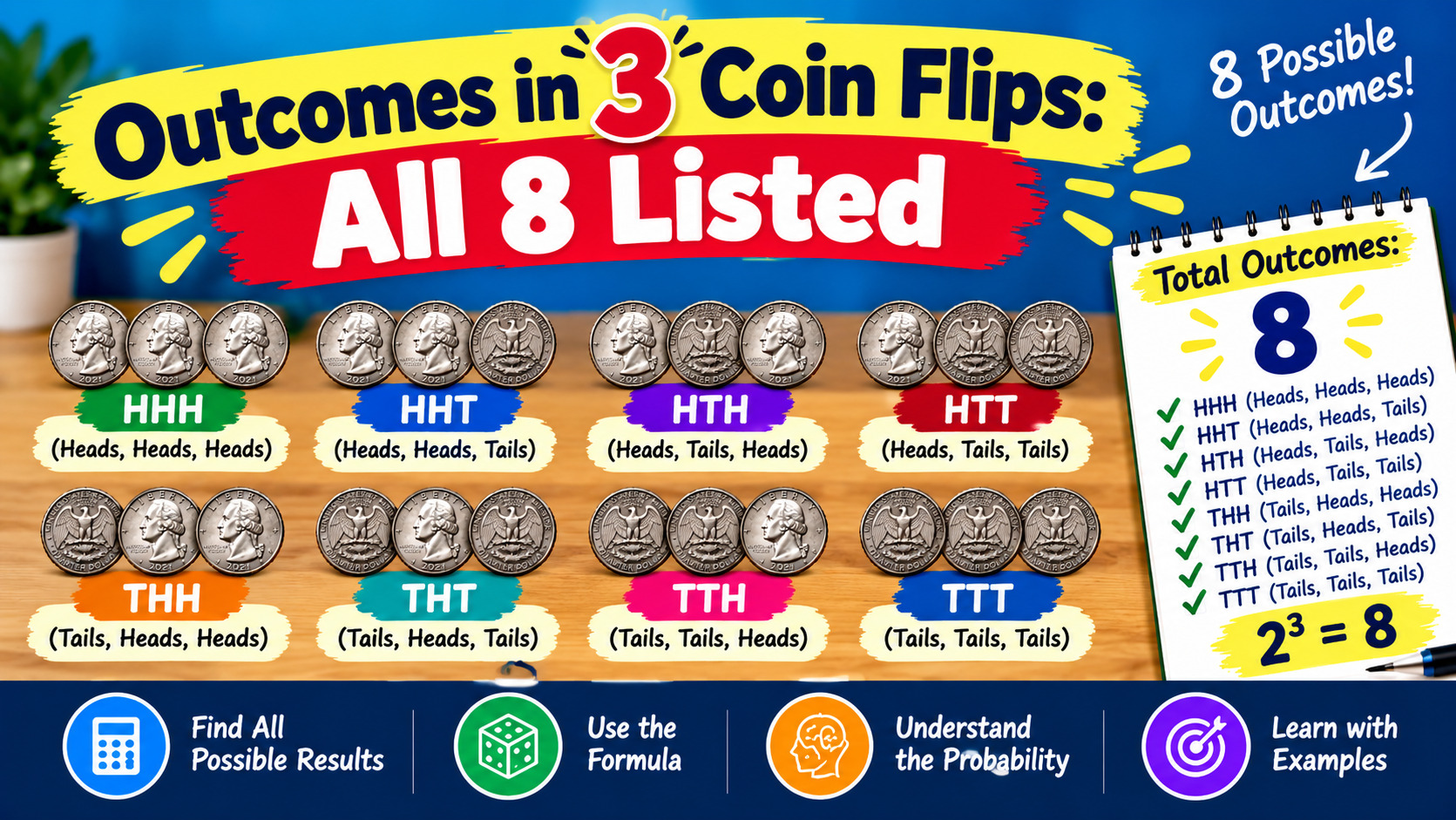
Outcomes in 3 Coin Flips.Quick answer: The outcomes in 3 coin flips of a fair coin are HHH, HHT, HTH, HTT, THH, THT, TTH and TTT. That’s 8 equally likely results, each with a 12.5% chance. Flipping three different coins once each gives the same eight.
Key Takeaways About the Outcomes in 3 Coin Flips
- Three flips give 2 × 2 × 2 = 8 outcomes.
- Every single outcome has a 1/8 (12.5%) chance.
- Exactly one head and exactly two heads are the most likely results, at 37.5% each.
- HH, HT, TH, TT is the list for two flips, not three.
- Each extra flip doubles the number of outcomes.
Outcomes in 3 Coin Flips: How Many Are There?
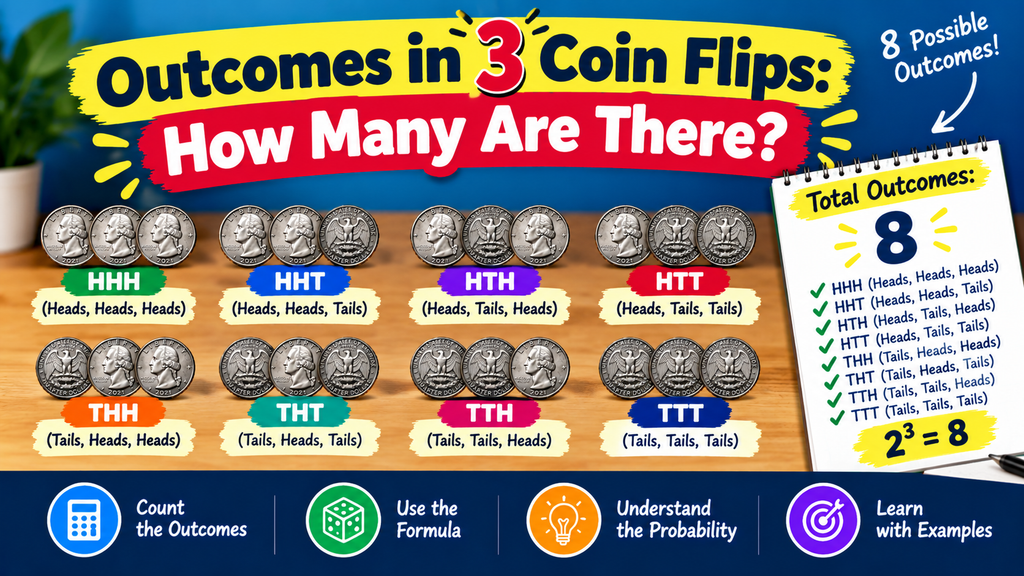
There are 8 possible outcomes when you flip a coin three times. The first flip can land two ways, the second can land two ways, and so can the third. Multiply them: 2 × 2 × 2 = 8.
The full list of possible results has a name, the sample space. If you like formal definitions, the sample space entry on Wikipedia covers it. For a worksheet, just think of it as the complete checklist of everything that could happen.
A fair coin has no favorite side, so all eight outcomes in 3 coin flips are equally likely. That’s what makes the counting work. To find any probability, count the outcomes you want and divide by 8.
No coin handy? You can flip a coin online and follow along with the lists below.
List All Outcomes in 3 Coin Flips (All Possible Combinations)
Here are all eight, with H for heads and T for tails:
- HHH: three heads in a row.
- HHT: two heads, then a tail.
- HTH: head, tail, head.
- HTT: one head, then two tails.
- THH: a tail, then two heads.
- THT: tail, head, tail.
- TTH: two tails, then a head.
- TTT: three tails.
Order matters here. HHT, HTH and THH all have two heads, but they’re three separate outcomes because the flips happen one after another. Use the free coin flip tool a few times and you’ll see each of these show up.
Tree Diagram for the Outcomes in 3 Coin Flips
A tree diagram shows where the 8 comes from. Start with one dot. Draw two branches, H and T, for flip one. At the end of each branch, draw two more for flip two. Then two more at the end of each of those for flip three.
Start
├─ H
│ ├─ H
│ │ ├─ H → HHH
│ │ └─ T → HHT
│ └─ T
│ ├─ H → HTH
│ └─ T → HTT
└─ T
├─ H
│ ├─ H → THH
│ └─ T → THT
└─ T
├─ H → TTH
└─ T → TTT
Count the endings on the right. Eight. Every path from the start to an ending is one outcome. If you’re putting this on a classroom handout or webpage, a clean drawn image of the tree is easier to read than text.
Outcomes in 3 Coin Flips: Why HH, HT, TH, TT Isn’t Enough
The list HH, HT, TH, TT is what you get from two flips. It has four outcomes, so it can’t cover three flips. This is a very common mix-up, and I’ve seen it on plenty of homework.
The fix is easy. Take each two-flip outcome and add an H or a T to the end:
- HH becomes HHH and HHT
- HT becomes HTH and HTT
- TH becomes THH and THT
- TT becomes TTH and TTT
Four outcomes, each split in two, gives eight. That’s the doubling rule in action. If you want to see the smaller case first, try the heads or tails game with just two flips, then add the third, or read our walkthrough of the outcomes in 2 coin flips.
Probability Table for the Outcomes in 3 Coin Flips
Each of the outcomes in 3 coin flips has a probability of 1/8, or 12.5%. Grouped by the number of heads, it looks like this:
| Number of heads | Outcomes | Ways | Fraction | Percentage |
| 0 | TTT | 1 | 1/8 | 12.5% |
| 1 | HTT, THT, TTH | 3 | 3/8 | 37.5% |
| 2 | HHT, HTH, THH | 3 | 3/8 | 37.5% |
| 3 | HHH | 1 | 1/8 | 12.5% |
The numbers add up to 8/8, a full 100%. A few more chances come straight from the list:
- At least one head: 7/8 = 87.5% (everything except TTT).
- At least one tail: 7/8 = 87.5%.
- At least two heads: 4/8 = 50%.
- All three flips match (HHH or TTT): 2/8 = 25%.
The expected number of heads is 1.5. You can never actually flip 1.5 heads, of course. It’s an average over many rounds. For the single all-heads result, see our page on the probability of 3 heads in a row.
Chart of the Outcomes in 3 Coin Flips: Heads and Tails Counts
Picture a bar chart with four bars, one for each head count. The bars for 0 and 3 heads are short, at 12.5%. The bars for 1 and 2 heads are tall, at 37.5%. It looks like a small hill.
Those counts, 1, 3, 3, 1, are also row 3 of Pascal’s triangle. In binomial terms they’re C(3,0) = 1, C(3,1) = 3, C(3,2) = 3 and C(3,3) = 1, which add up to 8. If you want to see the pattern in the rest of the triangle, the Pascal’s triangle page shows how each row builds on the one above.
For your own page, a simple bar chart image with 12.5, 37.5, 37.5 and 12.5 on top of the bars works well.
Outcomes in 3 Coin Flips: Three Coins at Once vs One Coin Three Times
Flipping three coins together gives the same outcomes in 3 coin flips as flipping one coin three times. The only rule is that you can tell the coins apart.
Say you have a penny, a nickel and a dime. Penny heads, nickel tails, dime heads is a different result from penny tails, nickel heads, dime heads. Both have two heads, but they’re different outcomes, just like HTH and THH.
Younger kids often struggle with this when all the coins are in the air at once. A sticker on each coin, or three different colors of coin, clears it up fast. Because each coin doesn’t affect the others, these are independent events, which is why you can multiply the possibilities.
Worksheet Answers for the Outcomes in 3 Coin Flips
Here are six common worksheet questions with answers you can copy.
1. How many outcomes are there when a coin is flipped 3 times? Each flip has 2 outcomes, so 2 × 2 × 2 = 8.
2. What is the probability of exactly 2 heads? The outcomes with exactly two heads are HHT, HTH and THH. That’s 3 out of 8, so 3/8 = 37.5%.
3. What is the probability of at least one tail? Only HHH has no tails, so 7 outcomes work. 7/8 = 87.5%.
4. What is the probability that all three flips match? HHH and TTT match. That’s 2 out of 8, so 2/8 = 25%.
5. What is the probability of at least 2 heads? Two heads (3 ways) plus three heads (1 way) gives 4 outcomes. 4/8 = 50%.
6. What is the probability that the first flip is heads and there are exactly 2 heads in total? Look for outcomes that start with H and have two heads: HHT and HTH. That’s 2/8 = 25%.
I’ll admit question 6 used to catch me out. I’d count THH as well, forgetting it starts with a tail. Always check the “first flip” condition before you count.
How to Solve Any Question About the Outcomes in 3 Coin Flips
Whatever the question asks about the outcomes in 3 coin flips, this method works:
- Write out all 8 outcomes.
- Read the question and circle only the outcomes that match.
- Count the circled outcomes.
- Divide that count by 8.
- Convert to a percentage if the question asks for one.
That’s it. If you’re building more practice, Khan Academy’s probability library has free lessons and exercises. And a quick virtual coin flipper is handy for checking an answer by experiment.
Real-Life Examples of the Outcomes in 3 Coin Flips
- Who goes first among three friends. Three friends each flip a coin. The odd one out (the one whose coin differs from the other two) goes first. That happens in 6 of the 8 outcomes, so it’s 75%. When all three match (25%), they flip again.
- A three-question true/false guess. You guess on all three questions. There are 8 ways your answers can turn out. Getting all three right is 1/8, or 12.5%. Getting at least two right is 50%. Guessing isn’t a terrible plan on a short quiz, though I wouldn’t build a study strategy on it.
- A board game turn. Suppose a game lets you move three spaces only if you flip three heads. That’s 12.5%, or about one turn in eight. You’d be waiting a while.
From 3 Flips to More: How Outcomes Grow
Each new flip doubles the count. The formula is 2 raised to the number of flips.
| Number of flips | Outcomes |
| 1 | 2 |
| 2 | 4 |
| 3 | 8 |
| 4 | 16 |
| 5 | 32 |
| 10 | 1,024 |
Three flips are easy to write out by hand. Ten flips, with over a thousand outcomes, are not, which is why people switch to formulas. If you want to see the next step up, we have a guide to the probability of 5 coin flips with the 32-outcome table. For a deeper mathematical look at coin tossing in general, see Wolfram MathWorld’s page on coin tossing.
Test the Outcomes in 3 Coin Flips Yourself
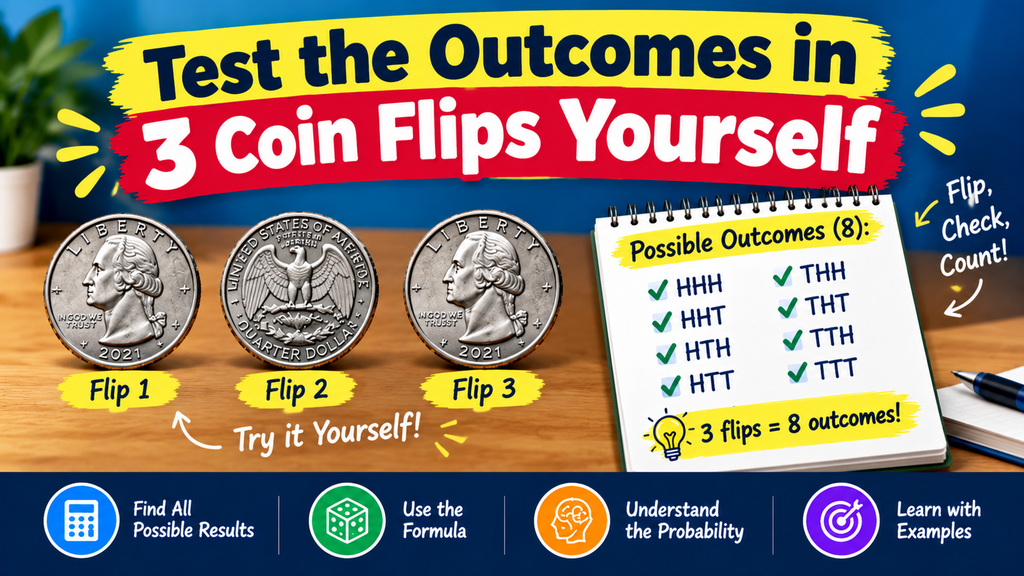
Reading about it helps, but running the experiment makes it stick.
- Open the coin flip tool or pick up a real coin.
- Flip three times and write down the result, such as HTH.
- Count how many heads you got.
- Repeat for 40 rounds.
- Compare your counts to the expected 5, 15, 15 and 5 for 0, 1, 2 and 3 heads.
My result: [INSERT MY REAL RESULT HERE, for example “In 40 rounds I got 4 rounds with no heads, 16 with one, 14 with two and 6 with three”]. Don’t worry if yours is a little off. With only 40 rounds, small gaps are normal. Try 200 rounds with a coin flip simulator and the split should creep closer to 12.5, 37.5, 37.5 and 12.5 percent. That settling effect is the law of large numbers, which Britannica’s overview of probability theory explains well.
Common Mistakes With the Outcomes in 3 Coin Flips
- Saying there are only 4 outcomes. The head counts 0, 1, 2 and 3 are four results, but they aren’t equally likely. Count the 8 ordered outcomes instead.
- Treating HHT, HTH and THH as the same. They’re three different sequences, so they count three times.
- Reusing the 2-flip list. HH, HT, TH, TT is for two flips. Three flips need eight entries.
- Forgetting TTT. It’s easy to miss, and it’s a real outcome.
- Believing a tail is “due.” After two heads, the third flip is still 50/50. The coin has no memory. This is called the gambler’s fallacy.
If you want to see how often streaks show up by pure chance, spend a few minutes with a coin toss simulator and count the longest run you get.
Try It Yourself: See the Outcomes in 3 Coin Flips Play Out
Numbers on a page only go so far. Go to flip-a-coin.us, flip three times, and keep a tally. After a few dozen rounds you’ll notice that mixed results show up far more often than all heads or all tails, right where the table says they should.
How many outcomes are there in 3 coin flips?
There are 8 outcomes in 3 coin flips, found by multiplying 2 × 2 × 2. They are HHH, HHT, HTH, HTT, THH, THT, TTH and TTT. Each one is equally likely, with a probability of 1/8, or 12.5%.
What are all possible combinations of 3 coin flips?
The combinations are HHH, HHT, HTH, HTT, THH, THT, TTH and TTT. If order matters, that’s 8. If you only count the number of heads, you get 4 results (0, 1, 2 or 3 heads), but those aren’t equally likely.
What is the probability of getting exactly 2 heads in 3 coin flips?
It’s 3/8, or 37.5%. Three outcomes have exactly two heads: HHT, HTH and THH. This ties with exactly one head as the most likely result of three flips.
What is the probability of getting at least one head in 3 flips?
It’s 7/8, or 87.5%. Only TTT has no heads, so every other outcome counts. The same is true for at least one tail, because a fair coin treats both sides equally.
Is HH, HT, TH, TT the list of outcomes in 3 coin flips?
No. That list has four outcomes and belongs to two flips. For three flips, add an H or a T to each one, which gives eight outcomes: HHH, HHT, HTH, HTT, THH, THT, TTH and TTT.
How do I solve a question about the outcomes in 3 coin flips?
List all 8 outcomes, circle the ones that match the question, count them, and divide by 8. For example, exactly two heads has 3 matching outcomes, so the answer is 3/8, or 37.5%.
Is flipping 3 coins at once the same as flipping one coin 3 times?
Yes. You get the same eight outcomes and the same probabilities. The coins just need to be distinguishable, like a penny, a nickel and a dime, so that results like HTH and THH count separately.
How many outcomes are there in 4 coin flips?
There are 16 outcomes, because 2 × 2 × 2 × 2 = 16. In general, n flips give 2ⁿ outcomes. Five flips give 32, and ten flips give 1,024.

Related Articles

How to Flip a Coin: 5 Easy, Proven Steps (Hand & Digital)
How to flip a coin: rest the coin on your curled index finger, tuck your thumb behind it, then flick upward so it spins in the…
Coin Flip Outcomes Table: 2, 3 & 4 Flips Explained
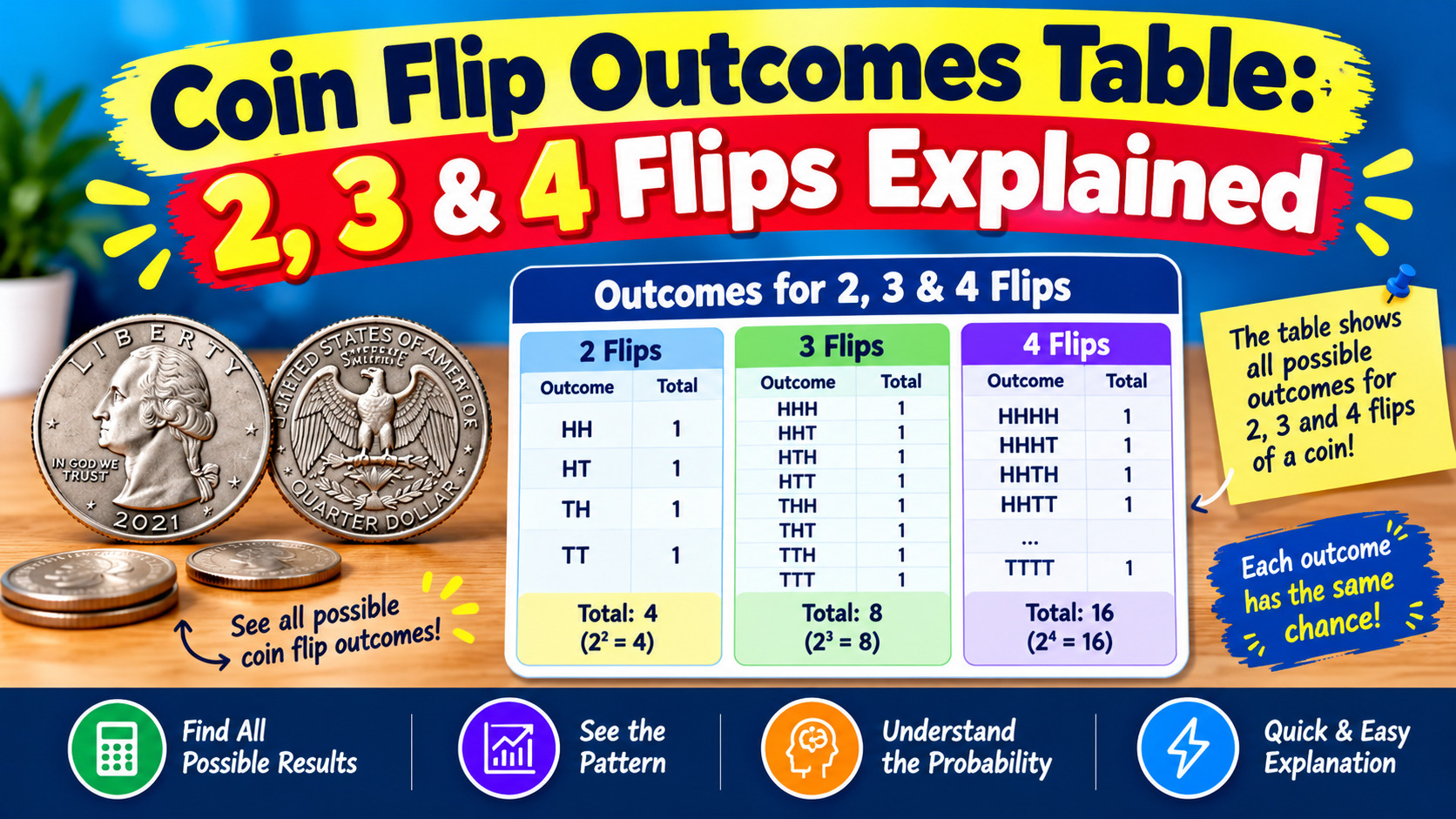
Coin Flip Outcomes Table: 2, 3 & 4 Flips Explained A coin flip outcomes table lists every possible result when you flip a coin a set…
Outcomes in 2 Coin Flips: The Full List and Why It’s 4
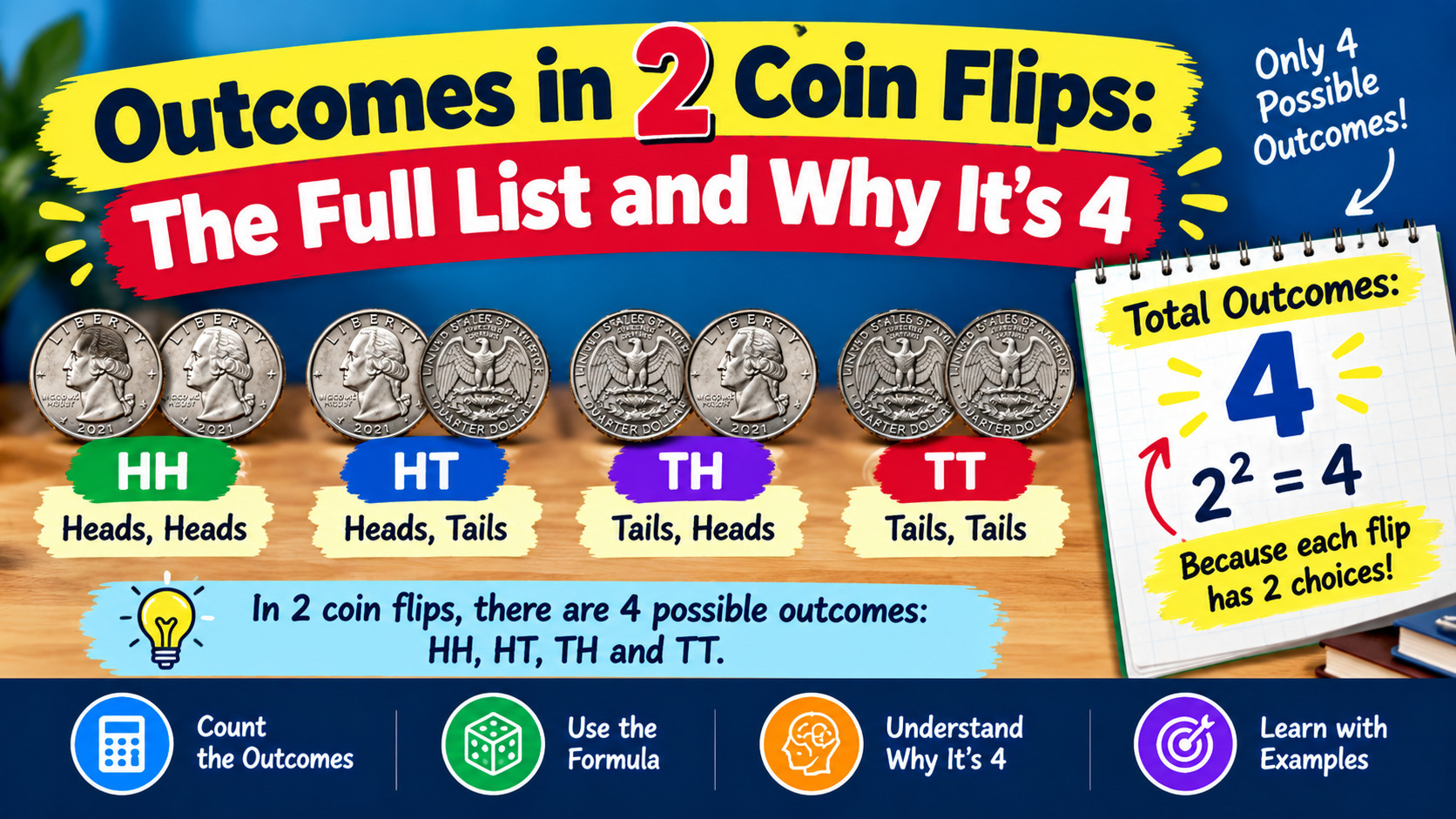
Outcomes in 2 Coin Flips..Quick answer: The outcomes in 2 coin flips of a fair coin are HH, HT, TH and TT. That’s 4 equally likely…
Need a Quick Decision?
Flip a coin and let chance decide — instantly, honestly, and for free.
Flip a Coin