
Probability of 5 Coin Flips: Heads, Tails and Every Outcome Explained
 Updated November 11, 2026
9 min read
In this article
- Key Takeaways About the Probability of 5 Coin Flips
- What Is the Probability of 5 Coin Flips?
- How to Calculate the Probability of 5 Coin Flips
- Probability of 5 Coin Flips All Heads
- Probability of 5 Coin Flips All Tails
- Probability of Getting Tails in 5 Coin Flips
- Probability of Exactly 5 Heads or 5 Tails in 5 Coin Flips
- Probability Table for 5 Coin Flips
- Probability of 5 Coin Flips: Real-Life Examples
- Probability of 5 Coin Flips Calculator
- Common Mistakes and the Gambler’s Fallacy
- Try It Yourself: Test the Probability of 5 Coin Flips
Probability of 5 Coin Flips: Heads, Tails and Every Outcome Explained
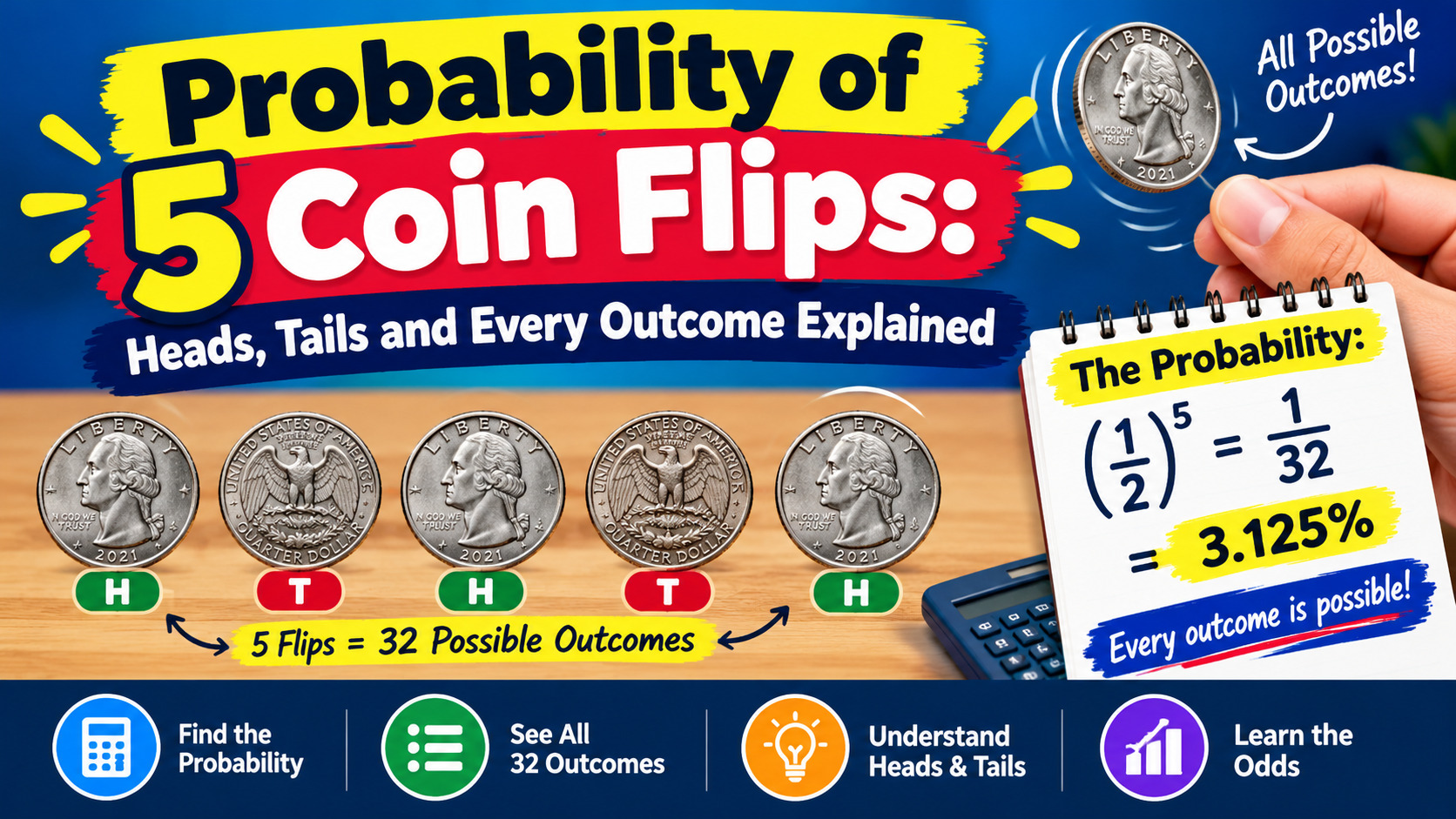
Quick answer: The probability of 5 coin flips depends on what you ask for, but the starting point is always the same: a fair coin flipped 5 times has 32 possible outcomes. Getting all heads has a probability of 1/32, or 3.125%. Getting all tails is the same. The most likely result is 2 or 3 heads, each at 31.25%.
Key Takeaways About the Probability of 5 Coin Flips
- 5 flips give 2 × 2 × 2 × 2 × 2 = 32 equally likely sequences.
- All heads or all tails: 3.125% each, about 1 in 32.
- Exactly 2 heads or exactly 3 heads: 31.25% each.
- At least one tail: 96.875%.
- Past flips never change the next one.
What Is the Probability of 5 Coin Flips?
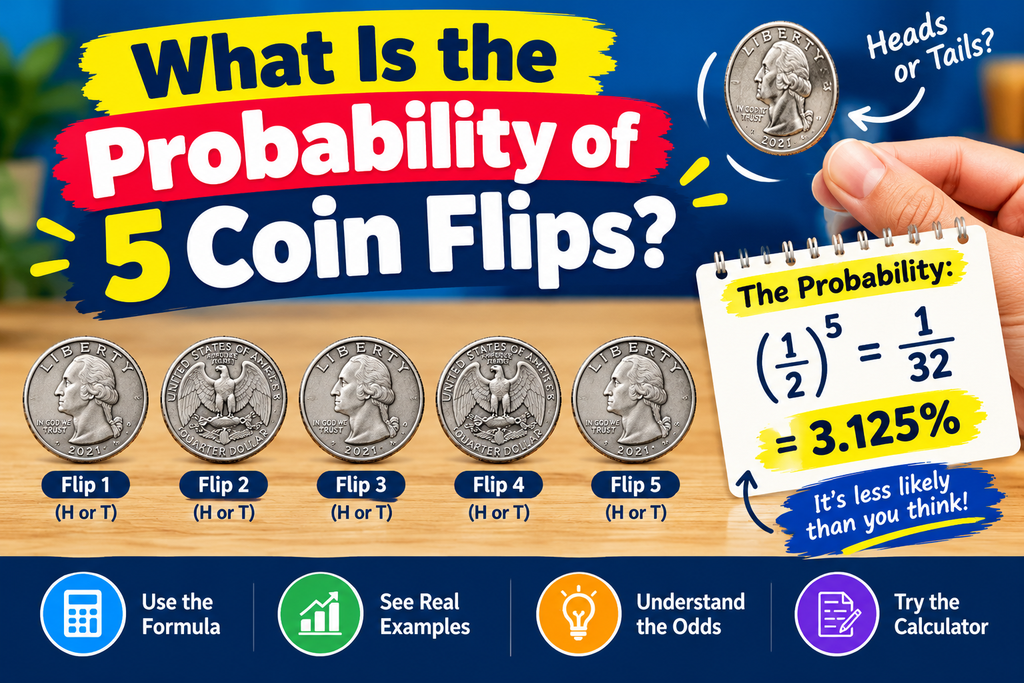
There isn’t one single probability of 5 coin flips, because it depends on what you’re asking. All heads? Exactly three tails? At least one head? Each question has its own answer, but they all come from the same starting point.
Each flip has two outcomes, heads or tails, and a fair coin lands on each half the time. Flip it five times and the outcomes multiply: 2⁵ = 32 sequences. HHHHH is one. HTHTH is another. TTHHT is another. The full list is called the sample space, and every sequence on it has the same 1/32 chance.
That last part trips people up, so I’ll repeat it. HTHHT is exactly as likely as HHHHH. One just looks more random to us.
If you’d rather see this than read it, you can flip a coin online five times and compare what you get with the table below.
How to Calculate the Probability of 5 Coin Flips
For “exactly k heads in 5 flips,” use the binomial formula:
P(k heads) = C(5, k) × (0.5)⁵
C(5, k), read as “5 choose k,” counts how many different sequences contain exactly k heads. The (0.5)⁵ part is 1/32, the chance of any one specific sequence. If you want the background, the Wikipedia page on the binomial distribution covers the theory in depth.
Here’s the process for the probability of 5 coin flips, step by step:
- Decide what you’re counting (say, exactly 3 heads).
- Work out C(5, 3) = 5! ÷ (3! × 2!) = 10.
- Multiply by 1/32.
- 10 × 1/32 = 10/32 = 31.25%.
For “at least” questions, it’s often easier to work backwards. The chance of at least one tail is 1 minus the chance of no tails: 1 − 1/32 = 31/32 = 96.875%.
This works because coin flips are independent events. What happened on flip 1 has no say over flip 2.
Probability of 5 Coin Flips All Heads
The probability of getting 5 heads in 5 flips of a fair coin is 1/32, or 3.125%.
You can see it by multiplying: ½ × ½ × ½ × ½ × ½ = 1/32. People often phrase this as the chance of 5 coin flips all heads or the odds of 5 coin flips all heads. Odds and probability aren’t quite the same thing. The probability is 1 in 32. The odds are 31 to 1 against, meaning for every 1 time it happens, you’d expect it to fail 31 times.
Over a long run, the probability of 5 coin flips all heads means you’d see five straight heads roughly once every 32 attempts. Some days it’ll take 10 tries, some days 80. That’s just how randomness behaves.
Probability of 5 Coin Flips All Tails
Same math, same answer: 1/32, or 3.125%.
A coin has no preference for heads. The chance of 5 coin flips all tails is identical to all heads, and the odds against are again 31 to 1. If you’re wondering whether the head side of a coin is “heavier” or somehow favored, for a normal coin the effect is tiny enough to ignore here.
Fun side note: the chance that all five flips match, whether all heads or all tails, is 2/32 = 6.25%, or 1 in 16.
Probability of Getting Tails in 5 Coin Flips
This depends on how you read the question, so here are the three common versions:
- Tails on one specific flip: 50%. Always. It doesn’t matter if the last four were heads.
- At least one tail in 5 flips: 31/32 = 96.875%.
- Exactly 3 tails in 5 flips: 10/32 = 31.25%.
The first one is where people get confused. If you’ve flipped four heads, the fifth flip is still 50/50. The coin has no memory.
Probability of Exactly 5 Heads or 5 Tails in 5 Coin Flips
Searchers often ask for the probability of exactly 5 heads in coin flips or the probability of exactly 5 tails in coin flips. When you’re flipping the coin only 5 times, “exactly 5 heads” means every flip was heads. So the answer is 1/32, or 3.125%, and the same is true for exactly 5 tails.
One thing to watch: if someone asks about “exactly 5 heads” in a larger number of flips, like 10, the answer changes completely. With 10 flips, exactly 5 heads is 252/1,024, about 24.6%. Always check how many flips the question is based on.
Probability Table for 5 Coin Flips
Here is the full probability of 5 coin flips for every outcome from 0 to 5 heads. Bookmark it, because you’ll use it again.
| Number of heads | Ways it can happen | Fraction | Percentage |
| 0 | 1 | 1/32 | 3.125% |
| 1 | 5 | 5/32 | 15.625% |
| 2 | 10 | 10/32 | 31.25% |
| 3 | 10 | 10/32 | 31.25% |
| 4 | 5 | 5/32 | 15.625% |
| 5 | 1 | 1/32 | 3.125% |
The probability of 5 coin flips across all six outcomes adds up to 32/32, a full 100%. Notice the shape: it bulges in the middle and thins out at the edges. Mixed results are common, extreme results are rare. The expected number of heads is 2.5, which is why 2 and 3 are the winners.
A few useful combos from the table:
- At least 3 heads: 16/32 = 50%
- At least 4 heads: 6/32 = 18.75%
- At most 1 head: 6/32 = 18.75%
Probability of 5 Coin Flips: Real-Life Examples
Let’s put numbers to some everyday situations.
Example 1: The toss in cricket. Say a captain wins the toss in five matches in a row. Each toss is 50/50, so the chance is 1/32, about 3%. It feels like a sign of luck or skill, but over a long career, streaks like that happen to someone, somewhere.
Example 2: A true/false quiz. You have no idea about any of five true/false questions and guess every one. Your chance of getting all five right is 1/32. Your chance of getting at least 3 right is 50%, which is why guessing can feel surprisingly decent on short quizzes.
Example 3: A bet with a friend. Your friend says, “I bet you can’t flip five heads in a row.” You’d win about 3 times out of 100 attempts. If they offer you a 10-to-1 payout, that’s a bad deal for you. The fair payout would be 31-to-1.
Did you know? Five heads in a row (3.125%) is slightly more likely than rolling double sixes with two dice (1/36, or about 2.8%). It’s one of those comparisons that surprises people.
[Add your own short note here if you can: for example, “I flipped a coin 5 times, 50 rounds in a row, and got all heads twice. The math says to expect about 1.6.” Use your real result. A genuine personal test adds credibility.]
Probability of 5 Coin Flips Calculator
You don’t need special software to find the probability of 5 coin flips.
Online: Use the coin flip tool at flip-a-coin.us to simulate flips. Run five flips, write down the result, and repeat 30 or 40 times. You’ll start to see the table above come to life. It’s a quick way to test probability with a virtual coin flip without digging out spare change.
In Excel or Google Sheets: Use the BINOM.DIST function.
- =BINOM.DIST(3,5,0.5,FALSE) returns 0.3125, the chance of exactly 3 heads.
- =BINOM.DIST(3,5,0.5,TRUE) returns 0.8125, the chance of 3 or fewer heads.
- For “at least 3 heads,” use =1-BINOM.DIST(2,5,0.5,TRUE), which gives 0.5.
By hand: Multiply C(5, k) by 1/32 to get the probability of 5 coin flips for any k. That’s the whole calculator.
If you want a gentler walkthrough of these ideas, Khan Academy’s probability library is a good free place to practice.
Common Mistakes and the Gambler’s Fallacy

The biggest mistake with the probability of 5 coin flips is thinking a streak has to “balance out.” You’ve seen four heads, so tails is “due.” It isn’t. The fifth flip is 50/50, same as the first. This error has a name: the gambler’s fallacy.
Here are the other mistakes I see most:
- Thinking HHHHH is less likely than HTHHT. They’re both 1/32.
- Mixing up “probability” and “odds.” 1 in 32 and 31 to 1 describe the same event differently.
- Forgetting that the number of flips matters. Exactly 5 heads out of 5 flips is very different from 5 heads out of 10.
- Assuming short runs behave like long ones. Five flips are jumpy. Five thousand are much steadier. This is the law of large numbers at work, and Britannica’s overview of probability theory explains it well.
Streaks are normal. They’re the reason a heads or tails game can feel rigged when it isn’t. If you want to see how random streaks look, try running a coin flip simulator for a few minutes and count the longest run you get. Our guides to the probability of 4 heads in a row and the probability of 4 tails in a row show how the odds of longer streaks drop.
For a more mathematical treatment of coin tossing, Wolfram MathWorld’s page on coin tossing is worth a look.
Try It Yourself: Test the Probability of 5 Coin Flips
The probability of 5 coin flips is one thing on paper, but watching it play out is better. Head over to flip-a-coin.us, flip five times, and see where you land. Do it a few dozen times and you’ll likely find that mixed results show up far more often than all heads or all tails, just like the table says.
What is the probability of 5 coin flips all heads?
It’s 1/32, or 3.125%. You get that by multiplying ½ five times. The same number applies to all tails. Over many sets of five flips, you’d expect about 1 in every 32 to come up all heads.
What is the chance of 5 coin flips all tails?
The chance is also 1/32, or 3.125%. A fair coin treats heads and tails equally, so every specific sequence of five flips, including TTTTT, has the same probability.
What are the odds of 5 coin flips all heads?
The odds are 31 to 1 against. That means five heads in a row should happen once for every 31 times it doesn’t. In probability terms, that’s a 3.125% chance.
What is the probability of getting tails in 5 coin flips?
It depends on the question. Tails on any single flip is 50%. At least one tail in five flips is 96.875%. Exactly three tails is 31.25%.
What is the probability of exactly 5 heads in coin flips?
In 5 flips, exactly 5 heads means all heads, so it’s 3.125%. If the number of flips is larger, the answer changes. For example, exactly 5 heads in 10 flips is about 24.6%.
What is the probability of exactly 5 tails in coin flips?
In 5 flips, it’s 1/32, or 3.125%. As with heads, the answer changes if you’re flipping more than five times, so always check the total number of flips first.
What is the most likely result of 5 coin flips?
Exactly 2 heads or exactly 3 heads. Each has a 31.25% chance, so together they make up 62.5% of all outcomes. Extreme results like 0 or 5 heads are rare.
Does a coin “remember” previous flips?
No. Each flip is independent. After four heads, the next flip is still 50% heads and 50% tails. Believing otherwise is the gambler’s fallacy.

Related Articles

How to Flip a Coin: 5 Easy, Proven Steps (Hand & Digital)
How to flip a coin: rest the coin on your curled index finger, tuck your thumb behind it, then flick upward so it spins in the…
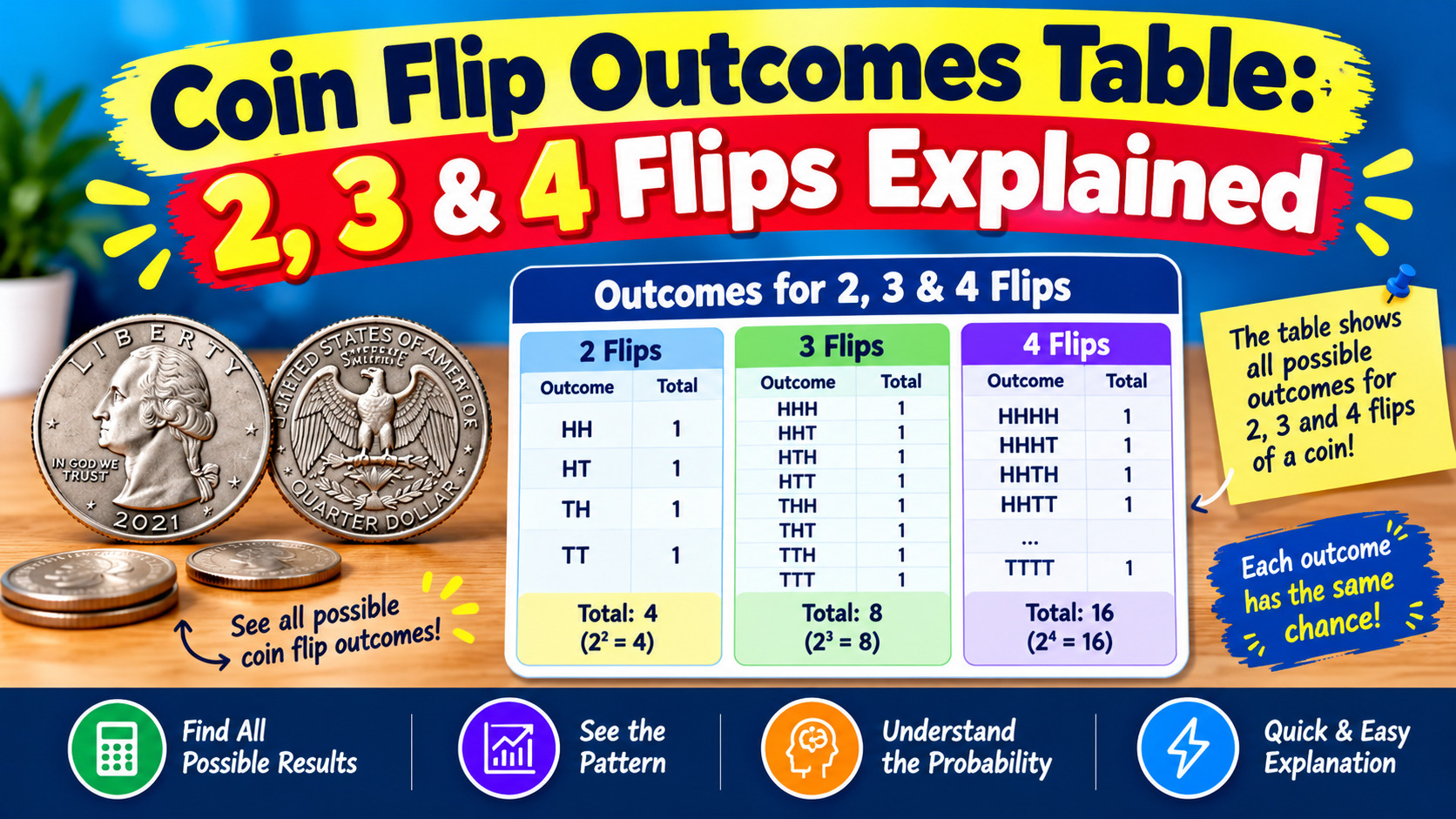
Coin Flip Outcomes Table: 2, 3 & 4 Flips Explained
Coin Flip Outcomes Table: 2, 3 & 4 Flips Explained A coin flip outcomes table lists every possible result when you flip a coin a set…
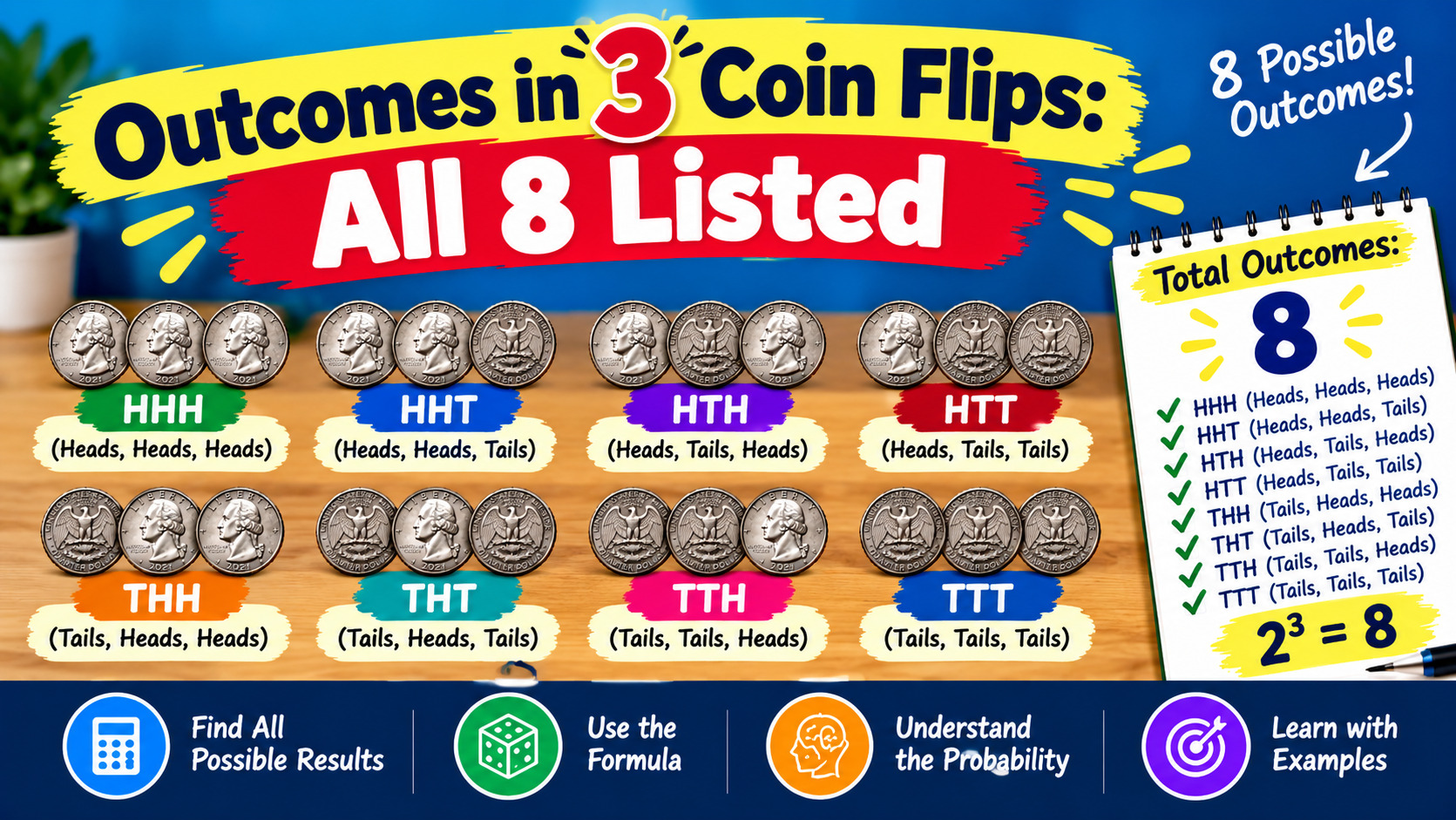
Outcomes in 3 Coin Flips: All 8 Listed
Outcomes in 3 Coin Flips.Quick answer: The outcomes in 3 coin flips of a fair coin are HHH, HHT, HTH, HTT, THH, THT, TTH and TTT.…
Need a Quick Decision?
Flip a coin and let chance decide — instantly, honestly, and for free.
Flip a Coin