
Probability of 4 Heads in a Row: Formula, Percentage & Odds
 Updated November 11, 2026
10 min read
In this article
- What Is the Probability of 4 Heads in a Row?
- Probability of 4 Heads in a Row as a Percentage and Odds
- Why the Probability of 4 Heads in a Row Is 1/16: Sample Space of 4 Coin Flips
- Probability of 4 Heads in a Row Using the Formula
- Probability of 4 Heads in a Row Using the Binomial Formula
- Probability of 4 Heads in a Row: Solved Example, Step by Step
- Probability of 4 Heads in a Row Calculator: How to Work It Out Yourself
- Probability of 4 Heads in a Row Somewhere in 5, 10 and 20 Flips
- How the Probability of 4 Heads in a Row Compares With 2, 3, 5 and 10 Heads
- Does Getting 3 Heads Make the Fourth More Likely?
- Common Mistakes With the Probability of 4 Heads in a Row
- Try It Yourself: Test the Probability of 4 Heads in a Row
The probability of 4 heads in a row with a fair coin is 1/16, which is 0.0625 or 6.25%. Four flips have 16 equally likely outcomes, and only one of them is HHHH. That works out to odds of 15 to 1 against, assuming a fair coin and independent flips.
Picture a friend who flips four heads in a row and starts acting like a wizard. Is that really so rare? About one time in sixteen, so not very. This guide shows where the number comes from, how to work it out yourself, how often HHHH turns up inside longer runs of flips, and why three heads never make a fourth any more likely. If you’d like to test it as you read, grab a free online coin flip and see how long it takes you to land one.
What Is the Probability of 4 Heads in a Row?
The probability of 4 heads in a row is 1/16, or 6.25%, for a fair coin flipped four times. A fair coin is one with equal chances of heads and tails. Each flip is independent, meaning earlier flips never change later ones.
Notice what that number covers. It’s the chance that your next four flips are all heads. It is not the chance of spotting four heads somewhere inside a long sequence, which is much higher, and we’ll get to that below. Keep those two questions apart and most of the confusion about streaks goes away.
Probability of 4 Heads in a Row as a Percentage and Odds
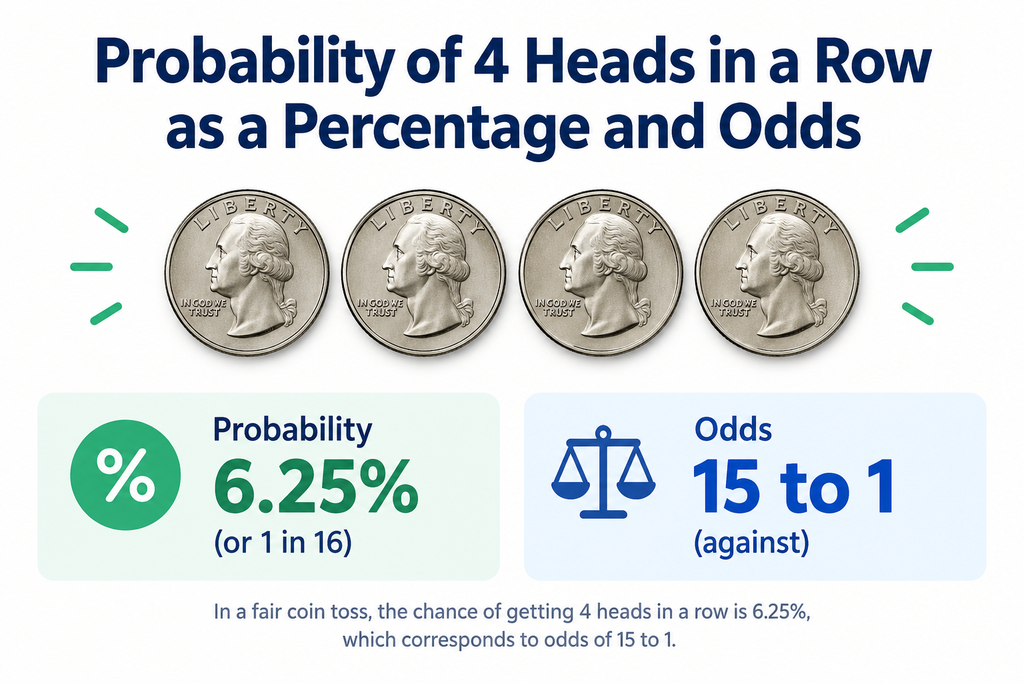
The probability of 4 heads in a row as a percentage is 6.25%, which is 1/16 as a fraction and 0.0625 as a decimal. The odds are 15 to 1 against, because one outcome works and fifteen don’t. All of these describe the same chance on a fair coin.
| Fraction | Decimal | Percentage | Odds |
| 1/16 | 0.0625 | 6.25% | 15 to 1 against |
People also ask for the 4 heads in a row chance percentage when they really mean “four of the same face.” That’s HHHH or TTTT, so it’s 2/16, or 12.5%.
Why the Probability of 4 Heads in a Row Is 1/16: Sample Space of 4 Coin Flips
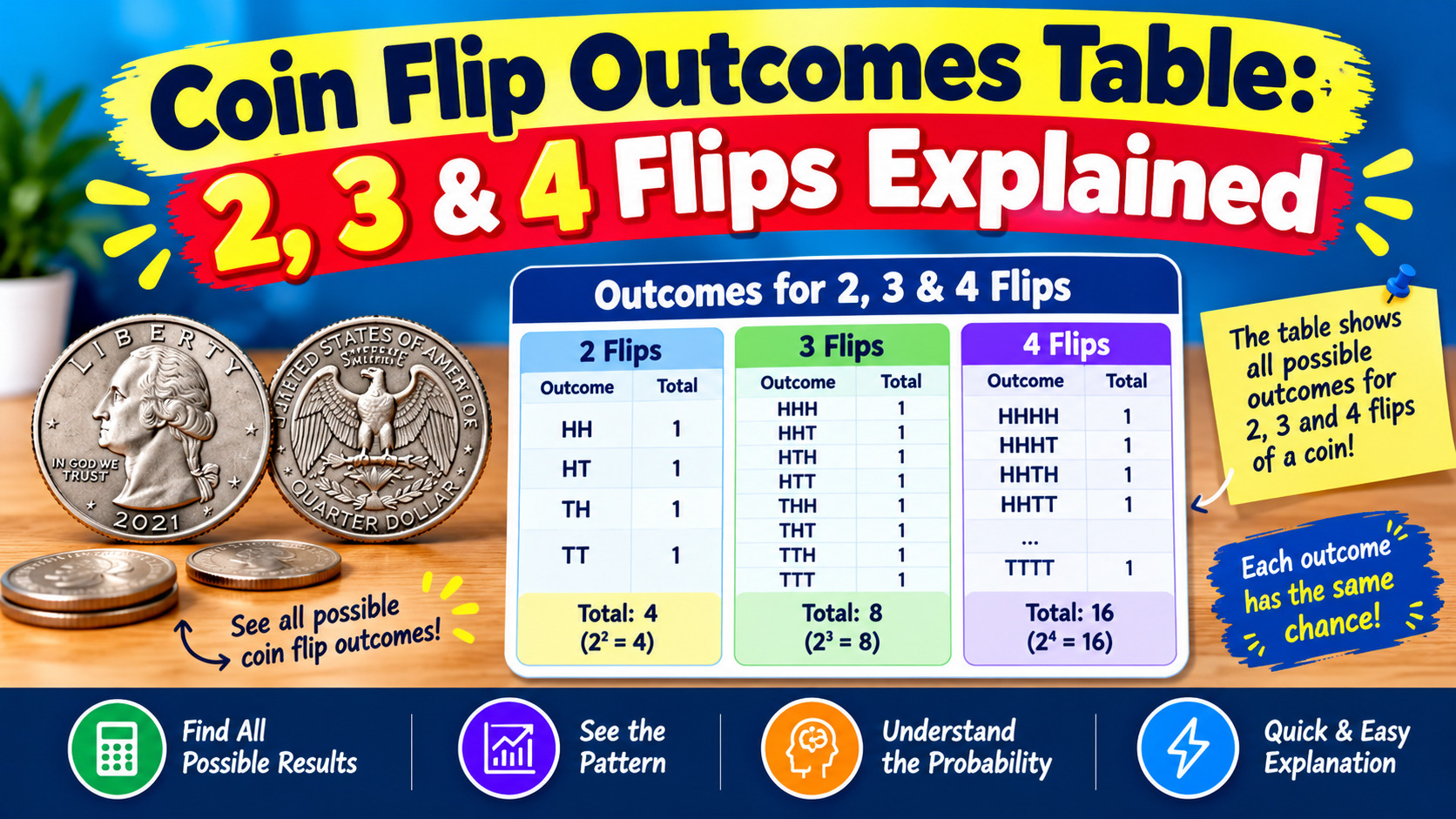
A sample space is the list of every possible outcome. Four flips of a fair coin have 2 × 2 × 2 × 2 = 16 outcomes, all equally likely, and exactly one of them is HHHH. That’s why 4 coin flips all heads has a probability of 1 out of 16.
Listing them all is easier than it sounds. Group them by the number of heads:
| Heads | Outcomes | How many |
| 4 | HHHH | 1 |
| 3 | HHHT, HHTH, HTHH, THHH | 4 |
| 2 | HHTT, HTHT, HTTH, THHT, THTH, TTHH | 6 |
| 1 | HTTT, THTT, TTHT, TTTH | 4 |
| 0 | TTTT | 1 |
Add the last column and you get 16. Every individual outcome is exactly as likely as every other.
Probability of 4 Heads in a Row Using the Formula
For independent flips, the formula is P = (1/2)ⁿ, where n is the number of heads in a row. For four heads, (1/2)⁴ = 1/16. This is the multiplication rule: you multiply the chance of each flip together to get the chance that all of them happen.
Written out, it’s 1/2 × 1/2 × 1/2 × 1/2 = 1/16. Each extra head you demand cuts the chance in half, which is why the numbers shrink so quickly. If you need a refresher on the ideas behind it, Khan Academy’s probability basics are free and clear.
Probability of 4 Heads in a Row Using the Binomial Formula
The binomial formula gives the chance of exactly k heads in n flips: P(X = k) = C(n, k) × (1/2)ᵏ × (1/2)ⁿ⁻ᵏ. For 4 heads in 4 flips, that gives 1/16, matching the multiplication rule. It counts “4 heads in 4 flips,” nothing more.
Here’s the working: C(4, 4) = 1, so P(X = 4) = 1 × 1/16 × 1 = 1/16. The Wikipedia page on the binomial distribution covers the general version.
Now the limit. The binomial formula does not directly give you a run of 4 heads somewhere in n flips. It counts how many heads appear, not where they sit. In 5 flips, “exactly 4 heads” includes HHTHH, which has no run of four. For runs inside longer sequences, you have to count sequences instead, which we’ll do shortly.
Probability of 4 Heads in a Row: Solved Example, Step by Step
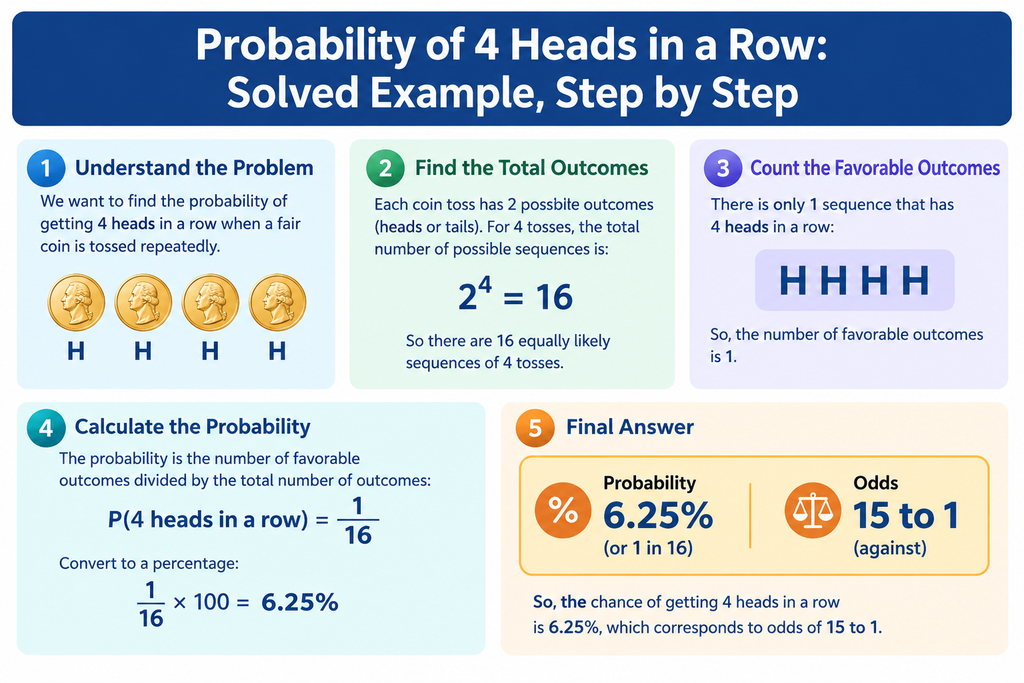
Here’s the working for two examples, a fair coin and a biased one. Both follow the same steps: write the chance of one head, raise it to the power of four, then convert to a percentage. The only thing that changes is the starting number.
Fair coin. What is the probability of 4 heads in a row?
- The chance of heads is 1/2, or 0.5.
- Raise it to the fourth power: 0.5 × 0.5 × 0.5 × 0.5 = 0.0625, which is 1/16.
- Convert to a percentage: 0.0625 × 100 = 6.25%.
Biased coin. Suppose heads comes up 60% of the time. Then 0.6⁴ = 0.1296, or about 13%, roughly double the fair-coin answer.
That last line is a good reminder that 6.25% belongs to a fair coin and nothing else.
Probability of 4 Heads in a Row Calculator: How to Work It Out Yourself
A 4 heads in a row probability calculator simply raises the chance of heads to the fourth power. You can do it yourself: type 0.5, raise it to the power of 4, and multiply by 100. Any online tool does the same arithmetic, however it’s labeled.
You’ll see the same idea under many names: a coin flip streak calculator for 4 heads, a 4 heads streak probability calculator, a 4 heads in a row odds calculator, or a four consecutive heads probability calculator. They all do this one multiplication. A coin flip probability calculator can save you the button presses, but it’s worth doing it by hand once so the number stops feeling like magic.
Probability of 4 Heads in a Row Somewhere in 5, 10 and 20 Flips
The chance of at least one HHHH grows quickly as you add flips: 6.25% in 4 flips, 9.375% in 5, about 24.5% in 10, and about 47.8% in 20. Each extra flip gives a streak another place to start, even though any single starting point stays unlikely.
| Number of flips | Chance of HHHH somewhere | Exact fraction |
| 4 | 6.25% | 1/16 (only HHHH) |
| 5 | 9.375% | 3/32 (HHHHH, HHHHT, THHHH) |
| 10 | about 24.5% | 251/1,024 |
| 20 | about 47.8% | 501,239/1,048,576 |
How do we get those? By counting sequences that have no HHHH and subtracting. The counts run 2, 4, 8, 15, 29, 56, 108, 208, 401, 773 for 1 through 10 flips, so for 10 flips it’s 1,024 − 773 = 251. On average you’ll wait about 30 flips for your first HHHH, though any one wait can be much shorter or longer.
How the Probability of 4 Heads in a Row Compares With 2, 3, 5 and 10 Heads
Every extra head halves the probability: 25% for two, 12.5% for three, 6.25% for four, 3.125% for five, and about 0.0977% for ten. Four sits in a comfortable middle ground, unlikely on one try but nothing to write home about.
| Heads in a row | Probability |
| 2 | 25% |
| 3 | 12.5% |
| 4 | 6.25% |
| 5 | 3.125% |
| 10 | 0.0977% |
Want the details for each? See the probability of 2 heads in a row, the probability of 3 heads in a row, the 5 heads in a row probability, and the 10 heads in a row probability.
Does Getting 3 Heads Make the Fourth More Likely?
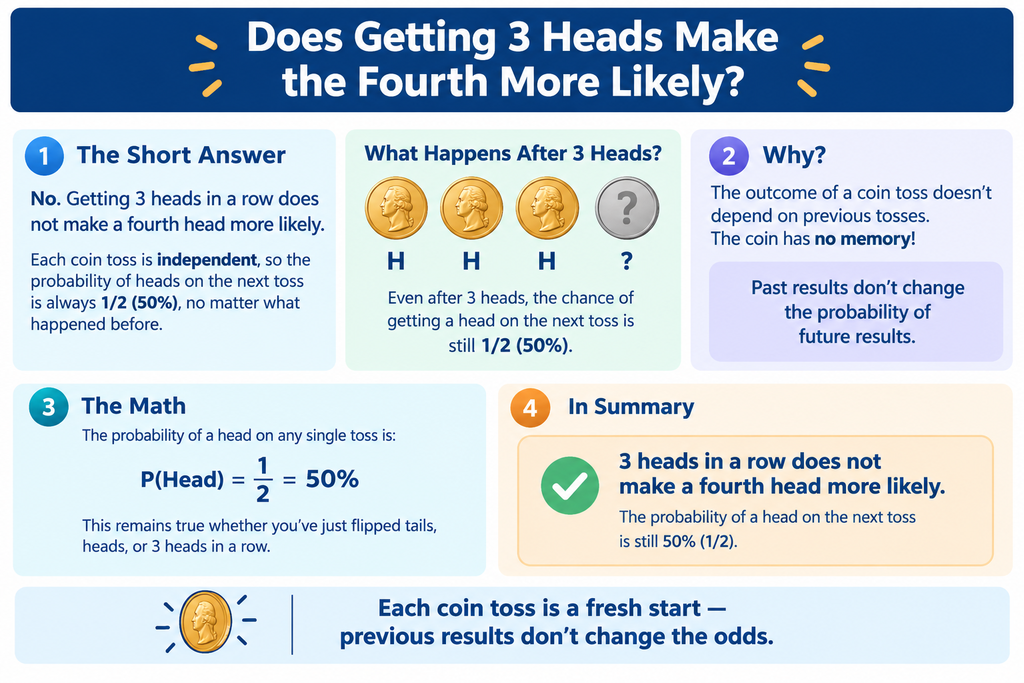
No. After three heads, the chance of heads on the next flip is still 1/2. Flips are independent events, so earlier results never change later ones. The coin has no memory of what it just did.
Here’s a clean way to see it. After HHH, the two possible results are HHHH and HHHT, and each has a probability of 1/16 as a full sequence. They’re exactly equally likely. The mistaken hunch that tails is “due” is called the gambler’s fallacy, and the opposite hunch, that heads will keep going, is just as wrong. For the idea in general, read about independent events, or see our guide on does heads make tails more likely.
Common Mistakes With the Probability of 4 Heads in a Row
Most slip-ups come from answering a slightly different question than the one asked. A quick checklist:
- HHHH versus 4 heads in any order. HHHH is 1/16. Four heads in any order across 4 flips is the same thing, but across 5 flips it’s different.
- Next four flips versus somewhere in n flips. The probability of 4 heads in a row on the next four flips is 6.25%. Somewhere in 20 flips is about 47.8%.
- A run versus a count. Exactly 4 heads anywhere in 5 flips is 5/32, or 15.625%, but a run of 4 heads in 5 flips is 3/32, or 9.375%.
- Forgetting biased coins. The formula changes if heads isn’t 1/2.
- Believing tails is due. It isn’t.
Try It Yourself: Test the Probability of 4 Heads in a Row
Here’s a simple experiment. Flip a coin four times, write down whether you got HHHH, and repeat that 160 times. With 160 sets, you’d expect about 10 all-heads rounds (160 ÷ 16 = 10). Your number will wander a bit around the probability of 4 heads in a row, and that wandering is part of the lesson.
My result: [INSERT MY REAL RESULT FROM FLIPPING 160 SETS OF 4]
A coin flip simulator makes this quick, and you can also try a random coin toss or a heads or tails generator for a different feel. One honest caveat: the Diaconis, Holmes and Montgomery paper Dynamical Bias in the Coin Toss predicted that real coins land on their starting side about 51% of the time, and a large 2023 experiment found a similar effect, so a real flipped coin isn’t perfectly 50/50. The effect is tiny, but it exists. For more on how coin tossing is analysed, see Wolfram MathWorld’s page on coin tossing, or flip a coin online and run your own tally.
Conclusion: The Probability of 4 Heads in a Row
The probability of 4 heads in a row is 1/16, or 6.25%, and it comes from one idea: multiply 1/2 by itself four times. That makes it uncommon on a single try but quite ordinary across many flips, since HHHH shows up somewhere in 20 flips nearly half the time. Three heads never make the fourth likelier, because the coin simply doesn’t remember. If you’d like to go further, our guide to coin flip streaks explained picks up where this page leaves off.
How I checked these numbers: I listed all 16 outcomes of four flips by hand and counted the winners, then confirmed the result with the formula (1/2)⁴. For the longer sequences, I counted the sequences with no HHHH and subtracted them from the total, and cross-checked the 5-flip case by listing HHHHH, HHHHT and THHHH.
What is the probability of getting 4 heads in a row?
The probability of 4 heads in a row with a fair coin is 1/16, or 6.25%. There are 16 equally likely outcomes in four flips and only one of them is HHHH. You can get it by multiplying 1/2 four times: (1/2)⁴ = 1/16.
What are the odds of flipping 4 heads consecutively?
The odds are 15 to 1 against, which is a 1 in 16 chance. One of the 16 possible outcomes is HHHH and the other 15 are not. Odds compare the winning outcomes with the losing ones, while probability compares winning outcomes with all outcomes.
What is the 4 heads in a row probability percentage?
The percentage is 6.25%. You find it by dividing 1 by 16 to get 0.0625, then multiplying by 100. The same percentage applies to four tails in a row, so the chance of four of the same face, either HHHH or TTTT, is 12.5%.
Can you use the binomial formula for the probability of 4 heads in a row?
Only for exactly 4 heads in 4 flips. The formula C(4, 4) × (1/2)⁴ gives 1/16. It does not directly give the chance of a run of 4 heads somewhere in a longer sequence, because it counts heads, not their positions. That needs sequence counting.
What is the chance of HHHH somewhere in 10 flips?
It’s about 24.5%. Of the 1,024 possible sequences of 10 flips, 251 contain at least one run of four heads, and 773 do not. A longer sequence gives a streak more places to start, so the chance rises from 6.25% to roughly one in four.
Does getting 3 heads make the fourth more likely?
No. Each flip is independent, so after three heads, the next flip is still 50% heads and 50% tails. HHHH and HHHT are equally likely sequences, at 1/16 each. Thinking tails is due is the gambler’s fallacy, and the coin has no memory.
How long does it take to get 4 heads in a row?
On average, about 30 flips before you first see HHHH. That’s only an average, though. You might see it in your first four flips or wait well past 100. The probability of 4 heads in a row describes what happens across many tries, not what any one run of flips will do.

Related Articles

How to Flip a Coin: 5 Easy, Proven Steps (Hand & Digital)
How to flip a coin: rest the coin on your curled index finger, tuck your thumb behind it, then flick upward so it spins in the…
Coin Flip Outcomes Table: 2, 3 & 4 Flips Explained
Coin Flip Outcomes Table: 2, 3 & 4 Flips Explained A coin flip outcomes table lists every possible result when you flip a coin a set…
Outcomes in 3 Coin Flips: All 8 Listed
Outcomes in 3 Coin Flips.Quick answer: The outcomes in 3 coin flips of a fair coin are HHH, HHT, HTH, HTT, THH, THT, TTH and TTT.…
Need a Quick Decision?
Flip a coin and let chance decide — instantly, honestly, and for free.
Flip a Coin