
Probability of 3 Heads in a Row (HHH): Formula, Examples & Calculator
 Updated November 11, 2026
10 min read

In this article
- What Is the Probability of 3 Heads in a Row?
- Why the Probability of 3 Heads in a Row Is 1/8: The Sample Space of 3 Coin Flips
- Probability of 3 Heads in a Row Using the Formula
- Probability of 3 Heads in a Row: Solved Example, Step by Step
- Probability of 3 Heads in a Row Calculator: Do It Yourself
- Probability of 3 Heads in a Row Somewhere in 4, 5, 10 and 20 Flips
- How the Probability of 3 Heads in a Row Compares With Other Streaks
- Does Getting 2 Heads Make the Third More Likely?
- Common Mistakes With the Probability of 3 Heads in a Row
- Try It Yourself: Test the Probability of 3 Heads in a Row
- Conclusion: The Probability of 3 Heads in a Row
Probability of 3 Heads in a Row (HHH): Formula, Examples & Calculator..The probability of 3 heads in a row is 1 in 8, or 12.5%. Picture a friend who just flipped heads twice and is grinning. “Watch, third one’s coming.” Is he onto something? Not really, but he’s also not asking for a miracle. Three heads in a row happens about once every eight tries, which is more often than most people guess.
This guide gives you the quick answer, the reasoning behind it, a formula you can reuse, solved examples, and the odds of spotting HHH inside a longer run of flips. If you’d rather watch it happen, you can try our free online coin flip while you read.
What Is the Probability of 3 Heads in a Row?
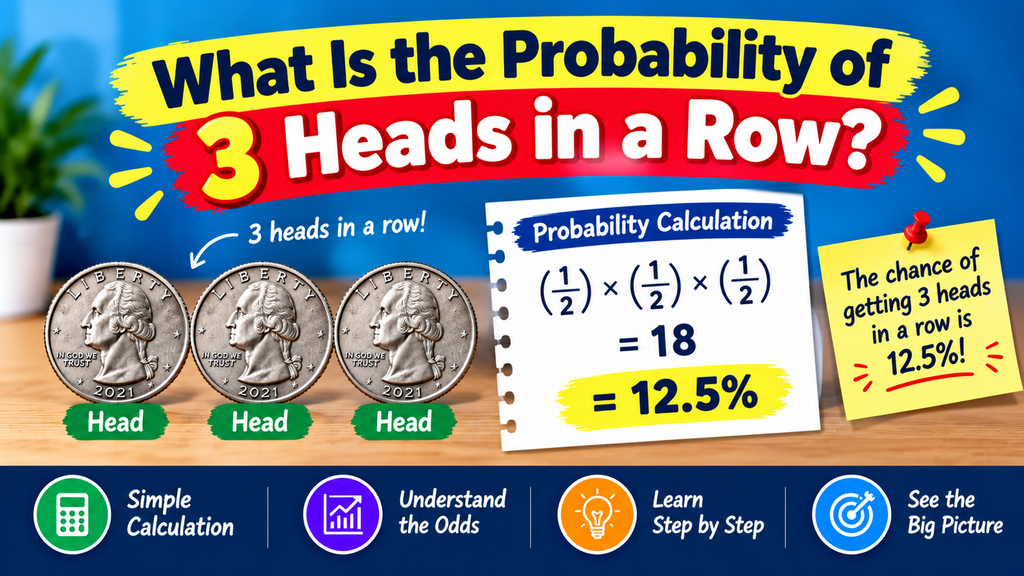
For a fair coin, the probability of 3 heads in a row is 1/8, which is 0.125 or 12.5%. That assumes every flip is independent, meaning earlier flips have no effect on later ones. In betting terms, the odds against it are 7 to 1.
A quick note on “fair.” It just means heads and tails each get a 50% chance. If that part feels shaky, our page on whether a coin flip is really 50/50 walks through it.
Also worth separating two questions that sound alike. “What’s the chance my next three flips are all heads?” is 12.5%. “What’s the chance HHH shows up somewhere in a long string of flips?” is much higher, and I’ll show the numbers further down.
Why the Probability of 3 Heads in a Row Is 1/8: The Sample Space of 3 Coin Flips
One flip has two outcomes. Two flips have four. Three flips have eight, because each new flip doubles the list. The full list of possible results is called the sample space, and for three flips it looks like this:
| Outcome | All heads? |
| HHH | Yes |
| HHT | No |
| HTH | No |
| HTT | No |
| THH | No |
| THT | No |
| TTH | No |
| TTT | No |
Eight rows, all equally likely, and exactly one says HHH. So the chance is 1 out of 8.
Notice something odd about that table. HTH looks “random” and HHH looks “special,” but each has the same 1/8 chance. We only notice HHH because it forms a pattern we have a name for. If you want the two-flip version of this idea first, see the probability of 2 heads in a row.
Probability of 3 Heads in a Row Using the Formula
The formula for n heads in a row on a fair coin is P = (1/2)^n. For three heads, that’s (1/2)³ = 1/8 = 0.125. You multiply because the flips are independent, and when several independent things all have to happen, their probabilities multiply.
Here’s the same thing written out:
P(HHH) = P(H) × P(H) × P(H) = 1/2 × 1/2 × 1/2 = 1/8
The formula works for any streak. Swap the exponent and you’ve got every other length:
- 2 heads: (1/2)² = 1/4 = 25%
- 3 heads: (1/2)³ = 1/8 = 12.5%
- 4 heads: (1/2)⁴ = 1/16 = 6.25%
- 5 heads: (1/2)⁵ = 1/32 = 3.125%
If you want a refresher on why multiplying independent events works, the Wikipedia page on independent events explains it, and Khan Academy’s probability lessons are free and beginner friendly.
Probability of 3 Heads in a Row: Solved Example, Step by Step
Here’s a worked example, then a second one with a twist. Both assume independent flips.
Example 1: A fair coin. You flip three times. What’s the probability of 3 heads in a row?
- Write the chance of heads on one flip: 1/2.
- Count how many heads you need in a row: 3.
- Multiply: 1/2 × 1/2 × 1/2 = 1/8.
- Convert to a percentage: 1 ÷ 8 = 0.125, and 0.125 × 100 = 12.5%.
Example 2: A biased coin. A trick coin lands heads 60% of the time. What’s the chance of three heads in a row?
- Chance of heads on one flip: 0.6.
- Multiply three times: 0.6 × 0.6 × 0.6 = 0.216.
- As a percentage, that’s 21.6%.
Same method, different starting number. The bias pushes the answer from 12.5% up to 21.6%. If you want to see how a biased coin changes the odds in other cases, that page goes through them.
Probability of 3 Heads in a Row Calculator: Do It Yourself
You don’t need special software for this. A 3 heads in a row probability calculator, or a 3 flips all heads probability calculator, is just the formula wrapped in a form. Type in the streak length, the tool raises 1/2 to that power, and it hands you a fraction and a percentage. Any phone calculator does the same job:
- Enter 0.5.
- Raise it to the 3rd power (0.5 × 0.5 × 0.5).
- You get 0.125.
- Multiply by 100 for 12.5%.
If you’d like a ready-made option, our coin flip probability calculator handles it for you. And if you’re searching for a coin toss streak probability calculator or a free online version, they all rest on this same one-line formula, so you can always check the result by hand.
What no calculator can do is tell you the next flip. It gives you the probability of 3 heads in a row across many tries. That’s all.
Probability of 3 Heads in a Row Somewhere in 4, 5, 10 and 20 Flips
The longer you keep flipping, the better the odds that HHH turns up somewhere. It’s about 19% in 4 flips, 25% in 5 flips, roughly 51% in 10 flips, and about 79% in 20 flips. A streak has more places to start in a longer sequence.
| Number of flips | Sequences containing HHH | Probability |
| 3 | 1 of 8 | 12.5% |
| 4 | 3 of 16 | 18.75% |
| 5 | 8 of 32 | 25% |
| 10 | 520 of 1,024 | about 50.8% |
| 20 | 825,259 of 1,048,576 | about 78.7% |
All figures assume a fair coin and independent flips.
How do you get the big ones without writing out a million sequences? Count the ones that don’t contain HHH, then subtract from the total. Those counts run 2, 4, 7, 13, 24, 44, 81, 149, 274, 504, and each number is the sum of the three before it. That’s a Tribonacci-style sequence. For 10 flips, 504 sequences have no HHH, so 1,024 − 504 = 520 do.
One more number. On average, you’ll wait about 14 flips to see your first HHH. Some people see it by flip 3, and others need 40. Fourteen is an average over many tries, not a promise.
How the Probability of 3 Heads in a Row Compares With Other Streaks
Every extra head cuts the chance in half. That’s why streaks feel so rare once they get long.
| Heads in a row | Fraction | Percentage |
| 2 | 1/4 | 25% |
| 3 | 1/8 | 12.5% |
| 4 | 1/16 | 6.25% |
| 5 | 1/32 | 3.125% |
| 10 | 1/1,024 | 0.0977% |
For the bigger ones, see the pages on 5 heads in a row and 10 heads in a row. Tails behave exactly the same way, so 5 tails in a row has the identical 1/32 chance.
And if you’d take three of either face, the chance of HHH or TTT in three flips is 2/8, or 25%. Two ways to win, so the odds double.
Does Getting 2 Heads Make the Third More Likely?
No. After two heads, the next flip is still 50% heads and 50% tails. A coin has no memory of what it did a moment ago, so past flips can’t push or pull the next one.
This is where the gambler’s fallacy sneaks in. The gambler’s fallacy is the feeling that a streak has to “even out,” so after two heads, tails is due. Or the flip side, that heads is hot and will keep going. Neither is true.
Here’s the part that clears it up. The probability of 3 heads in a row, 12.5%, describes all three flips before you start. Once two heads have already landed, only one flip is left, and that flip is a plain 50/50. Both statements are true at once, they just answer different questions. If you’d like more on this, read does heads make tails more likely.
A small honest caveat. Real coins aren’t perfect. Diaconis, Holmes and Montgomery predicted in their paper Dynamical Bias in the Coin Toss that a coin tends to land on its starting side about 51% of the time, and a large 2023 experiment with more than 350,000 flips found a similar effect. It’s a tiny bias, and for everyday math you can treat a coin as 50/50.
Common Mistakes With the Probability of 3 Heads in a Row
A few slips come up again and again:
- Mixing up “three heads in a row” with “three heads in any order.” In exactly three flips they’re the same thing (HHH). But in five flips, getting exactly three heads anywhere is 10/32, or 31.25%, which is a different question.
- Treating “next three flips” and “somewhere in n flips” as one thing. The probability of 3 heads in a row on the next three flips is 12.5%. The other climbs quickly with more flips.
- Forgetting the fair-coin assumption. A weighted coin changes everything, as the 21.6% example showed.
- Thinking a streak changes the coin. Two heads in a row doesn’t make the coin lucky or rigged. Streaks are a normal part of random sequences.
- Reading a 1-in-8 chance as “every eighth try.” It’s an average over lots of tries. You might get HHH twice in a row, then none for 30 tries.
Try It Yourself: Test the Probability of 3 Heads in a Row
Reading is fine, but flipping makes it stick. Here’s a quick test:
- Flip a coin three times and note whether all three were heads. That’s one set.
- Do 100 sets. A coin flip simulator saves your thumb.
- Count the sets that came up HHH.
You should see about 12 or 13. Anywhere from 5 to 20 wouldn’t be strange, because short experiments are noisy. More sets bring your result closer to the probability of 3 heads in a row.
My own result: [INSERT MY REAL RESULT FROM FLIPPING 100 SETS OF 3]
Need a steady supply of flips? A heads or tails generator will do it.
Conclusion: The Probability of 3 Heads in a Row
The probability of 3 heads in a row is 1/8, or 12.5%, whether you count the eight outcomes or multiply 1/2 three times. Give HHH more flips to appear in and the odds climb: about 19% in four flips, 51% in ten, and 79% in twenty.
What matters most is independence. Two heads in a row don’t make the third any more or less likely. To explore longer runs, coin flip streaks explained is a good next read.
How I checked these numbers: I listed every outcome by hand for 3, 4 and 5 flips, used the no-HHH counting method for 10 and 20 flips, and confirmed each result against the formula.
What is the probability of getting 3 heads in a row?
The probability of 3 heads in a row is 1/8, or 12.5%, with a fair coin. Three flips have eight equally likely outcomes, and only HHH is all heads. You get the same result by multiplying 1/2 × 1/2 × 1/2, since each flip is independent.
What is the probability of 3 consecutive heads in 4 flips?
It’s 3/16, or 18.75%. Of the 16 possible outcomes, HHHH, HHHT and THHH contain three heads in a row. The extra flip gives the streak a second place to start, which is why the chance rises from 12.5%.
What are the odds of 3 coin flips all being heads?
The probability of 3 heads in a row is 1/8 (12.5%), and the odds against are 7 to 1. That means for every one all-heads result, you’d expect seven results that aren’t. It’s an average across many sets of three flips, not a guarantee.
How do you calculate the probability of 3 heads in a row using the formula?
Use P = (1/2)^n, where n is the number of heads in a row. For three heads, (1/2)³ = 1/8 = 0.125, or 12.5%. For a biased coin, replace 1/2 with that coin’s chance of heads, such as 0.6.
Is there a free online calculator for 3 heads in a row?
Yes, plenty of tools do it, and they all raise the chance of heads to the power of the streak length. For three heads on a fair coin, that’s 0.5³ = 0.125. You can also do it on any phone calculator in a few seconds.
What is the chance of 3 heads in a row in 10 flips?
About 50.8%, or 520 out of 1,024 sequences. You count the 504 sequences with no HHH and subtract from 1,024. A longer run of flips gives three heads many more chances to appear somewhere in the sequence.
If I flip two heads, is the third flip more likely to be tails?
No. The third flip is still 50% heads and 50% tails. Each flip is independent, so earlier results don’t change it. Believing tails is “due” is the gambler’s fallacy. The probability of 3 heads in a row, 12.5%, only applies before the first flip.
How many flips does it take to get 3 heads in a row?
On average, about 14 flips. That’s only an average over many tries. You might see HHH on your third flip or wait 40 flips. Averages describe the long run, not any single sequence.

Related Articles

Is Heads or Tails More Likely? 7 Proven Facts
Is heads or tails more likely? No. On a fair coin, heads and tails each have a 50% chance, so neither wins more over time. The…

Is Heads or Tails Good Luck? 7 Surprising Truths
Is heads or tails good luck? No. On a fair coin, heads and tails each land about 50% of the time, so neither side is luckier,…

Flip a Coin 10 Times: What to Expect from 10, 20, 30 and 50 Flips
If you flip a coin 10 times, you’ll most often land on about 5 heads, but anything from 3 to 7 heads is completely normal. That…
Need a Quick Decision?
Flip a coin and let chance decide — instantly, honestly, and for free.
Flip a Coin