
Probability of 2 Heads in a Row (HH): Easy Math, Real Examples
 Updated November 11, 2026
11 min read
In this article
- What Is the Probability of 2 Heads in a Row?
- Why the Probability of 2 Heads in a Row Is 1/4: Sample Space and the Multiplication Rule
- Probability of 2 Heads in a Row in 3 Coin Flips
- Probability of 2 Heads in a Row Somewhere in 4, 5 and 10 Flips
- Probability of 2 Heads in a Row: Worked Examples
- HH Probability Calculator: How to Work It Out Yourself
- Does One Head Change the Next Flip?
- Common Mistakes People Make With the Probability of 2 Heads in a Row
- Try It Yourself: Test the Probability of 2 Heads in a Row
- Conclusion: The Probability of 2 Heads in a Row
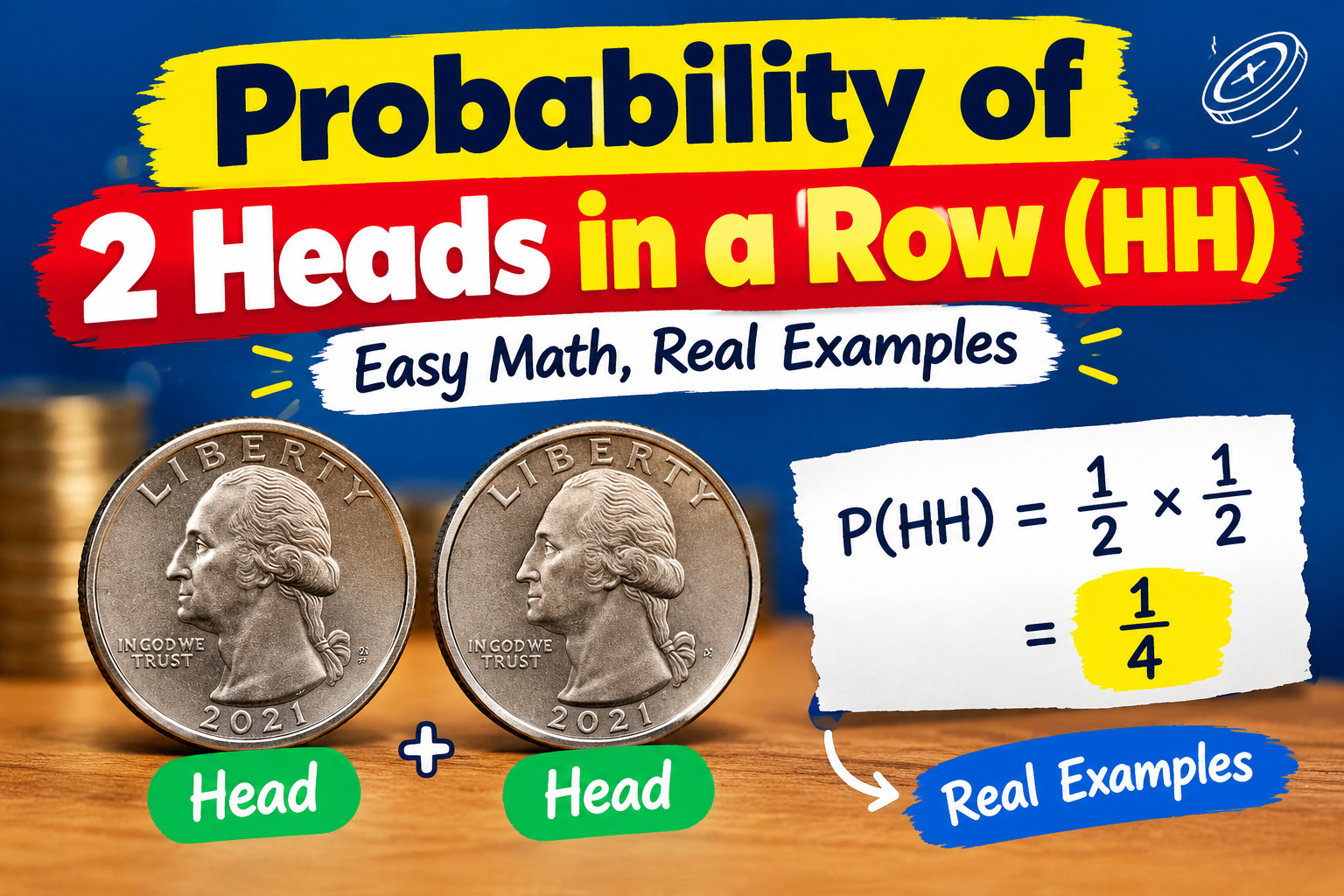
Probability of 2 Heads in a Row (HH): Easy Math, Real Examples..The probability of 2 heads in a row is 1 in 4, or 25%. Say you and a friend flip a coin to decide who buys lunch, and it lands heads, then heads again. Lucky? Sort of. Rare? Not really. One time in four, that’s exactly what happens.
Most people who search for this want one of two things: the quick number, or a way to work it out for more than two flips. I’ll cover both. You can follow along with our free online coin flip if you’d rather see it happen than read about it.
What Is the Probability of 2 Heads in a Row?
For a fair coin, the probability of 2 heads in a row is 1/4, which is 0.25 or 25%. That assumes each flip is independent, meaning the first result has no effect on the second.
So what does “fair” mean here? Just that heads and tails each have a 50% chance. If you want the basics on that first, our page on whether a coin flip is really 50/50 covers it. And the heads or tails 50/50 explained guide goes a step further.
One quick clarification. When people say “two heads in a row,” they usually mean the very next two flips both come up heads. That’s the 25% figure for the probability of 2 heads in a row. The question changes if you’re asking about HH showing up somewhere inside a longer string of flips. I’ll get to that below, because the numbers are quite different.
Why the Probability of 2 Heads in a Row Is 1/4: Sample Space and the Multiplication Rule
There are two ways to get to 1/4, and they always agree. One is counting, the other is multiplying. Counting is easier to picture, so start there.
List every result for two flips. That list is called the sample space, and it’s just the full set of things that could happen:
- HH
- HT
- TH
- TT
Four outcomes, all equally likely. One of them is HH. So the probability is 1 out of 4.
Now the multiplication route. The chance of heads on flip one is 1/2. The chance of heads on flip two is also 1/2. Because the flips are independent events, you multiply: 1/2 × 1/2 = 1/4.
For any run of n heads, the formula is P = (1/2)^n. Two heads is (1/2)², three heads is 1/8, and so on. If you’d like a refresher on the underlying ideas, Khan Academy’s probability lessons are free and clear.
Probability of 2 Heads in a Row in 3 Coin Flips
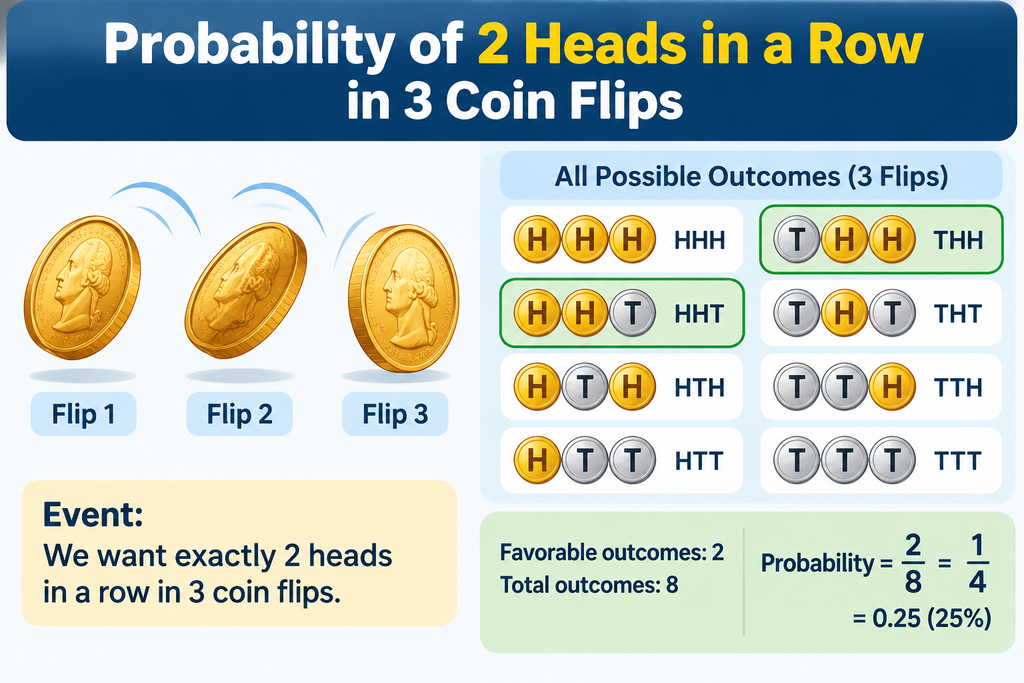
In three flips of a fair coin, the probability of 2 heads in a row appearing at least once is 3/8, or 37.5%. Three flips have 8 equally likely outcomes, and HH appears in three of them: HHH, HHT and THH.
Here’s the whole list, so you can check it yourself:
| Outcome | Contains HH? |
| HHH | Yes |
| HHT | Yes |
| HTH | No |
| HTT | No |
| THH | Yes |
| THT | No |
| TTH | No |
| TTT | No |
Three “yes” rows out of eight is 3/8.
Notice HTH. It has two heads, but they’re not next to each other, so it doesn’t count. That’s the most common slip with this question, and I’ll come back to it in the mistakes section.
If you only want exactly two heads in a row, with no third head attached, drop HHH. That leaves HHT and THH, which is 2/8, or 25%.
Probability of 2 Heads in a Row Somewhere in 4, 5 and 10 Flips
The more flips you allow, the better the odds that HH shows up somewhere. It’s about 50% in 4 flips, roughly 59% in 5 flips, and around 86% in 10 flips. HH is a small pattern, and a longer sequence gives it lots of places to appear.
| Number of flips | Sequences containing HH | Probability |
| 2 | 1 of 4 | 25% |
| 3 | 3 of 8 | 37.5% |
| 4 | 8 of 16 | 50% |
| 5 | 19 of 32 | about 59.4% |
| 10 | 880 of 1,024 | about 85.9% |
All of these assume a fair coin and independent flips.
How did I get the bigger ones without listing 1,024 sequences? It’s easier to count the sequences with no HH, then subtract. The counts go 2, 3, 5, 8, 13, 21… and each number is the sum of the two before it. That’s the Fibonacci sequence showing up in a coin problem, which still surprises me a little. For 10 flips there are 144 sequences with no HH, so 1,024 − 144 = 880 do have one.
Longer streaks work the same way, just with smaller numbers. If you’re curious, see how fast the odds fall for 5 heads in a row and 10 heads in a row.
One more handy figure: on average, you’ll wait about 6 flips to see your first HH. Some people get it on flip 2, others wait 15 or more. Six is the average, not a promise.
Probability of 2 Heads in a Row: Worked Examples
Here are three short examples, because that’s how this stuff finally clicks.
Example 1: the lunch flip. You flip twice. What’s the probability of 2 heads in a row? The answer is 1/4, or 25%. You’d expect it about once in every four tries.
Example 2: four flips. A teacher asks the class to flip four times and watch for HH anywhere. From the table, that’s 8 of 16, or 50%. In a class of 30 kids, around 15 should see it.
Example 3: the second flip after a head. You just flipped heads. What’s the chance the next flip is heads too? It’s 1/2, not 1/4. The first head already happened, so only one flip is left to come. This one trips up a lot of people, and it connects to the next section.
HH Probability Calculator: How to Work It Out Yourself
A calculator for this is really just the formula in a nicer wrapper. If you’re searching for a heads heads probability calculator, a consecutive heads probability calculator, or a coin flip streak calculator for 2 heads, here’s what those tools do under the hood. You can do it on paper in a minute:
- Write the chance of heads on one flip: 0.5.
- Decide the streak length. For HH, that’s 2.
- Raise 0.5 to that power: 0.5² = 0.25.
- Multiply by 100 for the percentage: 25%.
That gives you the probability of 2 heads in a row for the next two flips. For HH somewhere in n flips, do this instead:
- Count the sequences with no HH. Start with 2 (for one flip) and 3 (for two flips), then keep adding the last two numbers: 5, 8, 13, 21…
- Divide that count by 2ⁿ, the total number of sequences.
- Subtract the result from 1.
For 5 flips: 13 ÷ 32 = 0.406, and 1 − 0.406 = 0.594. That matches the table.
If you’d rather skip the arithmetic, our coin flip probability calculator does the work for you. Just remember what a calculator can’t do. It tells you how likely a pattern is. It can’t tell you what the next flip will be.
Does One Head Change the Next Flip?
No. After a head, the next flip is still 50% heads and 50% tails. A coin doesn’t remember what it did a second ago, so earlier flips can’t push or pull later ones.
This is where the gambler’s fallacy lives. It’s the feeling that after heads, tails is somehow due, or that heads is “hot” and will continue. Neither is true. The gambler’s fallacy mixes up two different questions: how likely a whole pattern is before you start, and how likely the next flip is once part of it has happened.
The probability of 2 heads in a row is 25% before you flip anything. Once the first H lands, the second flip is a plain 50/50. Both facts are true at the same time. If this keeps nagging at you, read does heads make tails more likely for a longer walk-through.
There’s also a small honest caveat. Real coins aren’t perfect. Diaconis, Holmes and Montgomery predicted in their paper Dynamical Bias in the Coin Toss that a coin tends to land on the side it started on about 51% of the time, and a large 2023 experiment with more than 350,000 flips found a similar effect. That’s a tiny bias, and for everyday math it’s safe to treat a coin as 50/50.
Common Mistakes People Make With the Probability of 2 Heads in a Row
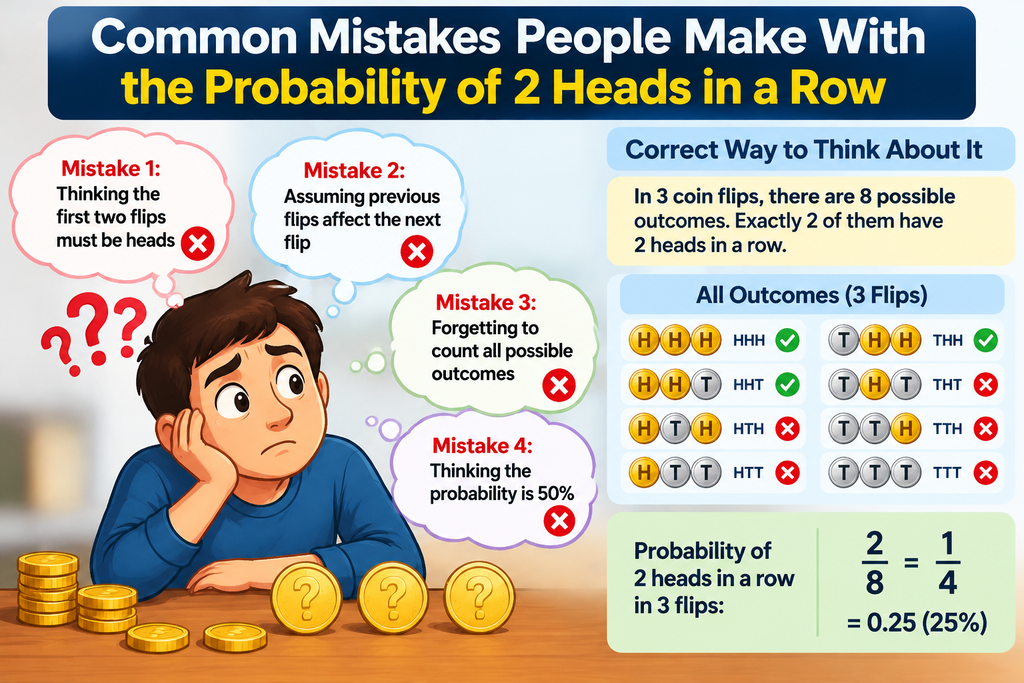
A few errors come up over and over:
- Counting HTH as HH. The two heads need to touch. HTH doesn’t qualify.
- Mixing up “HH” and “two heads in any order.” Two heads in two flips is just HH (25%). Exactly two heads in three flips is HHT, HTH and THH, which is 3/8.
- Confusing HH with exactly HH. HHH contains HH. If you want exactly two in a row, remove it.
- Forgetting the starting assumption. The numbers here are for a fair coin. A biased coin that lands heads 60% of the time gives 0.6 × 0.6 = 36% for HH.
- Treating “HH next” and “HH somewhere” as the same thing. The probability of 2 heads in a row on the next two flips is 25%. The other climbs quickly as flips are added.
Try It Yourself: Test the Probability of 2 Heads in a Row
Reading about this is fine. Flipping makes it stick. Try this:
- Flip a coin twice and note whether you got HH. That’s one pair.
- Repeat for 100 pairs. A coin flip simulator saves your thumb.
- Count the pairs that came up HH.
The probability of 2 heads in a row says you should see about 25, though anywhere from 15 to 35 wouldn’t be strange. Short experiments are noisy, and more pairs get you closer to 25%.
My own result: [INSERT MY REAL RESULT FROM FLIPPING 100 PAIRS]
If you want a quick supply of flips, a heads or tails generator works well for this.
Conclusion: The Probability of 2 Heads in a Row
The probability of 2 heads in a row is 1/4, or 25%, and you get there either by counting (one HH out of four outcomes) or by multiplying 1/2 × 1/2. Allow more flips and the odds of seeing HH somewhere climb quickly: 37.5% in three flips, 50% in four, and about 86% in ten.
The one thing to hold onto is independence. A head doesn’t make the next flip any more or less likely to be heads. If you want to see how longer runs behave, read about coin flip streaks, and the free flipper is there whenever you want to test any of this yourself.
How I checked these numbers: I listed every outcome by hand for 2, 3 and 4 flips, used the no-HH counting method for 5 and 10 flips, and confirmed each result with the formula.
What is the probability of 2 heads in a row?
It’s 1/4, or 25%, for a fair coin. Two flips have four equally likely outcomes (HH, HT, TH, TT), and only HH has two heads in a row. You get the same answer by multiplying 1/2 × 1/2, since the flips are independent.
What is the probability of getting HH in a coin toss?
Flipping twice, HH has a 25% chance. The first flip must be heads (1/2) and the second must be heads (1/2), so you multiply to get 1/4. This assumes a fair coin where heads and tails are equally likely.
What is the probability of HH in 3 coin flips?
It’s 3/8, or 37.5%. Of the eight possible outcomes, HHH, HHT and THH contain two heads in a row. If you want exactly two in a row and no third head, only HHT and THH count, which is 25%.
What is the probability of two heads consecutively in 5 flips?
About 59.4%, or 19 out of 32. You count the sequences with no HH (13 of them), divide by 32, and subtract from 1. More flips give HH more places to show up, so the odds rise.
Is the probability of HH the same as HT?
Yes, when you flip exactly twice. HH, HT, TH and TT each have a 25% chance. The first two just feel different because we notice patterns. If you ask about “one head and one tail in any order,” that’s HT or TH, so 50%.
After getting one head, what is the chance of another?
It’s 1/2, or 50%. Each flip is independent, so the first head doesn’t change the second. The 25% figure describes HH before any flipping. Once the first head lands, only one flip is left to happen.
Is there a calculator for HH probability?
Yes. To find the probability of 2 heads in a row, any heads heads probability calculator or consecutive heads calculator raises 1/2 to the streak length. For two heads that’s (1/2)² = 25%. You can also do it by hand, or use a coin flip streak calculator style tool.
How many flips does it take to get HH?
On average, about 6 flips. That’s only an average, though. You could land HH in your first two flips or wait 15 or more. Averages describe many tries, not any single run.

Related Articles

Is Heads or Tails More Likely? 7 Proven Facts
Is heads or tails more likely? No. On a fair coin, heads and tails each have a 50% chance, so neither wins more over time. The…

Is Heads or Tails Good Luck? 7 Surprising Truths
Is heads or tails good luck? No. On a fair coin, heads and tails each land about 50% of the time, so neither side is luckier,…

Flip a Coin 10 Times: What to Expect from 10, 20, 30 and 50 Flips
If you flip a coin 10 times, you’ll most often land on about 5 heads, but anything from 3 to 7 heads is completely normal. That…
Need a Quick Decision?
Flip a coin and let chance decide — instantly, honestly, and for free.
Flip a Coin