
Coin Flip Gambler’s Fallacy Example: Does a Coin Remember Previous Flips?
 12 min read
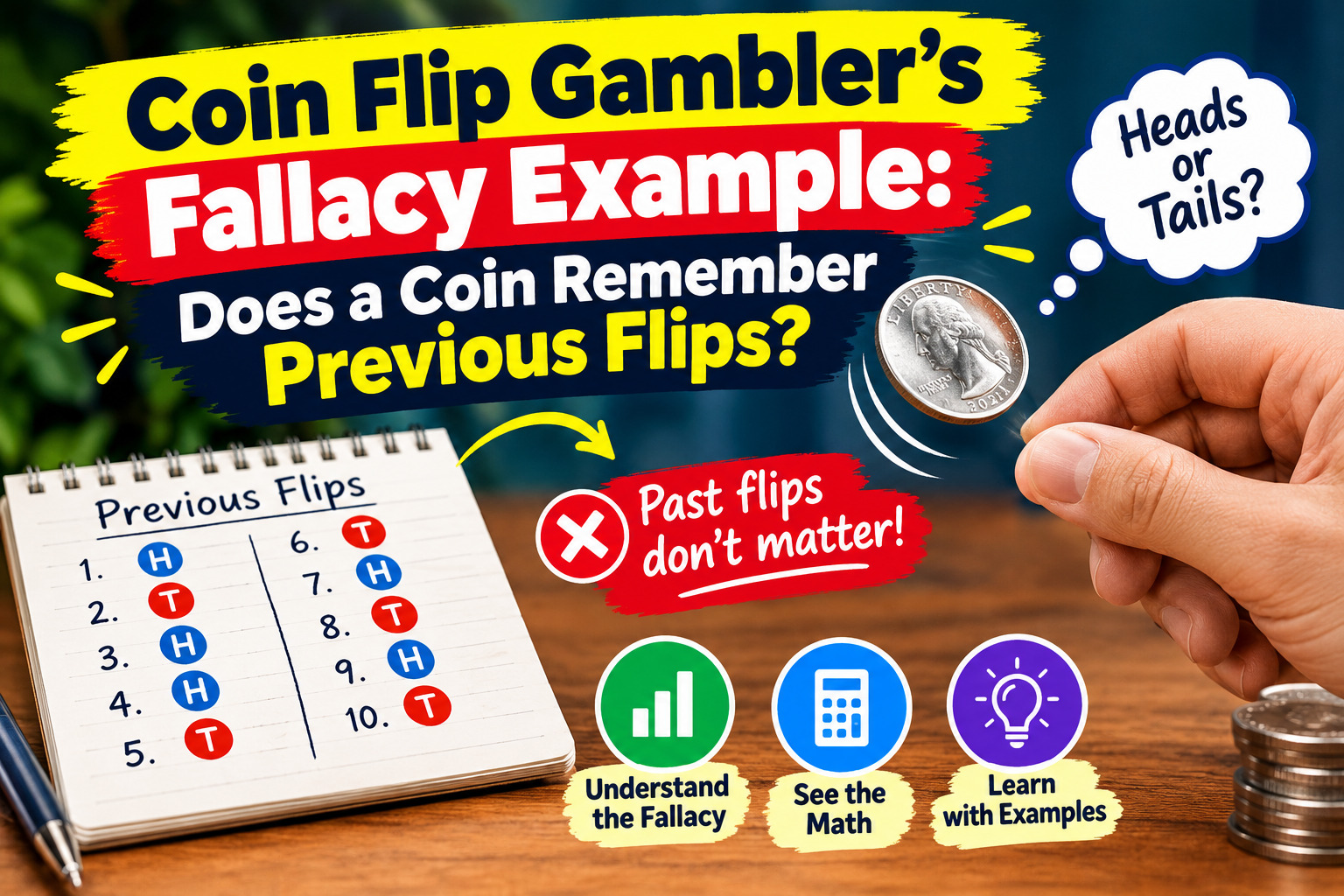
Coin Flip Gambler’s Fallacy Example: Does a Coin Remember Previous Flips?.No, a coin doesn’t remember anything. After five heads in a row, the next flip is still 50/50. Tails is not “due.” The belief that it is has a name, the gambler’s fallacy, and it’s one of the most common mistakes people make with probability.
You’re flipping a coin to settle something small. Heads. Heads again. Heads a third time, then a fourth, then a fifth. Somewhere around flip four, a little voice starts saying tails has to come next.
I’ve heard that voice every time I’ve run a long streak on the online coin flip tool. Everyone hears it. It feels like logic, but it’s not.
Let’s break down why it fails, using simple coin toss examples anyone can follow.
What is the gambler’s fallacy?
The gambler’s fallacy is the mistaken belief that past random events change the odds of future ones. If a coin lands heads several times, people assume tails becomes more likely to “balance things out.”
Psychologists sometimes call it the Monte Carlo fallacy. The coin flip is the cleanest example because a fair coin has only two outcomes, each with a 50% chance, and nothing about the last flip changes that. If you want the textbook version, the gambler’s fallacy entry on Wikipedia covers the formal definition and history.
Does a coin flip remember previous flips?
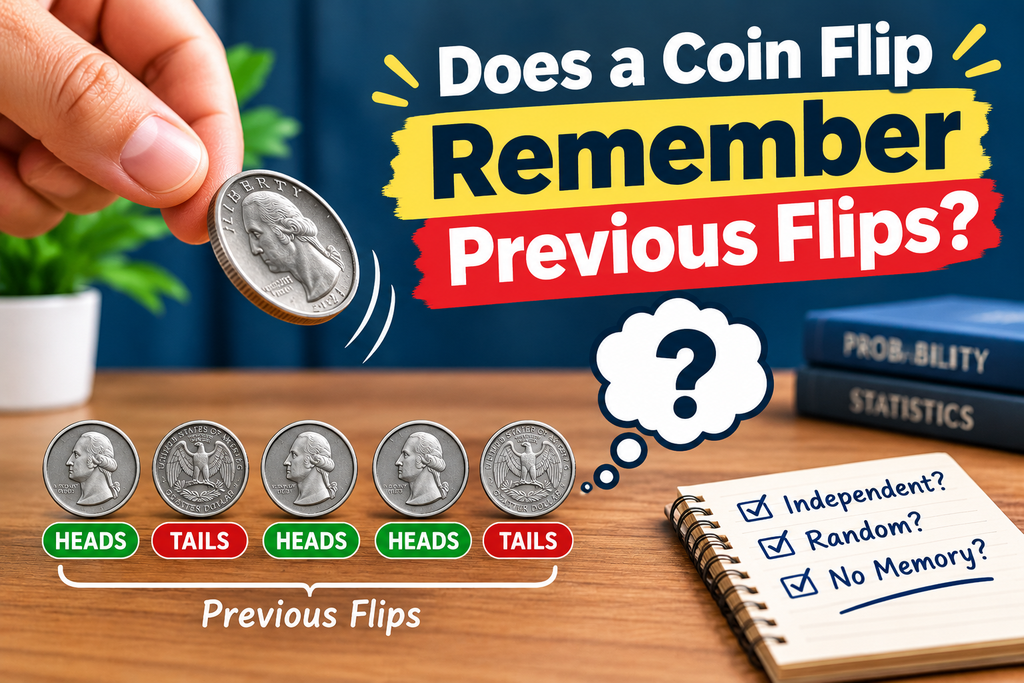
Short answer: no. A coin has no memory, no sense of fairness, and no mechanism for keeping score.
Each toss is what mathematicians call an independent event. The result of one flip has zero influence on the next. The coin that just landed heads five times is physically the same coin as before, flipped by the same kind of motion, with the same two sides.
Think about what it would take for a coin to “remember.” It would need to store information, compare its record to 50%, and then adjust its landing to correct the imbalance. A piece of metal can’t do any of that.
So when someone asks “does a coin flip have memory after streaks?”, the answer is the same however long the streak is. Five heads, ten heads, twenty heads: the next flip is still 50/50 for a fair coin.
If you want to dig into the odds themselves, our guide to coin flip probability walks through the basics.
Coin flip after 5 heads: what’s the probability?
The probability of tails on the next flip after five heads is exactly 50%, the same as it was on the very first flip.
What confuses people is mixing up two different questions:
- What’s the chance of getting five heads in a row before you start flipping?
- What’s the chance of heads on the next flip after you already have five heads?
The first is small. The second is just 50%. The five heads are already in the past, so they’re no longer a risk. They’re just history.
Here’s how the odds of a specific streak shrink:
| Heads in a row | Chance of that exact streak | Chance of heads on the next flip |
| 1 | 50% (1 in 2) | 50% |
| 2 | 25% (1 in 4) | 50% |
| 3 | 12.5% (1 in 8) | 50% |
| 5 | 3.125% (1 in 32) | 50% |
| 7 | 0.78% (1 in 128) | 50% |
| 10 | 0.098% (1 in 1,024) | 50% |
Look at the right-hand column. It never moves. A long streak is rare to start with, but once it exists, it tells you nothing about the next toss. If you’d like to explore these numbers further, try the coin flip odds page.
A simple gambler’s fallacy example with a coin toss
Say you and a friend are playing a game. You flip a fair coin, and your friend bets on tails every time.
Your friend loses the first five rounds because heads keeps showing up. Now they’re confident. “Tails is due. I’m putting double on it.”
Here’s what actually happens on round six. The coin lands heads half the time and tails half the time, just like it always has. Your friend’s doubled bet has the same 50% chance of winning as the first one. They’ve simply raised the stakes on a coin that doesn’t care.
That is a textbook gambler’s fallacy example. It’s also a good one to show beginners, because you can test it yourself in a couple of minutes. Flip 20 times and write down what happens right after any streak of three or more. You’ll find that tails doesn’t show up any more often after heads streaks than it does anywhere else. Go ahead and try it with the heads or tails flipper.
Heads streak vs. tails streak: is there any difference?
For a fair coin, there’s no difference at all. A streak of heads and a streak of tails are equally likely, and the logic behind them is identical.
If you see five tails in a row, the next flip is 50/50. Heads isn’t due. Tails isn’t “hot.” The fallacy works the same way in both directions, so whether you’re reading about a heads streak or a tails streak, the same rule applies.
One small real-world note: no physical coin is perfectly fair. A well-known study by Persi Diaconis and colleagues at Stanford found that a flipped coin lands on the same side it started on about 51% of the time, because of how it wobbles in the air. You can read their paper, Dynamical Bias in the Coin Toss. That bias is tiny, and it has nothing to do with previous flips. It certainly doesn’t make a streak more likely to “correct itself.”
Why do people predict tails after many heads?
Because our brains expect small samples to look like the big picture. Psychologists call this the representativeness heuristic, and Daniel Kahneman and Amos Tversky wrote about it back in the 1970s.
We know that, over thousands of flips, heads and tails come out roughly even. So when we see a streak, it feels “unbalanced,” and we expect the next flip to fix it. But a short run of flips isn’t required to look balanced. Kahneman and Tversky joked about this and called it a belief in “the law of small numbers.”
The real rule is the law of large numbers, which says the average settles toward 50% as the number of flips grows. It does this by dilution, not by correction. If you get 10 heads in a row and then flip another 1,000 times at 50/50, those first 10 heads barely register in the final percentage. Nothing “evened out.” The early streak just got buried. You can read more on the law of large numbers if you want the math.
Another reason is plain emotion. A streak feels dramatic, and drama makes us want a story. “It has to change soon” is a more satisfying story than “it’s just random.”
Gambler’s fallacy vs. the hot hand fallacy
These two are mirror images, and people often mix them up.
- Gambler’s fallacy: “Heads came up a lot, so tails is due.”
- Hot hand fallacy: “Heads came up a lot, so heads will keep coming.”
Both treat random flips as if they’re connected. The hot hand idea comes from basketball, where fans believe a player who has scored several times in a row is more likely to score again. Researchers have argued about whether that’s a real effect in sports for decades. For a coin, though, it’s simple. Neither belief applies, because each flip is independent.
If you’re curious about regression to the mean, which is related but different, this overview explains why extreme results are often followed by more average ones without any “correction” being involved.
Real-world examples of the gambler’s fallacy
Monte Carlo, 1913. The most famous story comes from a roulette table at the Monte Carlo Casino. The ball landed on black 26 times in a row. As the streak went on, gamblers piled onto red, certain it had to come next. They lost millions of francs. Every spin was independent, and red was never “due.”
Lottery numbers. Some people avoid numbers that won last week, thinking they can’t come up again. Others pick numbers that haven’t hit in a long time, believing they’re overdue. In a fair lottery, every draw starts fresh.
Even professionals fall for it. A study from economists Daniel Chen, Tobias Moskowitz, and Kelly Shue found signs of the gambler’s fallacy in the decisions of asylum judges, loan officers, and baseball umpires, who were slightly less likely to make the same decision twice in a row. You can find the paper, Decision Making Under the Gambler’s Fallacy, on the NBER site. If trained professionals slip, it’s no surprise that the rest of us do.
Try it yourself: a 20-flip experiment

You don’t have to take my word for it. Here’s a quick test.
- Open the free coin flip tool and flip 20 times. Write down each result.
- Mark every spot where you see three or more of the same side in a row.
- Look at the very next flip after each streak.
- Count how many times it matched the streak and how many times it switched.
Over a small number of flips, your numbers will bounce around. That’s normal. Run it again with 100 flips, or use our multiple coin flip option, and you’ll see the results hover close to half and half.
One more thing worth knowing: streaks happen far more often than most people expect. In 100 fair flips, you’ll almost always see at least one run of five or more of the same side. Typically the longest streak in 100 flips lands somewhere around six or seven. When I ran my own test of 100 flips, my longest streak was [ADD YOUR OWN RESULT HERE]. If your streak looks “too long to be random,” that’s exactly what real randomness looks like. In fact, a sequence with no streaks at all would be the suspicious one.
Key takeaways
- A coin has no memory. Every flip is independent.
- After five heads, the chance of tails is still 50%.
- A long streak is rare in advance, but it says nothing about the next flip.
- The law of large numbers works by dilution, not by “correcting” past results.
- Heads streaks and tails streaks follow the same rule.
- Streaks are a normal part of random sequences, so don’t read meaning into them.
- The bottom line
- The next time you watch heads pile up and feel that pull toward tails, remember that the coin can’t feel it. Every flip is a fresh start, and streaks are just what randomness looks like up close.
- If you’d like to make fair decisions the easy way, use our free coin flip tool, or read more in our guides on fair decision making, how random a coin flip really is, and coin flip vs. dice roll.
- This article is for educational purposes only and isn’t gambling advice.
Does a coin flip remember previous flips?
No. A coin has no memory, so each flip is independent of every flip before it. The odds on a fair coin stay at 50% for heads and 50% for tails, no matter what happened earlier.
What is the probability of tails after 5 heads?
It’s 50%. The chance of getting five heads in a row is 1 in 32, but that’s a calculation made before the flips. Once you have the five heads, the next flip is a brand new 50/50 event.
What is a simple gambler’s fallacy example with a coin toss?
You flip heads six times in a row and then bet heavily on tails, thinking it’s “due.” The coin doesn’t know about the earlier flips, so tails still has only a 50% chance. That’s the fallacy in action.
Is tails more likely after a heads streak?
No. Tails is exactly as likely as it was before. Believing tails becomes more likely after heads is the gambler’s fallacy. Believing heads will keep coming is the hot hand fallacy. Neither works on a fair coin.
Why do people predict tails after many heads?
Because people expect short runs of flips to look balanced. This habit is called the representativeness heuristic. A streak feels “off,” so the mind assumes the coin must swing back. But randomness doesn’t make up for earlier results.
Does a coin flip have memory after long streaks?
No, even after very long ones. Whether it’s 5, 10, or 20 in a row, the next flip stays at 50/50. A long streak is unlikely to happen, but once it has, it doesn’t change the next toss.
Is a real coin perfectly 50/50?
Almost, but not exactly. Research from Stanford suggests a coin lands on its starting side about 51% of the time. That tiny bias comes from the physics of the toss, not from past flips, and it doesn’t create the “due” effect people expect.
Do streaks mean a coin is rigged or unfair?
Usually not. Streaks are normal in random sequences. A few heads in a row, even five or six, doesn’t prove anything. You’d need hundreds or thousands of flips with a clearly lopsided result to start doubting a coin. Want to see the pattern for yourself? Try our coin flip simulator.

Related Articles

Coin Flip GIF: 5 Free Ways to Get Animations, Sounds and Images
The safest way to get a coin flip gif is to use a free online flipper or a CC0 / public-domain animation, then save it as…

Flip a Coin 100 Times: Ultimate 2026 Guide + Free Simulator
Flip a coin 100 times and you’ll usually see about 50 heads and 50 tails, but anything from roughly 40 to 60 heads is normal. You…

Heads and Tails Coin Flip: The Ultimate 2026 Guide
A heads and tails coin flip is the quickest fair way to settle a decision between two options. You toss a coin, one side lands up,…
Need a Quick Decision?
Flip a coin and let chance decide — instantly, honestly, and for free.
Flip a Coin