
50/50 Coin Flip: Is It Really Fair? The Real Probability Explained
 Updated November 11, 2026
10 min read

In this article
- What Does a 50/50 Coin Flip Mean?
- Is a Coin Toss Always a 50/50 Coin Flip?
- Can a Coin Flip Be Anything Other Than 50/50?
- Why Isn’t Every 50/50 Coin Flip Exactly Even?
- Do Physical Coins Really Give a 50/50 Coin Flip?
- Is an Online 50/50 Coin Flip Really Random?
- Does the Previous Flip Affect the Next 50/50 Coin Flip?
- What Are the Odds of Five Heads in a Row in a 50/50 Coin Flip?
- How Many Flips Does It Take to Match a 50/50 Coin Flip?
A 50/50 coin flip is the classic way to settle a decision, and we all learned that the odds are exactly even. That is true for an ideal coin. In real life, the honest answer is “almost, but not quite.” Whether a coin flip is always 50/50 depends on what you mean: a perfect coin on paper, an actual coin in your hand, or a flip on a screen.
Quick answer: Yes, for an ideal fair coin, heads and tails each have a 50 percent chance. Real coins come very close, with tiny physical biases. Online flips use random algorithms that work very well for everyday use.
This guide explains where the 50/50 coin flip rule comes from, whether it is ever wrong, whether a coin remembers its last result, and what happens after five heads in a row. You can try things as you read with any online coin flip tool.
What Does a 50/50 Coin Flip Mean?
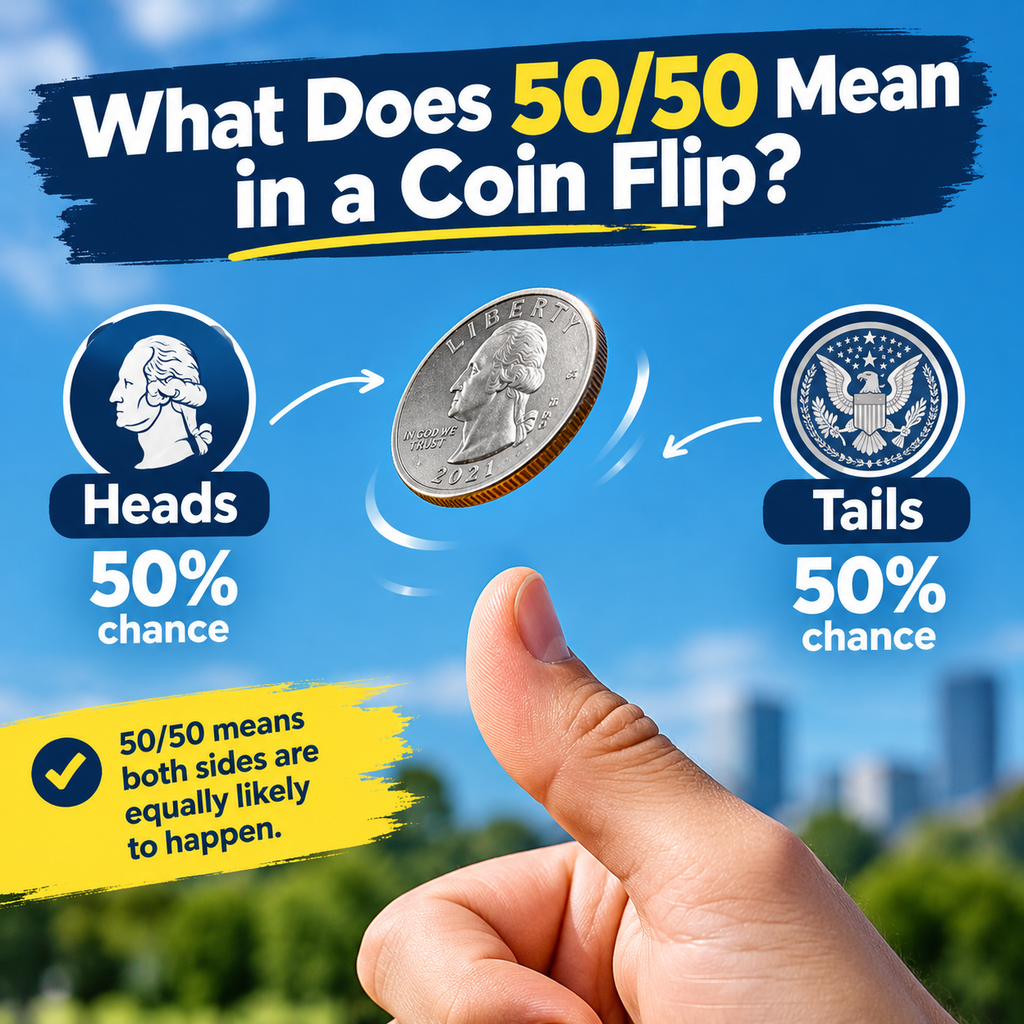
A 50/50 coin flip means heads and tails have an equal chance of landing face up: 50 percent each. It is a statement about the probabilities before the flip, not a guarantee about the next few results.
The key is the difference between expectation and reality. You expect five heads in 10 flips. But six heads and four tails, or even three heads and seven tails, can easily come from a perfectly fair coin. Think of a 50/50 coin flip as a tendency over time, not a plan.
If you want the basic math behind the number, our heads or tails 50/50 explained guide covers it step by step.
Is a Coin Toss Always a 50/50 Coin Flip?
Not always. A perfect fair coin is exactly 50/50, a genuine coin is very close, and an online flip is 50/50 by design. The problem is the word “always,” because real objects are never perfectly symmetrical.
| Type of flip | How close to 50/50? |
| Ideal fair coin (math model) | Exactly 50/50 |
| Real physical coin | Very close, with small biases |
| Online coin flip | 50/50 by design, with constraints detailed below |
So is a fair coin always 50/50? Yes, that is what “fair” means. The catch is that “fair” is an assumption we make about the coin, and a real coin has to live up to it.
Can a Coin Flip Be Anything Other Than 50/50?
Yes. A coin flip is not a true 50/50 coin flip when the coin is weighted, damaged, spun instead of flipped, or controlled by a skilled person or machine. Normal coins flipped normally are very near to fair, but the exceptions are real.
Here are the main ways it happens:
- Biased or weighted coins. A trick coin that lands heads 60 percent of the time and tails 40 percent has a heads probability of 0.6, not 0.5.
- Damage and wear. A bent or uneven coin may favor one side.
- Spinning instead of flipping. A coin spun on its edge can give very lopsided results, because small differences in the rim and weight matter more when it spins slowly.
- A skilled flipper or a machine. A person can learn to control how many times a coin rotates, and scientists have built machines that flip a coin the same way every time.
This is the difference between a fair coin and a loaded coin. A loaded coin has unequal probabilities, and the standard 50/50 shortcuts no longer apply.
Why Isn’t Every 50/50 Coin Flip Exactly Even?
A real toss involves physics, and physics is never flawless. Small changes in weight, toss, and landing create tiny leanings. A short run of flips adds randomness on top.
| Factor | Effect on the result |
| Uneven weight | May lean slightly toward one side |
| Coin design | Raised edges and deep patterns change how it turns |
| Flipping method | A flat wobble behaves differently from a crisp end-over-end spin |
| Landing surface | A hard table and a soft cloth change the bounce |
| Starting position | A small same-side tendency can develop |
| Number of flips | The more flips, the closer you get to 50% |
This also answers a common question: why do coin flips sometimes give more heads than tails? Mostly, pure luck. In 100 fair flips, heads beats tails about 46 percent of the time, tails beats heads about 46 percent of the time, and a perfect tie happens only about 8 percent of the time.
Do Physical Coins Really Give a 50/50 Coin Flip?
Almost, yes. Experiments with hand-flipped coins found a small bias of roughly 51% for a coin to land on the side it started on. A large 2023 trial with hundreds of thousands of flips showed a similar tiny effect. For everyday decisions, that difference is too small to matter.
Nobody has found a real coin that is wildly off. Famous long trials, such as one reportedly carried out in the 1940s with 10,000 flips, came out extremely close to half heads. The tiny same-side tendency only matters in careful scientific measurement, not when you are deciding who pays for lunch.
So how reliable is a 50/50 coin flip? Reliable enough that sports, games, and classrooms use it every day. To learn more of the math, Wolfram MathWorld has a page on coin tossing, and Khan Academy offers free lessons on probability basics.
Is an Online 50/50 Coin Flip Really Random?
Yes, for everyday use. Online coin flips, including a virtual coin flip, use software-generated random numbers that give equal odds of heads or tails. None of the physical quirks of a coin apply, because physics is not involved at all.
Here is how it works. A random number generator outputs a number, say 0 or 1. The program calls 0 heads and 1 tails, then shows the result with an animation. Each result is independent of the others.
There is one caveat. Most tools use pseudo-random generators, which rely on a mathematical formula designed to produce results that look random. True random numbers come from physical sources, such as electrical noise. For games, lessons, and quick decisions the difference does not matter. For uses like encryption, special random sources are needed. If you want the technical side, the National Institute of Standards and Technology publishes research on random number generation.
When you don’t have a coin, a free tool like Flip-a-Coin works well. Teachers and students who want many flips quickly can use a random coin flip generator.
Does the Previous Flip Affect the Next 50/50 Coin Flip?
No. Flips are independent, so one flip does not affect the next. A coin has no memory. It is just metal, with no way of knowing what it did before.
So why does it feel like it remembers? Because our brains look for patterns. After four heads in a row, you think tails is “due.” That feeling has a name: the gambler’s fallacy. It shows up at the casino table and the board game in your living room. Randomness does not even itself out on a schedule.
Is Each Coin Flip Independent of the Last?
Yes, with a fair coin. Independent events are events where one outcome does not change the probability of another.
An example makes it concrete. HHHHH does not make the sixth flip more likely to be tails, and TTTTT does not guarantee heads. You can multiply probabilities across flips (1/2 × 1/2 × 1/2 and so on) precisely because each flip stands alone. Wikipedia’s page on probability theory covers the basics, and our coin flip probability guide goes deeper with examples.
What Are the Odds of Five Heads in a Row in a 50/50 Coin Flip?
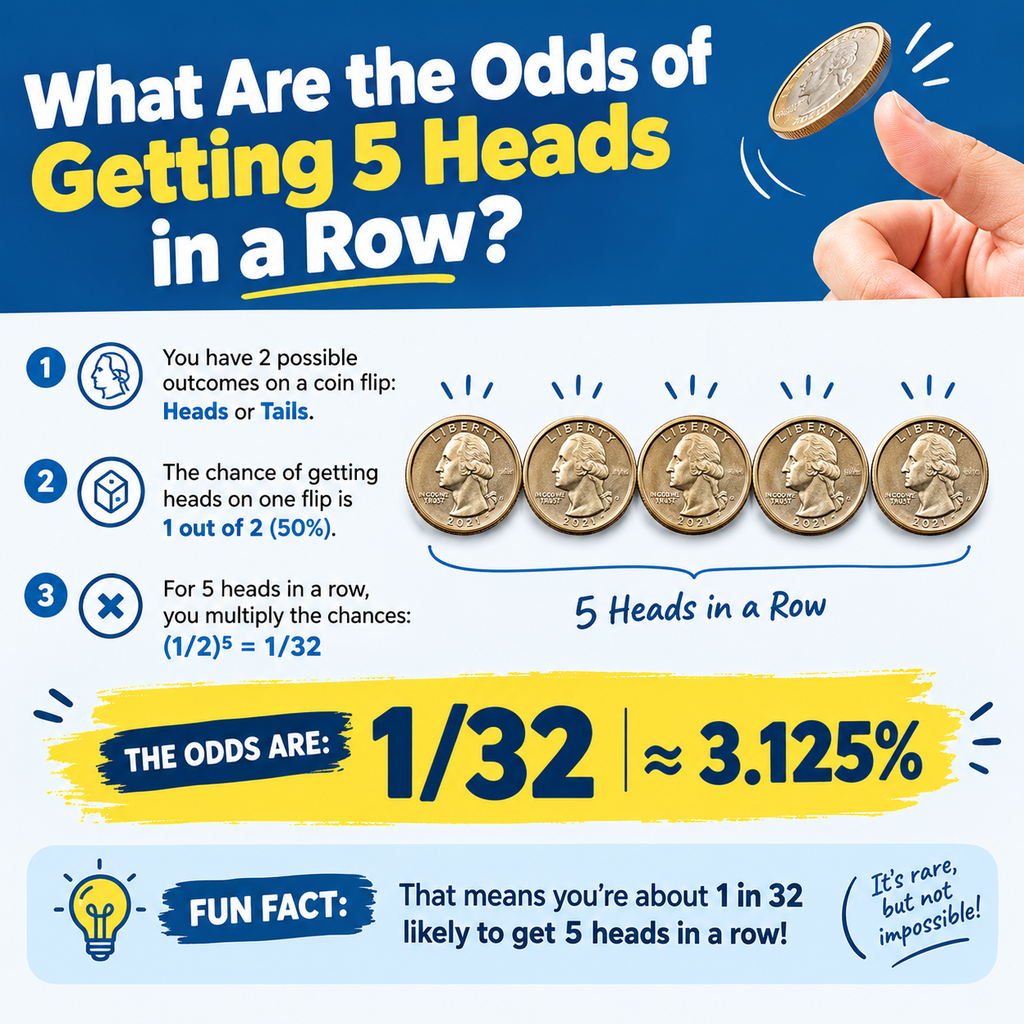
After five heads, the next flip is still 50% heads and 50% tails. The coin does not owe you a tails. A run does not change the odds.
The confusion comes from two different questions. The odds of flipping five heads in a row are 1/32 (3.125%). That number describes the whole sequence, before you begin. Once you already have five heads, only one flip remains, and its chance of heads is simply 1/2.
Streaks are normal in random sequences. If you toss a coin 100 times, you will see a streak of five or more heads somewhere in the sequence almost 80% of the time. A probability calculator can help you check the math for other cases. One caveat: a truly extreme run, like 20 heads in a row, would be a good reason to suspect the coin is not fair.
How Many Flips Does It Take to Match a 50/50 Coin Flip?
There is no exact number, because the counts are never required to match. What does happen is described by the law of large numbers: the more you flip, the closer the fraction of heads gets to 50%, even though the raw count can wander.
| Number of flips | Typical deviation from 50% (about 95% of the time) |
| 10 | up to about 30 percentage points |
| 100 | about 10 points |
| 1,000 | about 3 points |
| 10,000 | about 1 point |
Does flipping a coin 100 times give exactly 50 heads? Usually not. You get exactly 50 heads about 8% of the time, but between 40 and 60 heads about 96% of the time.
Here is an experiment you can try. Flip a coin 10 times and count the heads. Then flip it 100 times and check the percentage. The longer run will almost always land near 50%. A coin flip simulator makes this quick.
Conclusion: Is a 50/50 Coin Flip Always Even?
So is a 50/50 coin flip always 50/50? For a flawless coin, yes. For a real coin, very close, with tiny physical leanings that rarely matter. An online 50/50 coin flip is even by design, within the normal limits of pseudo-random software. Each flip is independent of the last, whatever the coin. Even after five heads in a row, the next flip is still 50% heads.
Is a coin toss really a 50/50 coin flip?
Yes, for a fair coin, the probability of heads and tails is 1/2. A real coin’s starting side, weight, and design can shift the chances by about a percentage point. In ordinary decisions the differences are too small to matter, so a coin flip is treated as 50/50.
Can a coin flip be anything other than 50/50?
Yes. A weighted, damaged, or specially made coin can favor one side, giving results like 60% heads and 40% tails. Spinning a coin on its edge instead of flipping it can also skew outcomes, and a skilled flipper or machine can influence the landing. A fair coin flipped fairly is very close to even.
Are real coin flips really 50/50?
Close. Studies of hand-flipped coins found a slight tendency, about 51%, for a coin to land on the side it started on, and a large 2023 experiment reported a similar tiny effect. Over thousands of real flips the results come out very near half and half, so real coins are fair enough for regular use.
Are online coin flips really 50/50?
Yes, for day-to-day use. Online tools use a random number method that picks heads or tails with equal probability, and each outcome is independent of the last. Most are pseudo-random: they follow a formula, but the output is statistically unpredictable. That is plenty for games, classrooms, and quick decisions, but not for security work.
Does the previous flip affect the next flip?
No. Each flip is an independent event, and earlier results do not change the odds of the next one. No matter how many heads or tails you have seen in a row, the next flip is still 50% heads and 50% tails. Believing otherwise is the gambler’s fallacy, one of the most common errors in probability.
Does a coin remember?
Not at all. A coin does not remember what happened before, so each flip is a fresh, independent event with the same odds. People are often surprised because our brains hunt for patterns in random sequences. A streak seems meaningful, but it is a normal part of randomness.
After five heads in a row, is the next toss still 50/50?
Yes. The odds of getting five heads in a row are 1/32, or 3.125%, but that describes the full sequence before it starts. With five heads already showing, one toss remains, and the chance of heads is still 1/2. The coin does not owe you a tails.

Related Articles

Is Heads or Tails More Likely? 7 Proven Facts
Is heads or tails more likely? No. On a fair coin, heads and tails each have a 50% chance, so neither wins more over time. The…
Is Heads or Tails Good Luck? 7 Surprising Truths
Is heads or tails good luck? No. On a fair coin, heads and tails each land about 50% of the time, so neither side is luckier,…

Flip a Coin 10 Times: What to Expect from 10, 20, 30 and 50 Flips
If you flip a coin 10 times, you’ll most often land on about 5 heads, but anything from 3 to 7 heads is completely normal. That…
Need a Quick Decision?
Flip a coin and let chance decide — instantly, honestly, and for free.
Flip a Coin