
Outcomes in 2 Coin Flips: The Full List and Why It’s 4
 Updated November 11, 2026
10 min read
In this article
- Key Takeaways About the Outcomes in 2 Coin Flips
- Outcomes in 2 Coin Flips: How Many Are There?
- List All Outcomes in 2 Coin Flips
- Tree Diagram for the Outcomes in 2 Coin Flips
- How Many Combinations Are There in 2 Coin Flips?
- Probability Table for the Outcomes in 2 Coin Flips
- Outcomes in 2 Coin Flips When Two Coins Are Flipped at Once
- Outcomes in 2 Coin Flips Explained for Students
- Real-Life Examples of the Outcomes in 2 Coin Flips
- From 2 Flips to More: How Outcomes Grow
- Test the Outcomes in 2 Coin Flips Yourself
- Common Mistakes With the Outcomes in 2 Coin Flips
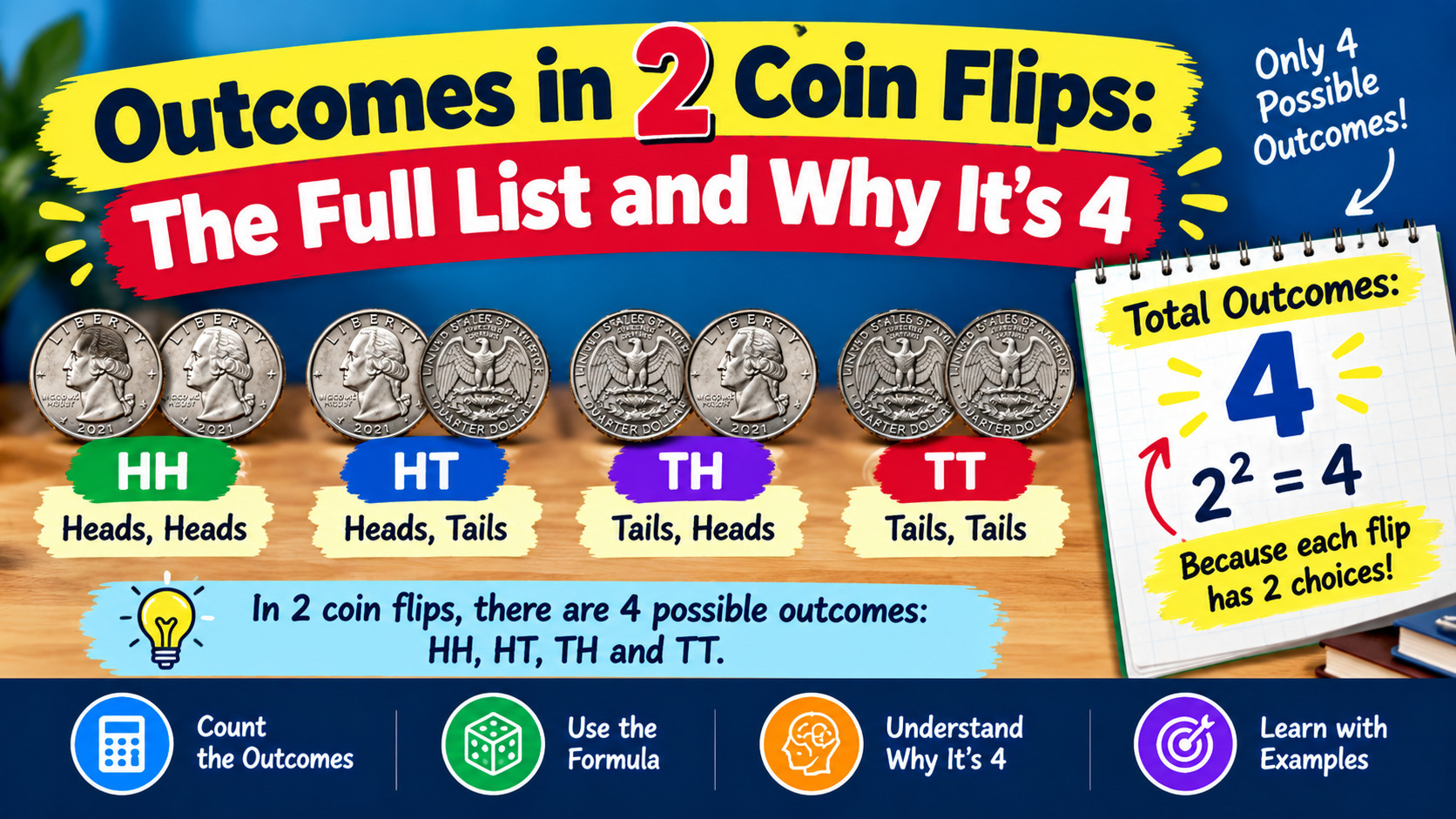
Outcomes in 2 Coin Flips..Quick answer: The outcomes in 2 coin flips of a fair coin are HH, HT, TH and TT. That’s 4 equally likely results, each with a 25% chance. If you flip two coins once each, you get the same four outcomes.
Key Takeaways About the Outcomes in 2 Coin Flips
- Two flips give 2 × 2 = 4 outcomes.
- The four outcomes are HH, HT, TH, TT.
- Exactly one head can happen two ways, so it’s 50% likely.
- Some people count 3 results, but those 3 aren’t equally likely.
- Every extra flip doubles the number of outcomes.
Outcomes in 2 Coin Flips: How Many Are There?
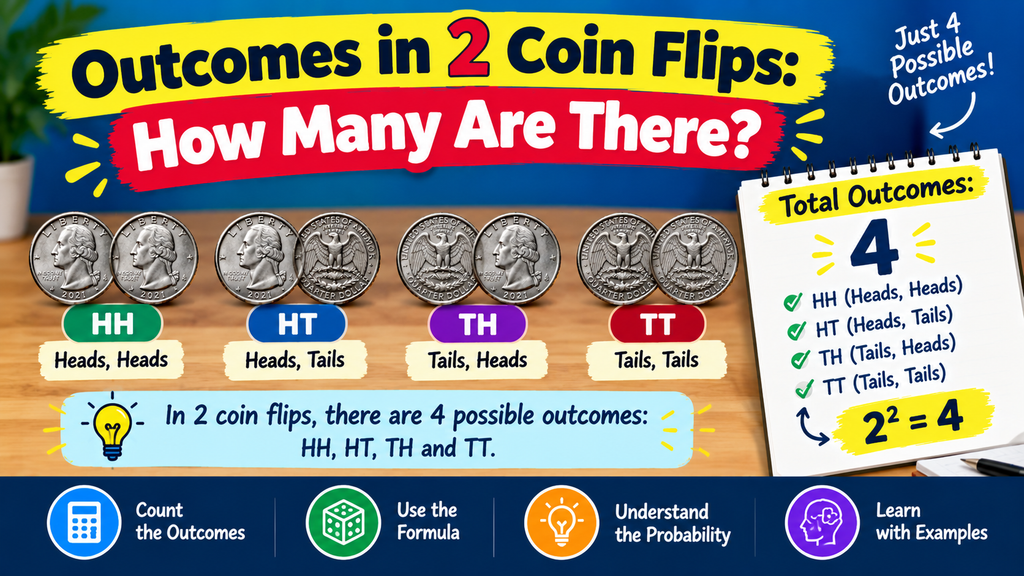
There are 4 possible outcomes when you flip a coin two times. The first flip can land two ways, and so can the second, so you multiply: 2 × 2 = 4.
Teachers call the full list of results the sample space. For two flips it’s {HH, HT, TH, TT}. If you want the formal definition, the Wikipedia page on sample space lays it out. For homework purposes, think of it as a checklist of everything that could possibly happen.
Because a fair coin has no favorite side, all four outcomes in 2 coin flips are equally likely. That’s what makes the counting so useful. You can find any probability by counting the outcomes you want and dividing by 4.
If you have a coin in your pocket, great. If not, you can flip a coin online and follow along.
List All Outcomes in 2 Coin Flips
Here they are, in order, with H for heads and T for tails:
- HH: heads on the first flip, heads on the second.
- HT: heads first, then tails.
- TH: tails first, then heads.
- TT: tails on both.
Notice that HT and TH are separate. The order matters because the flips happen one after the other. This is the part that trips people up, and I’ll come back to it in a moment.
Tree Diagram for the Outcomes in 2 Coin Flips
A tree diagram is the easiest way to see why there are four outcomes. Start with one dot. Draw two branches from it, H and T, for the first flip. From the end of each branch, draw two more branches for the second flip.
Here’s a plain text version:
Start
├── H ── H → HH
│ └── T → HT
└── T ── H → TH
└── T → TT
Count the endings at the right. Four. Each path from the start to an ending is one outcome. If you’re putting this on a webpage or worksheet, a clean image of this tree works much better than text. You can read more about the idea on the Wikipedia page for the probability tree diagram.
How Many Combinations Are There in 2 Coin Flips?
This is where the word “combinations” causes trouble, because people use it in two different ways.
- If order matters, there are 4 combinations: HH, HT, TH, TT.
- If order doesn’t matter, you only care about how many heads and tails you got. That gives 3 distinct results: two heads, one of each, or two tails.
I’ll be honest, this one tripped me up as a kid. I remember insisting there were only three outcomes, and my teacher kept saying four. We were both right about the counting, but only one of us was right about the probability. Those 3 results are not equally likely. “One head and one tail” can happen two ways (HT or TH), while two heads can happen only one way. So the chances are 25%, 50% and 25%.
For probability problems, count the four ordered outcomes in 2 coin flips. That’s the version that gives correct answers.
Probability Table for the Outcomes in 2 Coin Flips
Each of the outcomes in 2 coin flips has a probability of 1/4, or 25%. Here’s the table grouped by number of heads:
| Number of heads | Outcomes | Ways | Fraction | Percentage |
| 0 | TT | 1 | 1/4 | 25% |
| 1 | HT, TH | 2 | 2/4 | 50% |
| 2 | HH | 1 | 1/4 | 25% |
Some other useful chances from the same list:
- At least one head: 3/4, or 75% (everything except TT).
- At least one tail: 3/4, or 75%.
- Both flips match (HH or TT): 2/4, or 50%.
- The flips differ (HT or TH): 2/4, or 50%.
The expected number of heads is 1. That makes sense, since exactly one head is the single most likely result. If you want to go deeper on two-in-a-row results, see our page on the probability of 2 heads in a row.
If you’ve learned the binomial formula, the counts above are C(2,0) = 1, C(2,1) = 2 and C(2,2) = 1, which add up to 4.
Outcomes in 2 Coin Flips When Two Coins Are Flipped at Once
Flipping two coins at once gives the same outcomes in 2 coin flips as flipping one coin twice. The only requirement is that you can tell the coins apart.
Picture a penny and a nickel. Possible results:
- Penny heads, nickel heads (HH)
- Penny heads, nickel tails (HT)
- Penny tails, nickel heads (TH)
- Penny tails, nickel tails (TT)
That’s four outcomes in 2 coin flips, same as before. Kids often feel like HT and TH should be “the same thing” when both coins are in the air together. They’re not, because different coins landed differently. A good trick is to paint one coin red or put a sticker on it.
This also explains the phrase “two coins flipped once each, possible outcomes.” It’s just the same sample space with a different story around it. Each coin is independent, meaning one doesn’t affect the other. You can read more on independent events if you’re curious.
Outcomes in 2 Coin Flips Explained for Students
Here’s a method you can copy into your notebook to list the outcomes in 2 coin flips for any two-coin question:
- Write the first flip: H or T.
- Next to each one, write the second flip: H or T.
- List all combinations: HH, HT, TH, TT.
- Count the outcomes that match what the question asks.
- Divide that count by 4.
Practice question 1: What is the probability of getting exactly one head? Answer: HT and TH match, so 2 out of 4 = 1/2, or 50%.
Practice question 2: What is the probability of getting at least one tail? Answer: HT, TH and TT match, so 3 out of 4 = 75%.
If you want more practice problems, Khan Academy’s probability library has free lessons with answers. And a free coin toss is a nice way to check your answers by experiment.
Real-Life Examples of the Outcomes in 2 Coin Flips
- Who bats first. Two friends in the neighborhood agree that if both of their coins match, Ali bats first, and if they differ, Sara does. Is it fair? Yes. Matching is 50% and differing is 50%.
- A two-question true/false guess. You guess on two questions. There are 4 ways your answers can turn out: both right, first right and second wrong, first wrong and second right, both wrong. Your chance of getting both right is 25%. Your chance of getting at least one right is 75%.
- A board game move. A game says you move ahead only if you flip two heads. That’s 25%, so on average you’d move once every four turns. Not great odds, which is probably why the designers did it.
From 2 Flips to More: How Outcomes Grow
Every new flip doubles the count, so the formula is 2 raised to the number of flips.
| Number of flips | Outcomes |
| 1 | 2 |
| 2 | 4 |
| 3 | 8 |
| 4 | 16 |
| 5 | 32 |
| 10 | 1,024 |
Two flips are easy to list by hand. Five flips already have 32 outcomes, and ten have over a thousand, which is why people switch to formulas. If you’re curious how this looks at five flips, see our guide to the probability of 5 coin flips, where the same method gives 32 outcomes and a larger table. For a mathematician’s view of coin tossing, Wolfram MathWorld’s page on coin tossing goes deeper.
Test the Outcomes in 2 Coin Flips Yourself
Theory is nice, but running the experiment makes it stick. Here’s a simple way:
- Open the coin flip tool or grab a real coin.
- Flip twice and write down the result, like HT.
- Repeat for 40 rounds.
- Count how many times you got two heads, one of each, and two tails.
- Compare with the expected split: about 10, 20 and 10.
My result: [INSERT MY REAL RESULT HERE, for example “I did 40 rounds and got 9 HH, 22 mixed and 9 TT”]. Don’t be surprised if yours is a bit off. With only 40 rounds, a few extra or missing is normal. Try 200 rounds with a coin flip simulator and the numbers will drift closer to 25%, 50% and 25%. That’s the law of large numbers, and Britannica’s article on probability theory explains the idea well.
Common Mistakes With the Outcomes in 2 Coin Flips
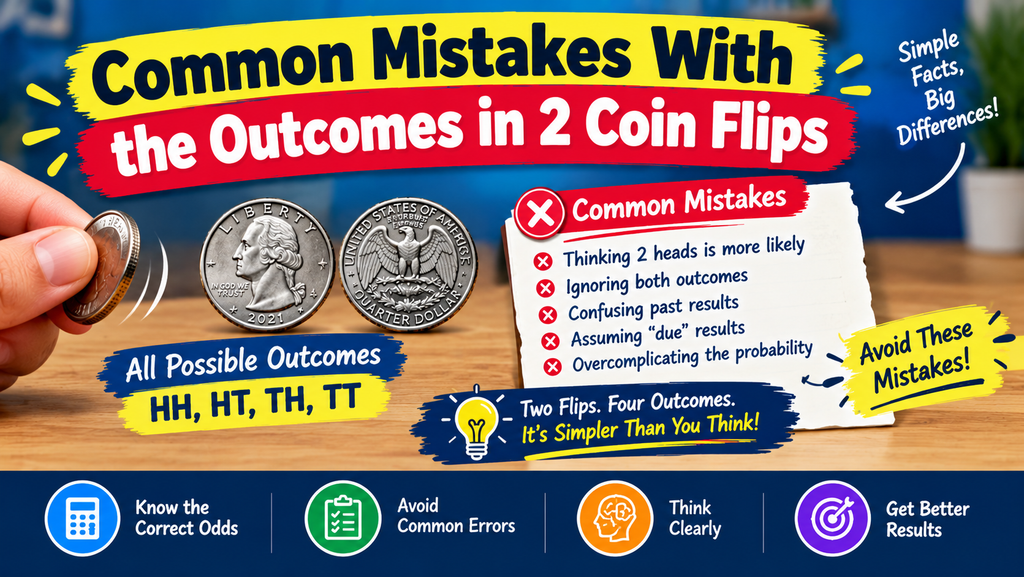
- Saying there are only 3 outcomes. The three “head counts” aren’t equally likely, so count 4.
- Treating HT and TH as the same. They’re different sequences, so they count twice.
- Thinking tails is “due” after heads. After a head, the next flip is still 50/50. The coin has no memory. This is called the gambler’s fallacy.
- Forgetting the coins must be distinguishable. With two identical coins, imagine labeling them.
- Mixing up one flip with two. One flip has 2 outcomes, two flips have 4.
If you want to see randomness misbehave on purpose, spend a few minutes with a virtual coin flip and watch how often short streaks appear.
Try It Yourself: See the Outcomes in 2 Coin Flips Play Out
Reading about four outcomes is fine, but flipping them is better. Go to flip-a-coin.us, flip twice, and keep a tally. After a few dozen rounds you’ll see that mixed results turn up about half the time, while HH and TT each turn up about a quarter of the time, just like the table says.
How many outcomes are there in 2 coin flips?
There are 4 outcomes in 2 coin flips: HH, HT, TH and TT. You get this by multiplying the two possibilities on each flip, 2 × 2 = 4. Each outcome is equally likely, with a probability of 25%.
How many combinations are there in 2 coin flips?
If order matters, there are 4 combinations. If you only count heads and tails and ignore order, there are 3 distinct results. For probability problems, use the 4 ordered outcomes, because they’re equally likely.
What are all the possible outcomes of flipping two coins?
The possible outcomes are HH, HT, TH and TT. That means two heads, heads then tails, tails then heads, or two tails. The same four apply whether you flip one coin twice or two coins once each.
What is the probability of getting two heads in 2 coin flips?
It’s 1/4, or 25%. Only one of the four outcomes, HH, gives two heads. The same probability applies to getting two tails, since a fair coin treats both sides equally.
What is the probability of getting exactly one head in 2 flips?
It’s 2/4, or 50%. Two outcomes, HT and TH, each contain exactly one head. This is the most likely result of two flips, which is why the expected number of heads is 1.
Is flipping two coins at once different from flipping one coin twice?
No. You get the same four outcomes and the same probabilities. The coins just need to be distinguishable, like a penny and a nickel, so that HT and TH count as different results.
Why do some people say there are 3 outcomes in 2 coin flips?
They’re counting head totals: zero, one or two heads. That’s three results, but they aren’t equally likely. One head happens two ways, so it’s 50%, while zero and two heads are 25% each.
How many outcomes are there in 3 coin flips?
There are 8 outcomes, because 2 × 2 × 2 = 8. In general, n flips give 2ⁿ outcomes. Four flips give 16, five give 32 and ten give 1,024.

Related Articles

How to Flip a Coin: 5 Easy, Proven Steps (Hand & Digital)
How to flip a coin: rest the coin on your curled index finger, tuck your thumb behind it, then flick upward so it spins in the…
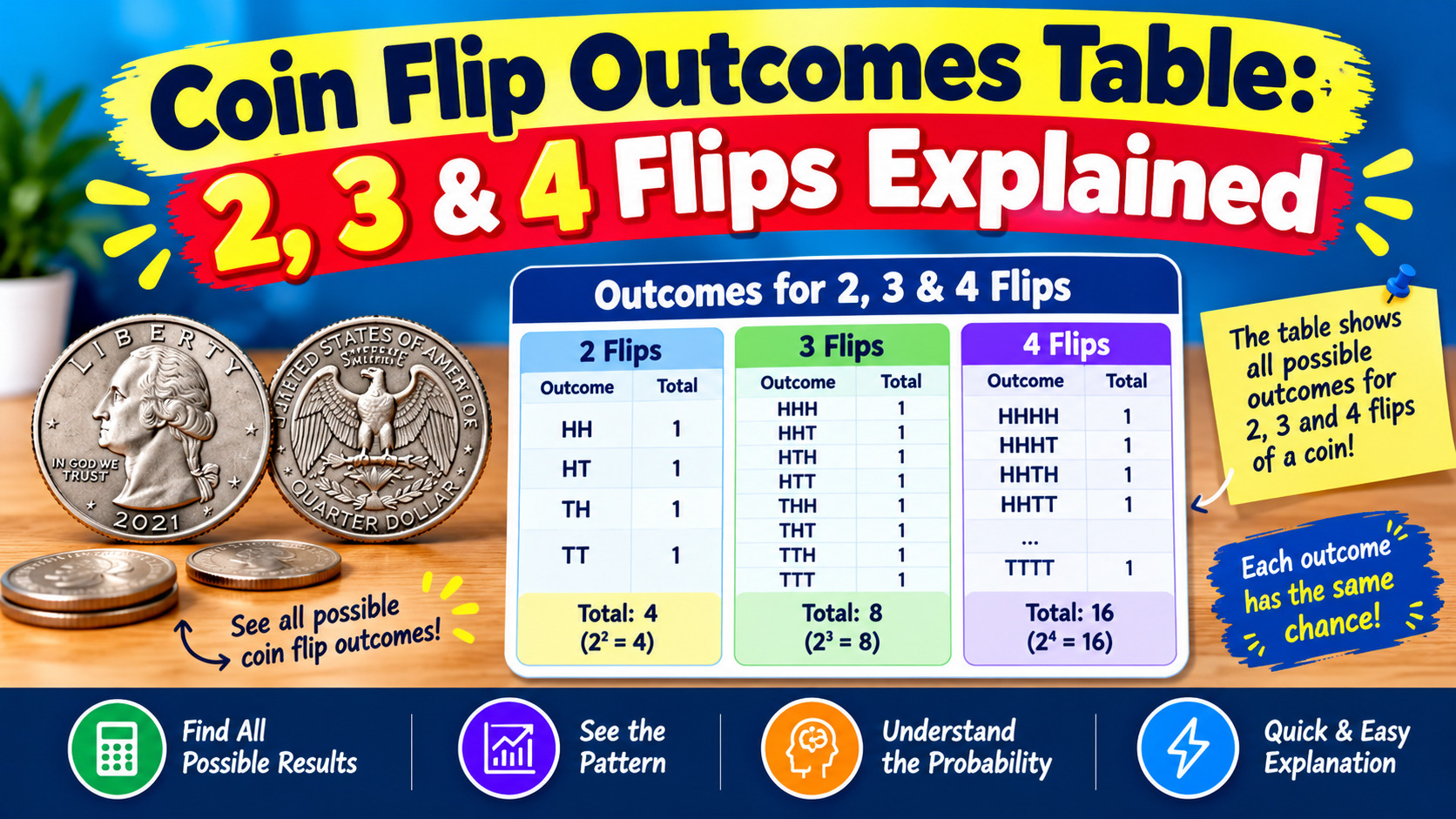
Coin Flip Outcomes Table: 2, 3 & 4 Flips Explained
Coin Flip Outcomes Table: 2, 3 & 4 Flips Explained A coin flip outcomes table lists every possible result when you flip a coin a set…
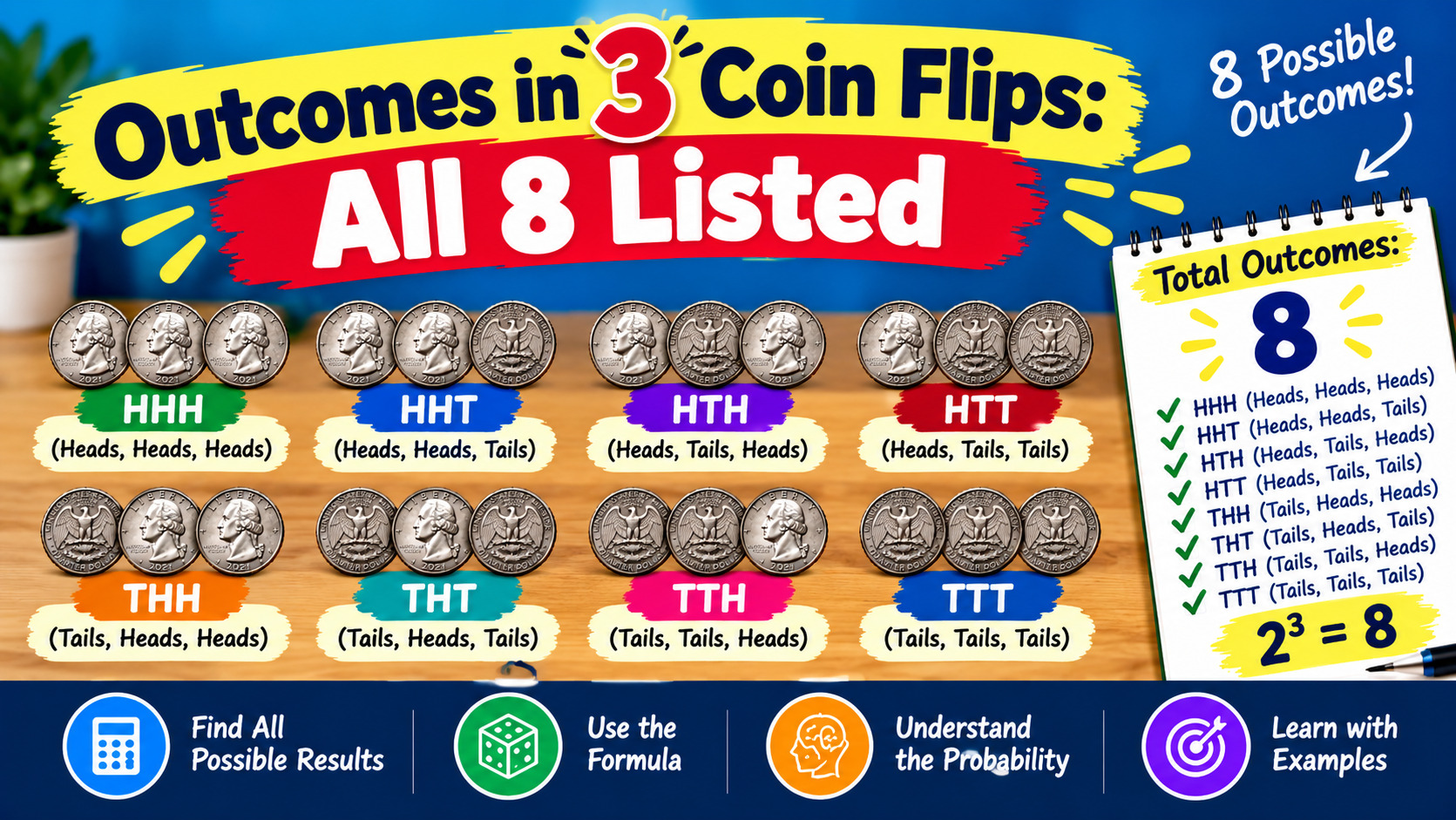
Outcomes in 3 Coin Flips: All 8 Listed
Outcomes in 3 Coin Flips.Quick answer: The outcomes in 3 coin flips of a fair coin are HHH, HHT, HTH, HTT, THH, THT, TTH and TTT.…
Need a Quick Decision?
Flip a coin and let chance decide — instantly, honestly, and for free.
Flip a Coin