
Probability of 3 Tails in a Row: Formula, Examples & Worksheet
 Updated November 11, 2026
9 min read
In this article
- What Is the Probability of 3 Tails in a Row?
- Probability of 3 Tails in a Row: Percentage and Odds
- Why the Probability of 3 Tails in a Row Is 1/8
- The Formula for the Probability of 3 Tails in a Row
- Can You Use the Binomial Formula for the Probability of 3 Tails in a Row?
- Probability of 3 Tails in a Row: A Worked Example (Fair Coin and Biased Coin)
- Do You Need a Calculator for the Probability of 3 Tails in a Row?
- What a Simulation Shows About the Probability of 3 Tails in a Row
- Probability of 3 Tails in a Row Somewhere in a Longer Run
- How the Probability of 3 Tails in a Row Compares With Other Streaks
- Does Getting 2 Tails Make a Third More Likely?
- Common Mistakes With the Probability of 3 Tails in a Row
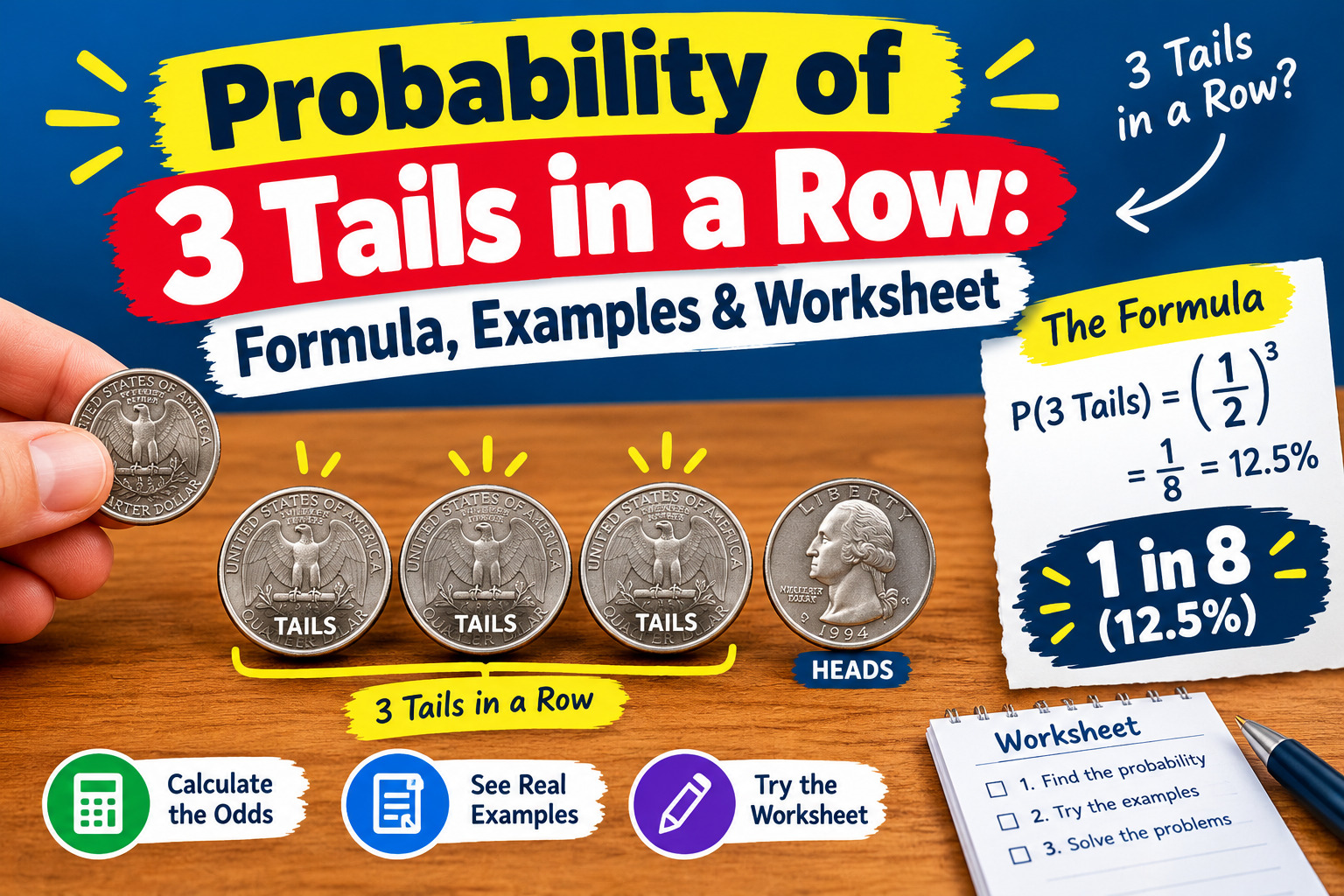
Probability of 3 Tails in a Row: Formula, Examples & Worksheet..The probability of 3 tails in a row with a fair coin is 1/8, which is 0.125 or 12.5%. Three flips have 8 equally likely outcomes, and only one of them is TTT. That makes the odds 7 to 1 against.
You’ve probably seen someone flip three tails and treat it like a miracle. It’s not. It happens about once every eight tries. This page shows where that number comes from, how to work it out yourself, and why the answer changes once you flip more than three times. You can flip a coin online as you read and see how often TTT turns up.
What Is the Probability of 3 Tails in a Row?
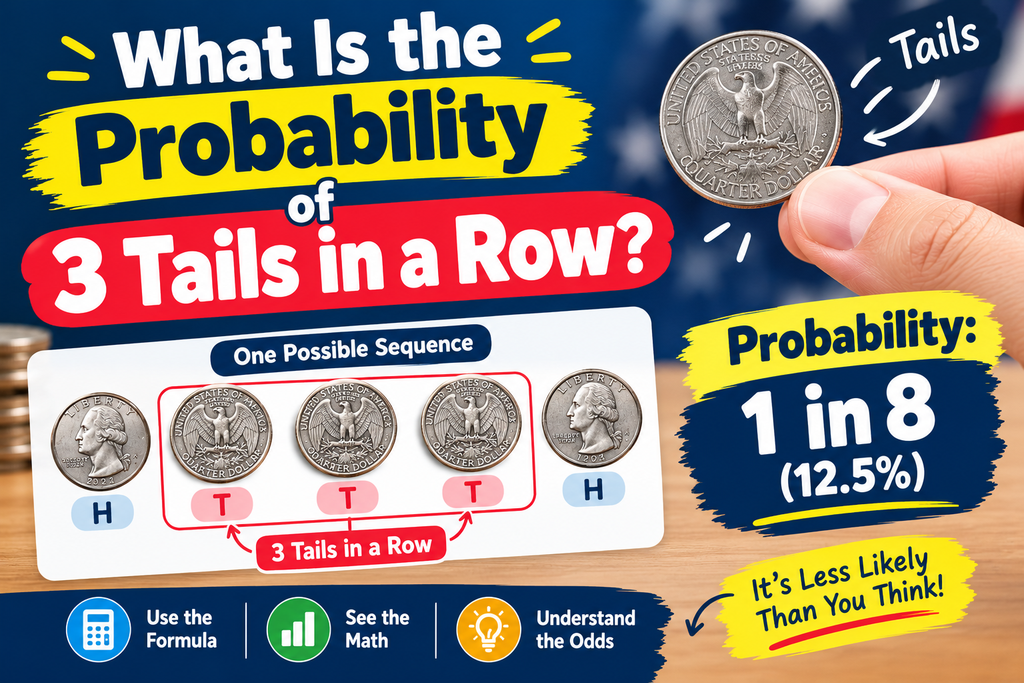
The probability of 3 tails in a row is 1/8, or 12.5%, when you flip a fair coin three times. “Fair” means heads and tails each have a 50% chance. And every flip is independent, so the coin doesn’t remember what it did last time.
Notice what this number answers. It covers the next three flips all landing tails. It does not tell you how likely TTT is to appear somewhere inside a long run of flips. That number is much bigger, and I’ll get to it below.
Probability of 3 Tails in a Row: Percentage and Odds
Probability and odds describe the same chance in two different ways. Here they are side by side:
| Fraction | Decimal | Percentage | Odds |
| 1/8 | 0.125 | 12.5% | 7 to 1 against |
If you’d be happy with three of the same face, either TTT or HHH, the chance doubles to 2/8, which is 25%.
Why the Probability of 3 Tails in a Row Is 1/8
List every possible result of three flips and you get 2 × 2 × 2 = 8 outcomes. Group them by how many tails they contain:
| Outcomes | Tails count |
| HHH | 0 |
| HHT, HTH, THH | 1 |
| HTT, THT, TTH | 2 |
| TTT | 3 |
That’s 1 + 3 + 3 + 1 = 8. TTT sits alone in the last row, so one outcome out of eight is what you want. Done.
The Formula for the Probability of 3 Tails in a Row
For independent flips, the chance of n tails in a row is (1/2)ⁿ. For three tails that’s 1/2 × 1/2 × 1/2 = 1/8.
Each extra tail cuts the chance in half. Four in a row is 1/16, and five is 1/32. If the multiplication rule feels shaky, Khan Academy’s probability lessons are free and a good refresher.
Can You Use the Binomial Formula for the Probability of 3 Tails in a Row?
Yes, but only for one specific question: exactly 3 tails in 3 flips. The formula is C(n, k) × (1/2)ᵏ × (1/2)ⁿ⁻ᵏ. Plug in n = 3 and k = 3 and you get 1 × 1/8 × 1 = 1/8, the same answer as before. The binomial distribution page covers the general version.
Here’s where people get tripped up. The binomial formula counts tails, not their positions. In 4 flips, “exactly 3 tails” includes THTT, and that has no run of three at all. So for streaks inside longer sequences, you have to count sequences instead. We’ll do that shortly.
Probability of 3 Tails in a Row: A Worked Example (Fair Coin and Biased Coin)
Fair coin. The chance of tails is 0.5. Multiply it three times: 0.5 × 0.5 × 0.5 = 0.125. As a percentage, that’s 12.5%.
Biased coin. Say tails lands 60% of the time. Then 0.6 × 0.6 × 0.6 = 0.216, or 21.6%. That’s almost double the fair-coin answer, just from a small nudge in the coin.
So the 12.5% figure only belongs to a fair coin. Change the coin and the answer changes with it.
Do You Need a Calculator for the Probability of 3 Tails in a Row?
Not really. A calculator for this just cubes the chance of tails. Type 0.5, raise it to the power of 3, multiply by 100, and you’ve got 12.5%.
Tools go by plenty of names: a tails-in-a-row calculator, a consecutive tails calculator, a coin toss probability calculator. They all do the same single multiplication. A tool saves a few button presses, but I’d work it out by hand once so the number stops feeling like magic.
What a Simulation Shows About the Probability of 3 Tails in a Row
A simulation just means flipping a lot and counting. Do 80 sets of three flips and you’d expect about 10 all-tails sets, because 80 ÷ 8 = 10. Your actual count will wander a bit around the probability of 3 tails in a row, and that wandering is what randomness looks like.
You can use a coin flip simulator to run the sets quickly, or flip a real coin and tally by hand.
My result: [Add your real result from flipping 80 sets of 3 here, for example “I got 13 TTT sets, three more than expected.”]
One honest caveat. Diaconis, Holmes and Montgomery’s paper Dynamical Bias in the Coin Toss predicted that a real coin lands on the side it started on about 51% of the time, and a large 2023 experiment found a similar effect. It’s a tiny effect, but it means a physical coin isn’t perfectly 50/50.
Probability of 3 Tails in a Row Somewhere in a Longer Run
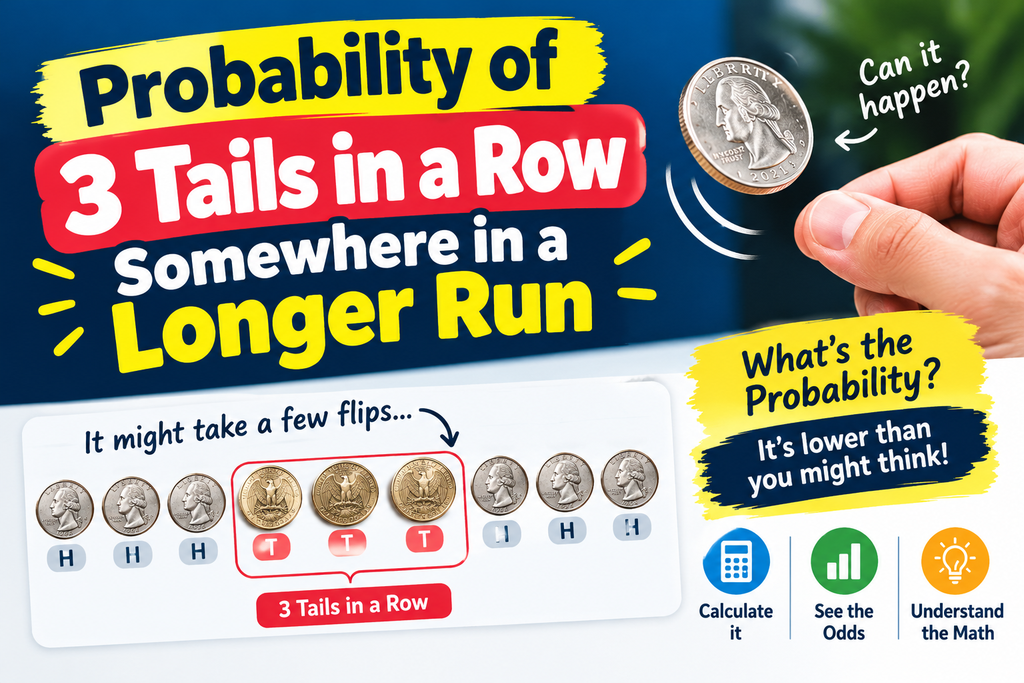
Give a streak more room and it gets far more likely. Here’s the chance of seeing at least one TTT in different numbers of flips:
| Flips | Chance of TTT somewhere | Exact count |
| 3 | 12.5% | 1/8 |
| 4 | 18.75% | 3/16 (TTTT, TTTH, HTTT) |
| 5 | 25% | 8/32 |
| 10 | about 50.8% | 520/1,024 |
| 20 | about 78.7% | 825,259/1,048,576 |
How did I get these? I counted the sequences with no TTT and subtracted them from the total. For 1 through 10 flips, the no-TTT counts go 2, 4, 7, 13, 24, 44, 81, 149, 274, 504. So for 10 flips: 1,024 − 504 = 520.
On average, you wait about 14 flips to see your first TTT. That’s an average only. Sometimes it shows up in your first three flips, and sometimes you’re still waiting at flip 30.
How the Probability of 3 Tails in a Row Compares With Other Streaks
Every extra tail halves the chance:
| Tails in a row | Probability |
| 1 | 50% |
| 2 | 25% |
| 3 | 12.5% |
| 4 | 6.25% |
| 5 | 3.125% |
| 10 | 0.0977% |
On a fair coin, heads streaks have the same numbers. If you want to keep going, check the probability of 3 heads in a row, the probability of 4 heads in a row, or 5 heads in a row and see how fast the chance drops.
Does Getting 2 Tails Make a Third More Likely?
No. After two tails, the next flip is still 50% tails and 50% heads. TTT and TTH are equally likely.
The feeling that heads is “due” is called the gambler’s fallacy. The opposite hunch, that tails is on a roll, is just as wrong. The coin has no memory, and the rule for independent events is the reason why.
Common Mistakes With the Probability of 3 Tails in a Row
Most errors come from answering a slightly different question than the one asked.
- Next three flips vs. somewhere in n flips. The probability of 3 tails in a row on the next three flips is 12.5%. Somewhere in 20 flips is about 78.7%.
- A run vs. a count. Exactly 3 tails anywhere in 4 flips is 4/16, or 25%. A run of 3 tails in 4 flips is 3/16, or 18.75%.
- Forgetting the coin might be biased. The 12.5% answer changes if tails isn’t 1/2.
- Thinking heads is due. It isn’t.
- Mixing up odds and probability. 1 in 8 is the chance. 7 to 1 against is the odds.
Practice Worksheet: Probability of 3 Tails in a Row
Try these on paper first, then check the answers. Assume a fair coin unless it says otherwise.
- What’s the probability of TTT in three flips?
- What’s the probability of either TTT or HHH in three flips?
- What’s the probability of 4 tails in a row?
- A coin lands tails 70% of the time. What’s the probability of TTT?
- If you run 80 sets of three flips, about how many TTT sets should you expect?
Answers: (1) 1/8, or 12.5%. (2) 1/4, or 25%. (3) 1/16, or 6.25%. (4) 0.7³ = 0.343, or 34.3%. (5) 80 ÷ 8 = 10.
Got all five? Then you’ve got it. For more on how streaks behave, coin flip streaks explained goes a bit deeper, and Wolfram MathWorld’s page on coin tossing is worth a look if you like the maths side.
Conclusion: The Probability of 3 Tails in a Row
The probability of 3 tails in a row is 1/8, or 12.5%, and it all comes from one idea: multiply 1/2 by itself three times. It’s unlikely on any single try but ordinary over many flips, since TTT shows up somewhere in 10 flips about half the time. When you’re ready to test it yourself, flip a coin now and count how long your first TTT takes.
How I checked these numbers: I listed all 8 outcomes of three flips by hand, counted the winner, and confirmed it with (1/2)³. For longer runs, I counted the sequences with no TTT and subtracted them from the total, then cross-checked the 4-flip case by listing TTTT, TTTH and HTTT.
What is the probability of getting 3 tails in a row?
The probability of 3 tails in a row is 1/8, or 12.5%, with a fair coin. Three flips have 8 equally likely outcomes, and only one is TTT. You can also get it by multiplying 1/2 three times: (1/2)³ = 1/8.
What are the odds of flipping 3 tails consecutively?
The odds are 7 to 1 against, which is the same as a 1 in 8 chance. One of the 8 outcomes is TTT and the other 7 aren’t. Odds compare winning outcomes to losing ones, while probability compares winning outcomes to all outcomes.
What is the formula for the probability of 3 tails in a row?
The formula is P = (1/2)ⁿ, where n is the number of tails in a row. For three tails, that’s (1/2)³ = 1/8, or 12.5%. It works because each flip is independent, so you multiply the chance of tails by itself once per flip.
Can you use the binomial formula for 3 tails in a row?
Only for exactly 3 tails in 3 flips, where C(3, 3) × (1/2)³ gives 1/8. It can’t directly give the chance of a run of three somewhere in a longer sequence, because it counts tails but ignores their positions.
What is the chance of TTT somewhere in 10 flips?
About 50.8%. Of the 1,024 possible sequences of 10 flips, 520 contain at least one TTT and 504 don’t. A longer sequence gives a streak more places to start, so the chance climbs from 12.5% to roughly one in two.
Does getting 2 tails make the third more likely?
No. After two tails, the next flip is still 50% tails and 50% heads. TTT and TTH are equally likely. Believing heads is due is the gambler’s fallacy. The coin has no memory of what it just did.
How long does it take to get 3 tails in a row?
On average, about 14 flips before TTT first appears. That’s only an average, though. You might see it right away or wait well past 30 flips. Probability describes many tries together, not what any single run will do.

Related Articles

How to Flip a Coin: 5 Easy, Proven Steps (Hand & Digital)
How to flip a coin: rest the coin on your curled index finger, tuck your thumb behind it, then flick upward so it spins in the…

Coin Flip Outcomes Table: 2, 3 & 4 Flips Explained
Coin Flip Outcomes Table: 2, 3 & 4 Flips Explained A coin flip outcomes table lists every possible result when you flip a coin a set…

Outcomes in 3 Coin Flips: All 8 Listed
Outcomes in 3 Coin Flips.Quick answer: The outcomes in 3 coin flips of a fair coin are HHH, HHT, HTH, HTT, THH, THT, TTH and TTT.…
Need a Quick Decision?
Flip a coin and let chance decide — instantly, honestly, and for free.
Flip a Coin