
Odds of Flipping 4 Heads in a Row: 1 in 16 (Proven Math)
 Updated November 11, 2026
12 min read

In this article
- What Are the Odds of Flipping 4 Heads in a Row? Quick Answer Table
- How to Calculate the Odds of Flipping 4 Heads in a Row
- What Are the Odds of Getting Tails 4 Times in a Row?
- What Are the Odds of Getting 5 Heads in a Row?
- Chances of a Coin Landing on Heads 5 Times: In a Row vs. In Total
- Gambler’s Fallacy: Is Tails “Due” After 4 Heads?
- Is a Real Coin Exactly 50/50?
- Which Is Heads and Which Is Tails? How to Identify Each Side of a Coin
- Try It Yourself: Run Your Own Streak Experiment
The odds of flipping 4 heads in a row are 1 in 16, or 6.25%. Five heads in a row drops to 1 in 32, or 3.125%. Every flip is independent, so the coin never “remembers” what came before. Multiply 0.5 by itself once for each flip you want, and you’ve got your answer.
You’ve probably seen it happen. Someone flips a coin to settle who pays for pizza, and it lands heads once, twice, three times, four times. The table goes quiet. Is the coin broken? Is tails finally “due”? Short answer: no, and no. Below you’ll find the exact numbers, the math behind them, and a few things most quick answers skip, like how often a streak shows up over many flips and how to tell which side of a coin is heads. If you’d like to test any of it while you read, our free online coin flip is one click away.
Key facts at a glance
- A fair coin lands heads 50% of the time and tails 50% of the time.
- Odds of flipping 4 heads in a row: 1/16 = 6.25%. Four tails in a row is exactly the same.
- Five heads in a row: 1/32 = 3.125%.
- Past flips never change the next one. After four heads, flip number five is still 50/50.
- Flip a coin 20 times and you’ll see at least one run of 4 heads about 48% of the time.
What Are the Odds of Flipping 4 Heads in a Row? Quick Answer Table
The odds of flipping 4 heads in a row are 1 in 16 (6.25%). Here’s how that stacks up against shorter and longer streaks:
| Heads in a row | Fraction | Percentage | Odds |
| 2 | 1/4 | 25% | 1 in 4 |
| 3 | 1/8 | 12.5% | 1 in 8 |
| 4 | 1/16 | 6.25% | 1 in 16 |
| 5 | 1/32 | 3.125% | 1 in 32 |
| 6 | 1/64 | 1.56% | 1 in 64 |
| 7 | 1/128 | 0.78% | 1 in 128 |
| 10 | 1/1,024 | 0.098% | 1 in 1,024 |
Quick note on wording. In everyday talk, “1 in 16” is a probability. Strictly speaking, mathematicians write odds as wins to losses, which would make it 1 to 15 against. Search results, textbooks and your friends all use “odds” loosely, and so do we here. Just keep the difference in mind if you ever deal with betting odds.
Notice how fast the numbers fall. Every extra heads cuts your chance in half. That halving is the whole story of streaks.
How to Calculate the Odds of Flipping 4 Heads in a Row
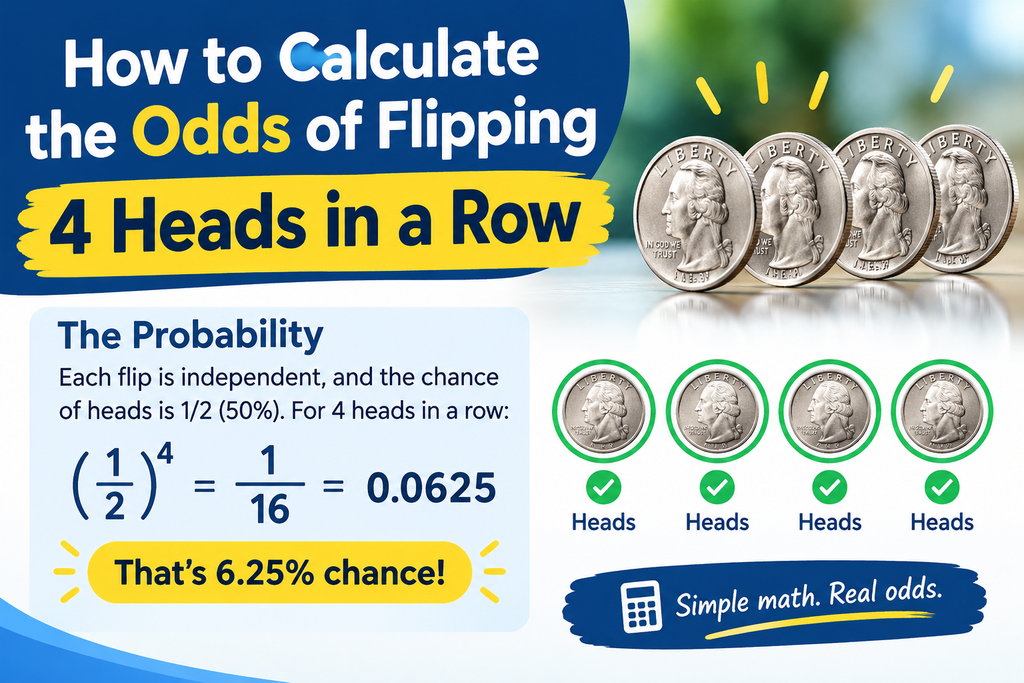
A coin flip is what statisticians call a Bernoulli trial: one try, two possible results, a fixed chance for each. Here’s the step-by-step version.
- Start with one flip. A fair coin has two equally likely sides, so the probability of heads is 1/2, or 0.5.
- Check that the flips are independent. The coin has no memory. Flip two doesn’t care what happened on flip one.
- Multiply once per flip. For four heads, that’s 0.5 × 0.5 × 0.5 × 0.5.
- Work it out. 0.5 × 0.5 = 0.25. Then 0.25 × 0.5 = 0.125. Then 0.125 × 0.5 = 0.0625.
- Convert it. 0.0625 × 100 = 6.25%. And 1 ÷ 0.0625 = 16, so it’s 1 in 16.
There’s a second way to see it, and I like it better because you can picture it. Four flips can land in 2 × 2 × 2 × 2 = 16 different sequences, from HHHH all the way to TTTT, and every one is equally likely. Only one of those 16 is all heads. One out of sixteen. Same answer, no multiplication needed.
What Are the Odds of Getting Tails 4 Times in a Row?
Exactly the same: 1 in 16, or 6.25%. Heads and tails are mirror images on a fair coin, so 0.5 × 0.5 × 0.5 × 0.5 works for tails too.
Here’s a twist people tend to like. What if you don’t care which side does the streaking? In four flips, HHHH and TTTT are two of the 16 possible sequences, so the chance of getting four of the same side is 2/16, or 1 in 8 (12.5%). Keep that in your back pocket the next time someone shouts “four in a row, no way!” A run on either side is a lot more ordinary than a run on the side you called in advance.
Whether you say head or tail, or heads or tails, the math doesn’t change. If the wording trips you up, our page on head or tail explains how people use each term.
What Are the Odds of Getting 5 Heads in a Row?
The odds of getting 5 heads in a row are 1 in 32, or 3.125%, because 0.5 × 0.5 × 0.5 × 0.5 × 0.5 = 0.03125. That’s half the odds of flipping 4 heads in a row, which makes sense: one more flip, one more halving.
If you searched for the chances of flipping heads 5 times in a row, or the probability of flipping 5 heads in a row, you’ve got it. Same number, worded three different ways. And if any five of the same side counts for you, heads or tails, the chance doubles to 2/32, which is 1 in 16 (6.25%). Funny detail: that’s identical to the chance of four heads in four flips.
What are the odds of winning 5 coin flips in a row?
Also 1 in 32, as long as you call the side before the coin lands. Each call has a 50% shot, and five correct calls in a row is 0.5 to the fifth power. The word “before” matters. If you pick your side after you see the result, you aren’t predicting anything, so the math doesn’t apply. Want to practise calling it? A simple coin flipper makes it easy to keep score.
Chances of a Coin Landing on Heads 5 Times: In a Row vs. In Total
These are two different questions, and mixing them up is the most common mistake people make with coin math. “5 heads in a row” means five heads back to back. “5 heads” in a longer batch of flips could be scattered anywhere.
For scattered heads, use the binomial formula. The probability is C(n, k) ÷ 2ⁿ, where n is the number of flips, k is the number of heads, and C(n, k) counts the ways to choose which flips are the heads. Take exactly 5 heads in 10 flips. There are C(10, 5) = 252 ways to do it, out of 2¹⁰ = 1,024 possible sequences. So 252 ÷ 1,024 ≈ 24.6%, or about 1 in 4. That’s far likelier than 1 in 32, because the heads are free to land wherever they like. You can read more about the formula in this binomial distribution overview, or work through it on Khan Academy’s probability lessons.
Now the part that surprises people. The odds of flipping 4 heads in a row in one specific set of four flips is 6.25%. But the chance that a longer session contains a run of four heads somewhere is much higher:
- In 10 flips: about 24.5%
- In 20 flips: about 47.8%
- In 100 flips: about 97%
For a run of five heads, the chance is about 25% in 20 flips. So when a streak shows up at game night, it isn’t a miracle. You just watched a long stretch of flips and a streak was always likely to appear somewhere in there. Curious how it feels? Flip a coin 5 times and count what you get, then do it again.
Gambler’s Fallacy: Is Tails “Due” After 4 Heads?
No. After four heads, the next flip is still 50/50. The 1 in 16 figure is a forecast you make before the first flip. Once four heads are already on the table, those flips are history, and only one flip is left to decide.
The classic real-life example comes from the Monte Carlo Casino in 1913. The story goes that a roulette ball landed on black 26 times in a row. Players kept piling money onto red, sure that red had to come next. Each spin was independent, so the wheel owed them nothing, and the casino made a fortune. This mistake is now called the gambler’s fallacy, or the Monte Carlo fallacy.
Its opposite twin is the “hot hand” belief, the idea that a streak will keep going. For a fair coin that’s just as wrong. Both ideas quietly assume the coin has a memory. It doesn’t.
Is a Real Coin Exactly 50/50?
Very nearly, but not perfectly. In a 2007 paper called “Dynamical Bias in the Coin Toss,” Persi Diaconis, Susan Holmes and Richard Montgomery analysed the physics and argued that a normally flipped coin has a slight tendency to land on the side that started facing up, roughly 51% of the time. You can read the original Diaconis, Holmes and Montgomery paper yourself. A large 2023 experiment by Bartoš and colleagues, covering more than 350,000 flips, reported a similar result of about 50.8%. You can find it in this arXiv study on same-side landings.
That’s a tiny edge. Even if a coin always started heads-up with a 50.8% chance of landing that way, the odds of flipping 4 heads in a row would move from 6.25% to about 6.7%. Nobody at your kitchen table will notice. A digital flipper skips the issue completely, since it picks heads or tails with a random number instead of a thumb and a spin. If you want to improve your real-world toss, our guide on how to flip a coin covers the basics.
Which Is Heads and Which Is Tails? How to Identify Each Side of a Coin
Heads is the obverse, the front of the coin, which usually carries a portrait or the main emblem. Tails is the reverse, the other side. Mints use the words “obverse” and “reverse,” and you can see the definitions on this obverse and reverse explainer.
A few examples you can check against a coin in your pocket:
- US penny: Lincoln’s portrait is heads. The shield on the back is tails.
- US quarter: Washington’s portrait is heads. The design on the back is tails.
- UK coins: the monarch’s portrait is heads. The denomination or emblem side is tails.
Rules differ between countries and coin series. Some coins, including many commemorative ones, don’t have an obvious portrait at all, and then nothing official tells you which side is which. The fix is simple. Say out loud which side is heads before the toss, and keep the call fixed. For the full list of etiquette and edge cases, see our heads or tails coin toss rules.
Try It Yourself: Run Your Own Streak Experiment

Math sticks better when you can poke at it. Open the flipping a coin simulator, flip 100 times, and jot down every run of four heads. You should spot at least one, since the chance is about 97%. It’s a good way to put the odds of flipping 4 heads in a row to the test with your own eyes.
[REPLACE WITH YOUR REAL TEST] Example: “I flipped 100 times and saw ___ runs of four heads. My longest streak was ___.” Use your actual numbers here. Real results make the page more trustworthy.
Not sure what to flip for? Try a yes or no coin flip, or play a quick round of the heads and tails game with a friend. And if you’re tempted to spin a coin instead of flipping it, know that a spun coin behaves differently, which we cover on that page.
The Bottom Line
The odds of flipping 4 heads in a row are low enough to feel special and common enough that you’ll see it eventually. Whether you’re settling a bet or just curious, use the heads or tails generator for a quick, fair flip and see how long a streak you can catch.
Past flips don’t affect the next one, so tails is never “due.” Heads is the obverse side of a coin and tails is the reverse.
Four heads in a row is 1 in 16 (6.25%). Five is 1 in 32 (3.125%). Each extra flip halves the chance.
A streak is unlikely in one set of flips, but likely somewhere in a long session. About 48% over 20 flips for four heads.
What are the odds of flipping 4 heads in a row?
The odds of flipping 4 heads in a row are 1 in 16, which is 6.25%. You get it by multiplying 0.5 by itself four times (0.5 × 0.5 × 0.5 × 0.5 = 0.0625). That figure assumes a fair coin and applies to any specific set of four flips you decide on in advance.
What are the odds of getting tails 4 times in a row?
They’re the same: 1 in 16, or 6.25%. A fair coin treats both sides alike, so four tails in a row follows the same multiplication as four heads. If you’d accept four of either side in four flips, the chance doubles to 1 in 8, or 12.5%.
What are the odds of getting 5 heads in a row?
Five heads in a row has a probability of 1 in 32, or 3.125%, because 0.5 multiplied by itself five times equals 0.03125. That’s exactly half the chance of getting four heads in a row. The same number applies to flipping tails five times straight.
What are the odds of winning 5 coin flips in a row?
If you call heads or tails before every flip, you win each call 50% of the time, so five wins in a row is 1 in 32 (3.125%). The calls must come before the flip. Choosing your side after seeing the result isn’t a prediction, so the math doesn’t apply.
What are the chances of a coin landing on heads 5 times out of 10 flips?
Exactly 5 heads in 10 flips has a probability of about 24.6%, or roughly 1 in 4. There are 252 ways to place 5 heads among 10 flips, out of 1,024 possible sequences. It’s far likelier than 5 heads in a row because the heads can land anywhere.
If a coin lands heads 4 times, is tails more likely next?
No. The next flip is still 50/50. Past flips don’t influence future ones, so tails isn’t “due.” Believing otherwise is called the gambler’s fallacy. The 1 in 16 chance applies before you start flipping, not after four heads have already landed.
Which is heads and which is tails on a coin?
Heads is the obverse, the front side that usually carries a portrait, such as Lincoln on a US penny or the monarch on a UK coin. Tails is the reverse, the other side. If a coin has no clear portrait, agree on which side is heads before you flip.

Related Articles

Is Heads or Tails More Likely? 7 Proven Facts
Is heads or tails more likely? No. On a fair coin, heads and tails each have a 50% chance, so neither wins more over time. The…

Is Heads or Tails Good Luck? 7 Surprising Truths
Is heads or tails good luck? No. On a fair coin, heads and tails each land about 50% of the time, so neither side is luckier,…

Flip a Coin 10 Times: What to Expect from 10, 20, 30 and 50 Flips
If you flip a coin 10 times, you’ll most often land on about 5 heads, but anything from 3 to 7 heads is completely normal. That…
Need a Quick Decision?
Flip a coin and let chance decide — instantly, honestly, and for free.
Flip a Coin