
Flipping a Coin Simulator: 5 Free, Fair Ways to Use One
 Updated October 31, 2026
9 min read

In this article
- Key Takeaways
- What Is a Flipping a Coin Simulator?
- How Does a Coin Flip Simulator Work?
- Is an Online Flipping a Coin Simulator Fair?
- Coin Flip Simulator vs a Real Coin
- How to Use a Coin Flipper Heads or Tails
- Flipping Coins in Bulk and Custom Coins
- Tails vs Heads: Which Is More Likely?
- Siri Heads or Tails and Google Coin Flip
- When to Use a Flipping a Coin Simulator (and When Not To)
- Final Thoughts
Key Takeaways
- A flipping a coin simulator uses a random number generator to pick heads or tails, so each flip is close to 50/50.
- Every flip is independent. Five heads in a row does not make tails “due”.
- Simulators are faster than a real coin and easier to trust in a group, because everyone watches the same screen.
- Voice assistants like Siri and Google can flip a coin too, but you can’t see how they decide.
- Use a simulator for low-stakes choices. Don’t use it for health, legal, or money decisions.
What Is a Flipping a Coin Simulator?
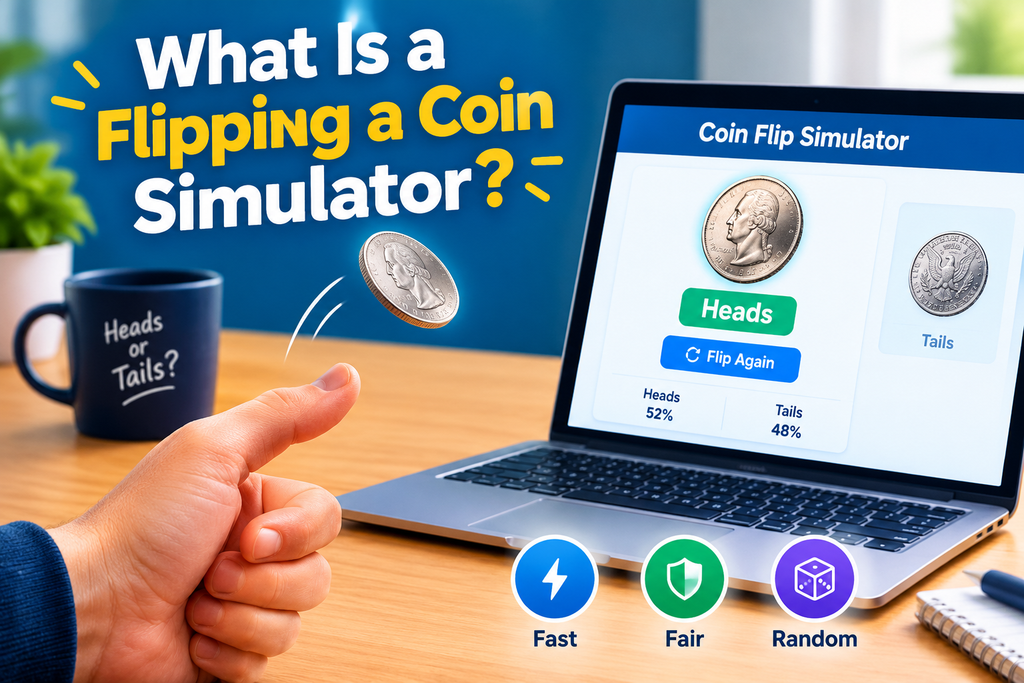
A flipping a coin simulator is a tool that mimics a coin toss on a screen. It uses a random number generator to choose heads or tails, then shows the result, often with an animated coin. It gives you a quick, fair answer when you don’t have a real coin handy.
Think of the last time you needed a tie-breaker and nobody had change. Maybe two friends wanted the same seat, or a team needed to know who kicks off. A simulator solves that in about two seconds. You open the page, press a button, and the screen shows the answer.
The free online coin flip tool on this site works exactly that way. [CONFIRM AND LIST YOUR REAL FEATURES HERE, for example: one-click flip, coin animation, sound, result history.]
How Does a Coin Flip Simulator Work?
Most simulators work by asking the computer for a random number between 0 and 1. If the number is below 0.5, the result is heads. If it’s 0.5 or higher, the result is tails. The coin animation is just decoration on top of that choice.
The “random” number usually comes from a pseudo-random number generator (PRNG). That is a formula that produces numbers that look random and pass statistical tests, but are technically calculated from a starting value called a seed. If you want the details, Wikipedia’s page on pseudorandom number generators covers them well.
In web browsers, developers often use JavaScript’s Math.random(). The MDN documentation for Math.random is blunt about it: it is fine for everyday things like games and choices, but it isn’t designed for security. Stronger options exist for cryptography, and the US National Institute of Standards and Technology publishes guidance on them in its random bit generation project.
For choosing who pays for lunch, pseudo-random is plenty. [CONFIRM WHICH METHOD YOUR TOOL USES BEFORE PUBLISHING THIS SECTION.]
Is an Online Flipping a Coin Simulator Fair?
Yes, a well-built flipping a coin simulator is fair for everyday use. Each flip has about a 50% chance of heads and 50% of tails, and the result of one flip has no effect on the next.
That last part trips people up. Say the simulator gives you heads six times in a row. It feels like tails must be coming. It isn’t. The tool has no memory, and neither does a real coin. This mistake has a name, the gambler’s fallacy, and it has cost people real money at casino tables.
Over a small number of flips, streaks are normal. Flip a coin ten times and getting 7 heads and 3 tails is no cause for alarm. Over thousands of flips, the totals settle close to half and half.
Add your real data here: run your tool 100 times and write down the actual count, for example “I got X heads and Y tails.” A real result from your own test builds trust and can’t be copied from another site. Delete this note once you add it.
Worth being honest about one thing: a pseudo-random generator is not truly random in the physics sense. For a lunch decision or a classroom game, you will never notice the difference.
Coin Flip Simulator vs a Real Coin
A simulator wins on speed and convenience. A real coin wins on feel. Both are fair for casual choices.
| Coin flip simulator | Real coin | |
| Fairness | About 50/50 | About 50/50 (a tiny bias exists) |
| Speed | Instant | Takes a few seconds, plus finding a coin |
| Trust in a group | Everyone sees the same screen | Someone might suspect a trick flick |
| Many flips at once | Easy | Slow and messy |
| Always available | Yes, with a phone | Only if you carry change |
If you do have a coin and want to practise the real technique, read our guide on how to flip a coin by hand, step by step.
How to Use a Coin Flipper Heads or Tails
Using a coin flipper takes less than ten seconds. Agree on the call first, press the button once, and accept the result.
- Open the tool. Go to Flip-A-Coin.us on your phone or computer.
- Decide what each side means. Heads = yes, tails = no, or heads = you go first. Say it out loud.
- Press the flip button. Do it once. No quietly pressing again if you don’t like it.
- Read the result. The coin shows heads or tails.
- Stick with it. The fun of a coin toss is that it ends the argument.
Need the official-style etiquette, like who calls and what happens on a tie? Our page on the heads or tails coin toss rules covers it.
Flipping Coins in Bulk and Custom Coins
Sometimes one flip isn’t enough. A teacher might want 20 flips for a probability lesson. A board gamer might need three coins at once. That’s where a bulk option helps.
[CONFIRM THESE FEATURES BEFORE PUBLISHING. If your tool has them, describe how to use them in 2 to 3 sentences each. If not, delete this section or the sentences that don’t apply.]
- Multiple coins: flip several coins at once and see the total heads and tails.
- Custom coins: rename the sides, for example “pizza” and “burgers”, so the coin answers your real question.
- Result history: see your last few flips, handy for best-of-5 contests.
If you want to flip more than one coin, try our multiple coin flip page. For custom sides, see the custom coin flip tool.
Tails vs Heads: Which Is More Likely?
Neither, for practical purposes. Heads and tails are both about 50%. A real coin has a tiny edge, though. Researchers led by the mathematician Persi Diaconis found that a flipped coin tends to land on the same side it started on about 51% of the time. You can read the paper, Dynamical Bias in the Coin Toss, if you like detail.
A simulator has no starting side to favour, so that particular bias doesn’t apply. That’s one small way a good flipping a coin simulator can be even fairer than a real coin.
Want more on the maths? Our article on coin flip probability goes through the odds, and the head or tail guide explains the history of the terms.
Siri Heads or Tails and Google Coin Flip
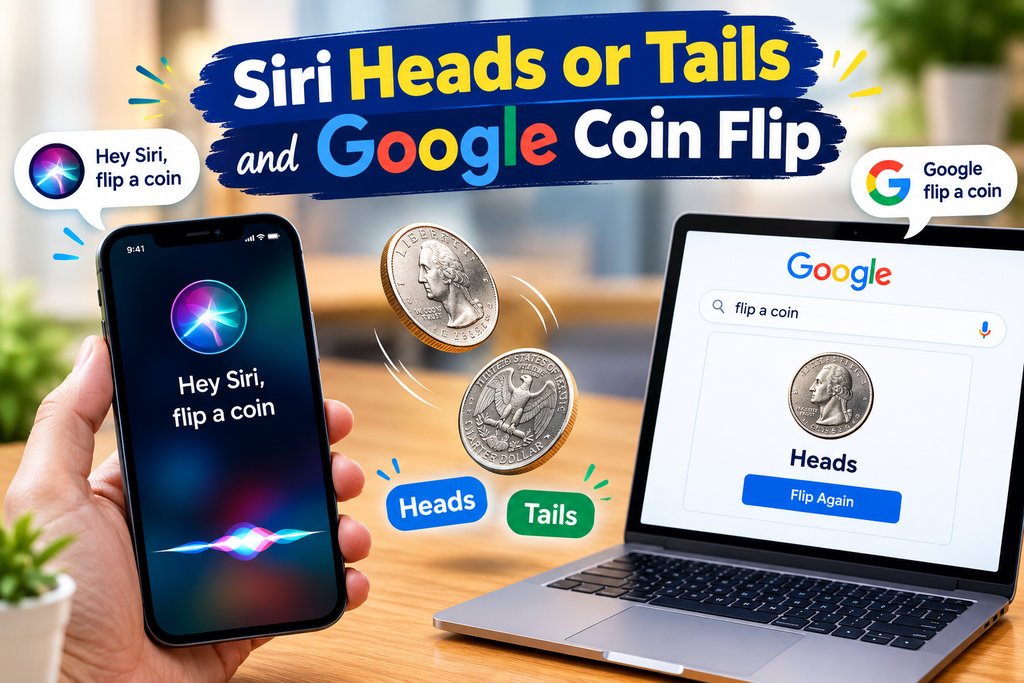
Both assistants can flip a coin for you. The simplest wording is “flip a coin”, and they’ll reply with heads or tails.
| Siri | Online simulator | ||
| Command | “Hey Siri, flip a coin” | “Hey Google, flip a coin” | Press the flip button |
| Needs voice | Yes | Yes | No |
| Shows the coin | Sometimes | Often, on screen | Yes |
| Good for groups | Okay | Okay | Best, everyone sees it |
If you type “flip a coin” into Google Search, it also shows its own coin flip box at the top of the results. Apple explains how to switch Siri on in its Siri support pages, and Google has a Google Assistant help center for commands.
The drawback of voice assistants is that you can’t tell how they choose, and they can mishear you. For a group decision, a visible tool is easier to trust.
When to Use a Flipping a Coin Simulator (and When Not To)
Use a simulator for small, low-stakes choices where you just need an answer and a fair process. Don’t use one for decisions that affect your health, your legal position, or your money.
Good uses:
- Sports: deciding who kicks off or who picks the end of the pitch
- Classrooms: quick probability lessons and fair turn-taking
- Friends and family: who pays, who drives, who does the dishes
- Games: tie-breakers, first player, or a heads and tails game
- Small decisions: pizza or noodles, movie A or movie B
Poor uses:
- Choosing a medical treatment
- Legal or contract decisions
- Investing or large purchases
And if you have more than two options, a coin won’t cut it. Try our yes or no coin flip, a dice roller, a random picker wheel or the random number generator.
Final Thoughts
A flipping a coin simulator is the fastest way to settle a small decision without hunting for change. It’s fair, it’s free, and everyone in the room can watch the result. Call it before you flip, press the button once, and accept the answer. When you’re ready, try the coin flip tool on Flip-A-Coin.us.
What is a flipping a coin simulator?
It’s an online tool that imitates a coin toss. A random number generator picks heads or tails and the screen shows the result, usually with an animated coin. It’s quick, free, and handy when you don’t have a real coin.
Is an online coin flip simulator truly random?
Mostly. Simulators use pseudo-random number generators, which are calculated rather than physically random. They pass statistical tests and are fine for everyday decisions, but they aren’t meant for security or gambling.
Is a coin flip simulator fair?
Yes. Each flip has about a 50% chance of heads or tails, and one result never affects the next. A real coin has a tiny bias of roughly 51%, which a simulator avoids.
Can I flip multiple coins at once online?
Often, yes. Some tools let you flip several coins together and show the total heads and tails. Check whether the tool you’re using has a multiple-flip option before you start.
Can I make a custom coin flip?
Some simulators let you rename the sides, so heads becomes “yes” and tails becomes “no”, or any two choices you like. It makes the result easier to understand at a glance.
What does “Hey Siri, flip a coin” do?
Siri flips a virtual coin and tells you heads or tails. Google Assistant responds the same way to “Hey Google, flip a coin”. Both work by voice, but you can’t see how the result is chosen.
Is it better to use a simulator or a real coin?
Both are fair for casual choices. A simulator is faster, always available, and easy for groups to watch. A real coin is better when you want the tactile feel of an actual toss.
Which is more likely, tails or heads?
Neither. They’re about equal, close to 50% each. Research suggests a real coin lands on its starting side about 51% of the time, a tiny edge that you’ll never notice in everyday use.

Related Articles

Coin Flip GIF: 5 Free Ways to Get Animations, Sounds and Images
The safest way to get a coin flip gif is to use a free online flipper or a CC0 / public-domain animation, then save it as…

Flip a Coin 100 Times: Ultimate 2026 Guide + Free Simulator
Flip a coin 100 times and you’ll usually see about 50 heads and 50 tails, but anything from roughly 40 to 60 heads is normal. You…

Heads and Tails Coin Flip: The Ultimate 2026 Guide
A heads and tails coin flip is the quickest fair way to settle a decision between two options. You toss a coin, one side lands up,…
Need a Quick Decision?
Flip a coin and let chance decide — instantly, honestly, and for free.
Flip a Coin