
Spin a Coin: Ultimate 2026 Guide + Free Flip Tool
 10 min read

In this article
- What Happens When You Spin a Coin?
- Is It Fair to Spin a Coin?
- Spin a Coin vs Flip a Coin
- How to Spin a Coin (If You Still Want To)
- Spinning Quarter: Does the Coin Type Matter?
- Heads or Tails Spinner and Spinning Decision Maker
- Google Spinner Coin: What You’ll Find
- The Fairest Way to Get Heads or Tails
- Fun and Practical Uses When You Spin a Coin
- Common Mistakes When You Spin a Coin
- Final Thoughts
When you spin a coin on its edge, it often lands more on one side than the other, so spinning is usually less fair than flipping. For a fair heads or tails result, flip the coin in the air or use a digital flip. This guide covers the three things people mean when they search spin a coin: physically spinning a quarter on a table, using a heads or tails spinner online, and Google’s spinner.
If you want a fair answer right now, our free online coin flip gives you one in a tap. It flips rather than spins, and as you’ll see below, that’s the better way to do it.
What Happens When You Spin a Coin?
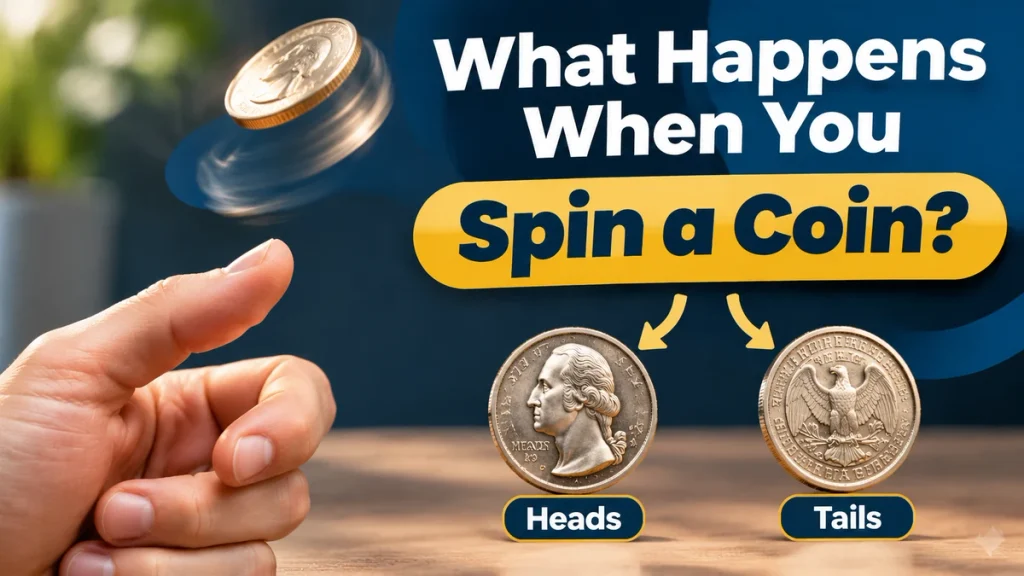
When you spin a coin on a table, it whirls on its edge, wobbles faster as it slows down, then drops flat onto one face. The whole thing lasts a few seconds, and the final wobble is the bit everyone watches.
Picture two kids at a kitchen table. One stands a quarter on its edge, flicks it, and the other shouts “heads!” before it falls. It’s fun, it’s quick, and it feels fair. Here’s the catch: the way a coin spins and falls isn’t the same as the way it tumbles through the air.
If you want some background on coin tosses in general, Wikipedia’s page on coin flipping is a handy starting point.
Is It Fair to Spin a Coin?
Not usually. When you spin a coin, the result often leans towards one side. Two things cause it: the weight isn’t spread perfectly evenly between the two faces, and the rim has a slight shape from how the coin is made.
Here’s what the sources say. Statisticians Andrew Gelman and Deborah Nolan wrote that a coin can’t really be biased when it’s flipped in the air and caught, but it can be biased if it’s allowed to bounce or if it’s spun. You can read the paper, You Can Load a Die, But You Can’t Bias a Coin, for the full argument.
There’s a striking example with old US pennies. One write-up on the Math Tourist blog reports that a spun Lincoln Memorial penny lands tails about 80% of the time. That’s one coin type, and it’s a blog account, so please don’t assume every coin does this. The point is that when you spin a coin, the coin itself can matter a lot.
A study by Persi Diaconis and colleagues, Dynamical Bias in the Coin Toss, looked at how real tossed coins behave, and it’s worth a read if you enjoy the physics. For the basics of fair chances, see our guide to you flip a coin what is p(heads).
So if you spin a coin to settle an argument, you might be quietly tilting things without knowing it.
Spin a Coin vs Flip a Coin
Spinning and flipping are not the same trick. A flip sends the coin tumbling through the air and you catch it. A spin keeps the coin on a surface, whirling on its edge. Here’s how they compare.
| Spin a coin | Flip a coin | Digital flip | |
| Fairness | Often leans towards one side | Close to 50/50 | 50/50, no physical bias |
| Effort | A flat, smooth surface and a steady flick | A toss and a catch | One tap |
| What affects the result | The coin, the table and the spin | The throw and the catch | The random source |
| Best use | A fun demo | Quick decisions in person | A fair answer anywhere |
If you’d like to flip a real coin the proper way, here’s how to flip a coin with an even toss. Our coin toss page also covers how people use a coin to settle things.
How to Spin a Coin (If You Still Want To)
If you still want to spin a coin for fun, here’s the usual way to do it.
- Find a flat, hard, smooth surface, like a table with nothing on it.
- Stand the coin on its edge and pinch the top between your thumb and finger.
- Flick it sharply so it spins fast.
- Let it fall on its own. Don’t touch it.
- Read the face that ends up showing.
A quick note on safety and manners. Keep the coin away from the table edge so it doesn’t roll off and disappear. And if two people are playing, agree what heads and tails mean before the spin, not after. Results will vary from coin to coin, so treat it as a bit of fun.
Spinning Quarter: Does the Coin Type Matter?
Yes, it can. A spinning quarter, a penny and a euro coin all have different shapes, weights and edges. Those details change how a coin whirls and which face it tends to end on.
The penny example above shows how much one coin’s design can matter. We’re not going to rank coins, because there’s no reliable way to say “this one’s best” for everyone. If you want to find out how your own coin behaves, you can run your own test, but remember that if you spin a coin a few times, a small sample won’t tell you much.
Heads or Tails Spinner and Spinning Decision Maker
A heads or tails spinner isn’t the same thing as when you spin a coin. It’s an on-screen wheel or spinner that lands on a choice, such as heads or tails, yes or no, or a list of names. A spinning decision maker is the same idea with more options.
Spinners are handy when you have more than two options, like picking a name from five. For a plain two-way choice, a flip is simpler and fairer. Our heads or tails page covers the classic version.
A quick honest note: our site flips a coin. It doesn’t have a spinner wheel.
Google Spinner Coin: What You’ll Find
People who search “google spinner coin” are usually looking for one of two things. Google has a built-in coin flip that appears when you search for something like “flip a coin”. It also has a separate spinner tool that you can find by searching “spinner”.
According to MakeUseOf’s guide to Google’s hidden decision tools, the spinner is a wheel with numbers, and you can change how many segments it has. Neither one lets you spin a coin the way you would on a table.
Google changes these tools from time to time, so try a search yourself and see what you get today.
The Fairest Way to Get Heads or Tails

If you were about to spin a coin to decide something, a digital flip is the fairer choice. Flip-A-Coin.us gives you heads or tails with a tap, and it uses your browser’s Web Crypto API for the result.
In plain words, that’s a built-in browser feature designed to produce strong, hard-to-predict random values. MDN explains how it works. Our how it works page goes through each step.
Here’s how to use it:
- Open the coin flip tool.
- Decide what heads and tails mean.
- Tap the coin or press the Flip button.
- Read the result. It’s free, needs no sign-up and works on any device.
A digital flip doesn’t have a rim, an uneven face or a bumpy table, so none of the physical bias that can affect a spun coin comes into it.
Fun and Practical Uses When You Spin a Coin
Spinning a coin isn’t a great way to decide things, but it’s still fun, and it’s useful for a few jobs.
- Quick fun. A bit of play at the kitchen table. Just don’t bet anything on it.
- Classroom physics. Teachers can ask students to spin a coin and record how often it ends on heads. The results often show that spinning isn’t 50/50.
- Science fair projects. Compare spinning with flipping and see which is closer to even. Remember that results will vary and a small sample can mislead.
- Fair decisions. For anything that matters, use a flip instead. Our heads and tails coin flip guide covers the basics of the game.
Common Mistakes When You Spin a Coin
These are the slips we see most often.
- Assuming a spun coin is 50/50. It often isn’t, and it depends on the coin.
- Spinning on a rough or tilted surface. A bumpy table affects the result.
- Not agreeing the rule first. Decide what heads and tails mean before you spin a coin, not after.
- Drawing big conclusions from a few spins. A handful of spins tells you very little.
- Mixing up a spun coin with a flipped one. They behave differently, so don’t use one to explain the other.
Final Thoughts
It’s fun to spin a coin, but it’s not a fair way to decide anything. A spun coin often leans towards one side, and the result depends on the coin and the table. For a fair heads or tails result, flip the coin or use a digital flip.
When you want an answer you can trust, head to Flip-A-Coin.us and let the coin decide. If you have questions, our FAQ has more answers, and if you spin a coin just for fun, enjoy it.
What happens when you spin a coin?
When you spin a coin on a table, it whirls on its edge, wobbles as it slows and then falls flat on one face. The result often leans towards one side, depending on the coin.
Is it fair to spin a coin?
Not usually. When you spin a coin, uneven weight and the shape of the rim can tilt the result. A coin that’s flipped in the air and caught is much closer to a fair 50/50.
Should I spin a coin or flip it?
Flip it. If you need a fair result, a flip is better than a spin. If you spin a coin just for fun, that’s fine, but don’t use it for decisions that matter.
Why do spun pennies land tails more often?
One write-up reports that older Lincoln Memorial pennies land tails about 80% of the time when spun, likely because of uneven weight. That’s one coin, so don’t assume it applies to every coin.
Does the Flip-A-Coin site spin a coin?
No. Our tool flips a coin and shows you the result with a tap. It doesn’t have a spinner wheel. Because it uses a digital random source, it avoids the physical bias that can affect a spun coin.
What is a heads or tails spinner?
A heads or tails spinner is an on-screen wheel that lands on heads or tails. It’s a different thing from when you spin a coin on a table, and it’s handy when you have more than two options.
Is there a Google spinner coin?
Google has a built-in coin flip and a separate spinner tool. The spinner is a wheel with numbers, and you can find it by searching “spinner”. Google changes its tools, so check what appears today.
What’s the fairest way to get heads or tails?
A digital flip is the fairest everyday option. It has no physical bias, and it takes one tap. If you’d rather use a real coin, flip it in the air and catch it, don’t spin a coin.

Related Articles
Why Is It Called Heads or Tails? 7 Surprising Facts
Why is it called heads or tails? Because a coin’s two sides were pictured as opposite ends of a body: the front shows a head, usually…
Lucky Penny Heads or Tails? 7 Surprising Beliefs
Lucky penny heads or tails? Heads. According to the popular superstition, a penny found heads up is lucky and worth picking up, while a tails-up penny…

Yes or No Coin Flip: Ultimate 2026 Guide + Free Tool
A yes or no coin flip means heads is yes and tails is no. You flip the coin once, and the side facing up gives your…
Need a Quick Decision?
Flip a coin and let chance decide — instantly, honestly, and for free.
Flip a Coin