
Heads or Tails Coin Toss Guides
When in Doubt Flip a Coin: 7 Proven Facts Behind the Quote
 11 min read
When in doubt flip a coin: it works, but not because the coin decides. While it spins, you notice which side you are hoping for, and that gut reaction shows what you want. A large study of over 20,000 coin flips found it can nudge people to act.
Here is the short version. The coin is not wise, lucky or magic. It simply forces you to picture two outcomes in a single second. In that second, most people feel relief about one result and disappointment about the other. That feeling is the real answer, and the coin only helped you hear it. The sections below explain where the saying comes from, what research says, how to use it step by step, and when you should not use it at all.
If you landed here after searching “when you can’t make a decision flip a coin,” “flip a coin and when it’s in the air you’ll know,” or “when you’re not sure flip a coin,” you are in the right place. The idea behind when in doubt flip a coin is simple, but the details matter. You can also use our free online coin flip while you read.
Key takeaways
- The saying when in doubt flip a coin works because of your reaction, not the result.
- A Danish poet, Piet Hein, wrote a short poem about this idea, and a TV character is often credited with a version of it.
- A University of Chicago study of more than 20,000 flips found coin tosses influenced real decisions.
- In that study, people told by the coin to make a change were happier six months later.
- It works best when both options are acceptable to you.
- It is a poor tool for decisions involving safety, health, law or serious money.
- If you feel disappointed by the result, listen to that feeling.
When in Doubt Flip a Coin: What Does It Mean?
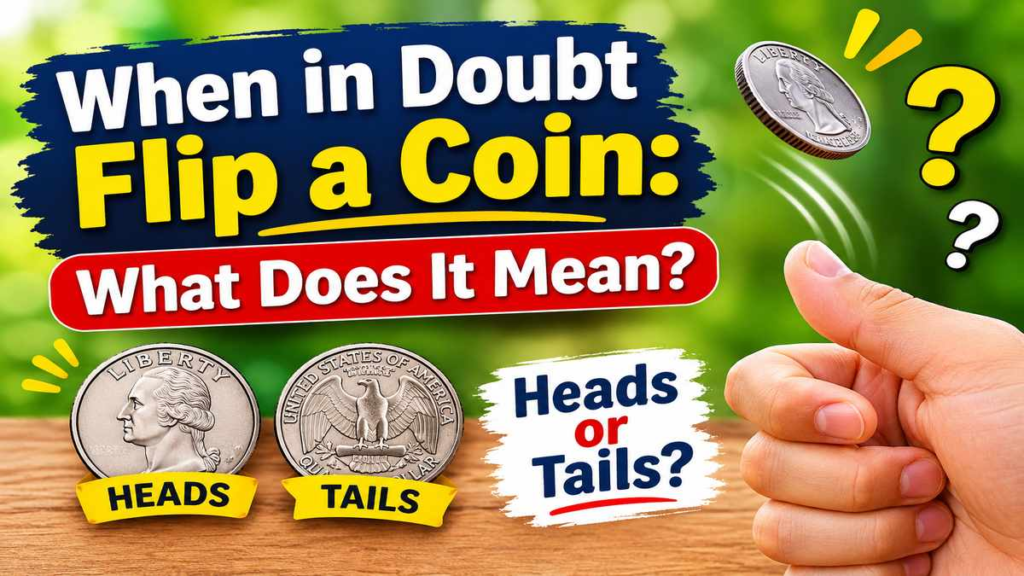
The meaning is easy to state. When you cannot choose between two options, assign one to heads and one to tails, flip, and watch your own reaction. If you feel glad, you know which one you wanted. If you feel let down, you know that too.
So when in doubt flip a coin is not advice to hand your life over to chance. It is a trick for hearing your own preference. The coin does not decide anything. It acts like a mirror. For a quick way to try it, our yes or no coin flip tool gives you an instant answer to test your reaction.
Where Does When in Doubt Flip a Coin Come From?
Nobody can name one first speaker, but a few well-known sources keep coming up.
Piet Hein. The Danish poet and mathematician wrote a short poem, often titled “A Psychological Tip,” that makes this exact point. In plain terms, it says you should not toss a coin to let chance settle the matter, but because the moment the coin is in the air, you suddenly know what you are hoping for. You can read the text and the original Danish on this Piet Hein page.
Boardwalk Empire. A version of the line is often credited to Arnold Rothstein, a character in the HBO series Boardwalk Empire who is based on a real New York gambler of the same name. You can read about the show on Wikipedia and about the real man on his Wikipedia page. Online quote sites commonly credit him with the line, though that is a popular attribution, not a proven first use.
Peaky Blinders. Many people link the idea to Thomas Shelby, because his coin is a recurring ritual in the show. We could not find a verified line from the series that matches the famous wording, so we treat it as a similar idea, not a confirmed quote. You can read more about his coin in our guide to famous coin flips.
Does When in Doubt Flip a Coin Really Work?
For many people, yes. The reason is simple: indecision is often not about missing information. You already know the facts. What is missing is the push to pick one. A coin removes the weight of “what if I choose wrong” for a moment, so your gut gets a turn.
This is why the saying when in doubt flip a coin sticks around. When you ask “which side am I hoping for,” you often answer before the coin lands. That quick feeling is more honest than long lists of pros and cons, especially for choices where both options are fine.
It does not work every time. If you truly feel nothing, then maybe both choices are equally good, and either one is fine. In that case the coin did its job by telling you not to worry.
What Science Says About When in Doubt Flip a Coin
There is real research here. Economist Steven Levitt of the University of Chicago ran a large field experiment, published in The Review of Economic Studies in 2021 and available as an NBER working paper. People who were struggling with a decision flipped a virtual coin on a website to help them choose. Heads meant make the change, tails meant stay as you are.
Here is what the study reported, as summarized in the paper and by PBS NewsHour:
- More than 20,000 coins were flipped over the year of data collection.
- People who got heads were about 25 percent more likely to make a change than those who got tails.
- For important decisions, such as quitting a job or ending a relationship, those told by the coin to make a change were happier six months later than those told to stay put.
- Levitt’s conclusion was that people may be too cautious when facing life-changing choices.
That last point is worth remembering. The coin did not know the right answer. But it pushed people past a fear of change, and on average they were glad they moved. It supports the idea that when in doubt flip a coin can help you act. It does not prove a coin is always right, and individual cases will differ.
When You Need to Make a Hard Decision Flip a Coin: Step by Step
Here is a simple way to use the method on a real decision:
- Name the two options. Write them down in a few words each, such as “take the new job” and “stay.”
- Assign sides. Heads is option one, tails is option two. Decide before you flip.
- Flip the coin. Use a real coin or our free online coin flip tool. If you need the basics, see how to flip a coin in 5 easy steps.
- Watch yourself, not the coin. While it spins, notice what you hope for.
- Decide. If you felt relief, go with it. If you felt disappointed, choose the other option. You can ignore the coin if your gut disagrees.
If you have more than two options, our three-sided coin tool can help, and the same rule applies: the reaction matters more than the result.
Flip a Coin: Should I Go to Work?
This is one of the most searched forms of the question, so let’s be careful. A coin can help you notice how you feel about going to work, but it should not make the call alone.
If you are tired and just want an excuse, the flip can show you whether you really want to stay home. But skipping work has real consequences, such as lost pay, letting your team down or breaking your contract. If you are sick, burned out or worried about something serious, the better step is to talk to your manager or a doctor, not to leave it to a coin. Use the flip for low-stakes questions, like whether to go to the gym or take a walk, and use your judgment for anything that affects your income or health.
When Not to Use the Coin
The rule when in doubt flip a coin is a great tie-breaker, but it has limits. Do not use a coin for:
- Safety decisions. Anything that could hurt you or someone else.
- Medical choices. Talk to a qualified professional.
- Legal or financial choices. Large amounts of money, contracts or legal duties need careful thought.
- Decisions where one option is clearly worse. If you already know the answer, you do not need a coin.
In short, use the coin when both options are acceptable and you are stuck, not when one choice carries serious risk.
Quotes About Flipping a Coin to Decide
People often search for quotes about this idea. Here are a few short lines in our own words that capture it:
- Let the coin ask the question and let your gut give the answer.
- A coin cannot choose for you, but it can show you what you wanted.
- When you are stuck, the best part of a coin flip is the moment before it lands.
- If you feel relief, you have your answer. If you feel let down, you have it too.
For the original sources, see the Piet Hein poem and the Boardwalk Empire credit above. If you want to understand the odds behind the coin, read why a coin toss is 50/50, and for the question of which side to call, see should I pick heads or tails.
When in Doubt Flip a Coin: Quick Guide
| Situation | Should you flip? | Why |
| Choosing a restaurant or movie | Yes | Low stakes, both fine |
| Two job offers you like equally | Yes, as a gut check | Reaction reveals your preference |
| Whether to quit a job you hate | As a nudge only | Think it through too |
| Whether to go to work today | Only for low-stakes doubts | Real consequences |
| A medical or safety decision | No | Ask a professional |
| One option is clearly better | No | You already know |
Final Thoughts
So, does when in doubt flip a coin work? Yes, as long as you treat the coin as a mirror and not a judge. The flip gives you a second to feel which outcome you want, and research suggests that a push like this can help people finally act. Use it for choices where either option is fine, and skip it when safety, health or serious money is on the line.
Next time you are stuck, name the two options, flip, and listen to your first reaction. That reaction is usually the answer. To keep exploring, browse the coin flip blog, read about heads or tails meaning and rules, or try our coin flip tool for your next decision.
When in doubt flip a coin: does it really work?
Yes, but not because the coin decides. While it spins, you notice which side you are hoping for, and that shows your real preference. A large study also found coin flips influenced real decisions.
What does “flip a coin and when it’s in the air you’ll know” mean?
It means that the moment before the coin lands, you feel which result you want. That feeling tells you what you really prefer, so you do not need to look at the result.
When you can’t make a decision, should you flip a coin?
It can help when both options are acceptable and you are stuck. It is not a good tool for serious decisions involving safety, health, law or large sums of money.
Who said “flip a coin and when it’s in the air you’ll know”?
Danish poet Piet Hein wrote a poem making this point, and a version of the line is often credited to the Boardwalk Empire character Arnold Rothstein. The idea likely existed in everyday speech before either.
Is this a Peaky Blinders quote?
Thomas Shelby uses a coin as a ritual in the series, but we could not confirm a line from the show that matches the famous wording. Treat it as a related idea.
Is there a movie with this quote?
The line is most often linked to the TV series Boardwalk Empire. People also connect the idea to other films and shows, but we could not confirm a specific movie, so we do not name one.
Flip a coin: should I go to work?
A coin can help you notice how you feel, but it should not decide this alone. Skipping work has real consequences, so think through your reasons and talk to your manager if something serious is going on.
Where can I flip a coin online for free?
You can use our free online coin flip for an instant heads or tails result.

Related Articles
Coin Toss Rules: 7 Key Rules for Sports and Everyday Games
Coin toss rules are simple: one side calls heads or tails before the coin is flipped, the coin lands in view, and the side that matches…
Heads or Tails Lottery: How to Play in 5 Simple Steps
How to play the heads or tails lottery? It depends on the version. On a lottery ticket, you reveal the symbols and win when two or…
Flip a Coin on Your Knuckles: 7 Easy Steps for Beginners
To flip a coin on your knuckles, hold it upright between your thumb and first finger, push it over onto the knuckle with your thumb, then…
Need a Quick Decision?
Flip a coin and let chance decide — instantly, honestly, and for free.
Flip a Coin