
Three-Sided Coin: Ultimate 2026 Guide + 3-Way Flip
 10 min read

In this article
- What Is a Three-Sided Coin?
- Can a Normal Coin Land on Its Side? (Why It Isn’t a Three-Sided Coin)
- How Thick Does a Three-Sided Coin Need to Be?
- Is a Three-Sided Coin Fair?
- How to Do a Fair 3-Way Flip Without a Three-Sided Coin
- 3 Coin Flip Generator: Flipping Three Coins vs a Three-Way Pick
- What About a 1 Sided Coin?
- When a Coin Lands on Its Side in Real Life
- Common Mistakes With a Three-Sided Coin
- Final Thoughts
A three-sided coin is a coin thick enough that it can land on its edge as well as on heads or tails. A normal coin almost never lands on its side, but a thick enough three-sided coin can land on each of its three outcomes about equally often. This guide explains how a three-sided coin works, how thick one would need to be, and how to make a fair 3-way flip with the coin you already have.
Want to try a flip first? Open our free coin flip, then come back and see how three outcomes can be built from two.
What Is a Three-Sided Coin?
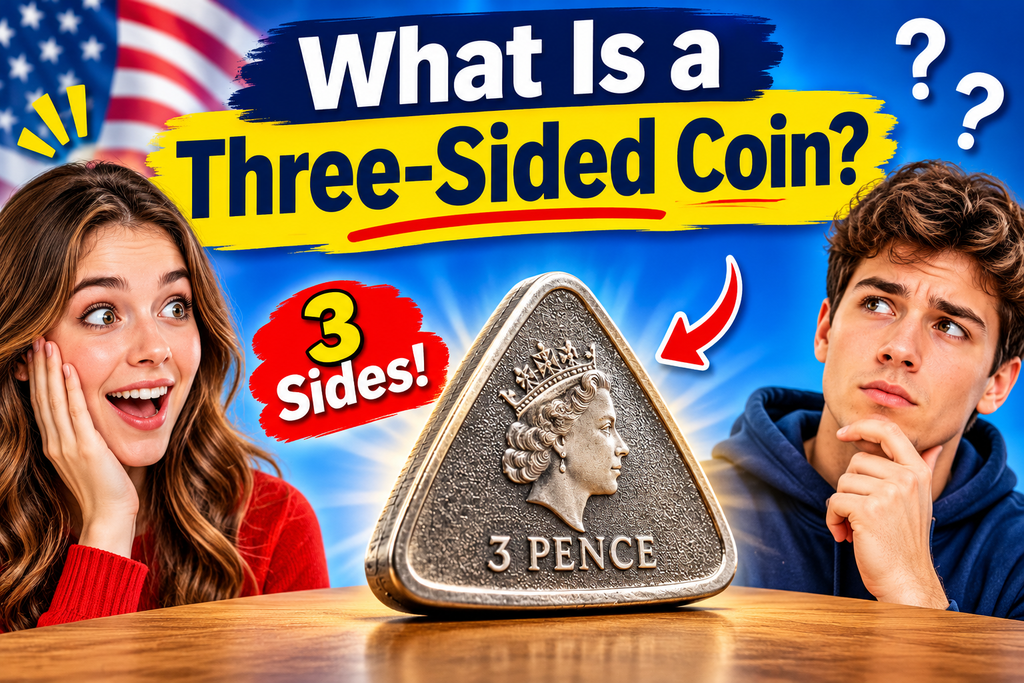
A three-sided coin is a thick coin with three possible results: heads, tails or edge. The edge is the rim around the middle, the part you’d run your fingernail along. If the coin comes to rest standing on that rim, that’s the third outcome.
Most of us picture a coin as having two sides. A three-sided coin works because it’s thick enough that the rim is a real surface, not just a thin line. The idea turns up in maths puzzles, physics classes and online videos, and it’s a fun one to think about.
If you’re new to the usual game, our heads or tails page covers the basics of two outcomes first.
Can a Normal Coin Land on Its Side? (Why It Isn’t a Three-Sided Coin)
Yes, but it’s rare. A normal coin can land on its edge, and Wikipedia’s page on coin flipping mentions it as a small but real possibility. It just doesn’t happen often enough to count as a third outcome.
The reason is thickness. A US quarter is about 1.75 mm thick and about 24.26 mm across, so its thickness is only around 7% of its width. That’s very thin. To stand on its rim, a coin like that has to land almost perfectly upright and keep still, which is why a normal coin behaves like a two-sided coin in practice and not like a three-sided coin.
The moment a coin does land on its rim, people tend to remember it. It’s the real-world cousin of the three-sided coin.
How Thick Does a Three-Sided Coin Need to Be?
The answer depends on a number physicists call the aspect ratio: thickness divided by diameter. A thin coin has a small ratio. A tall, chunky one has a big ratio.
A published analysis of thick coins, described in Physics Today and in the paper Probability, geometry, and dynamics in the toss of a thick coin, found that a fair three-sided coin should have an aspect ratio of 1/√3, which is about 0.58. In plain words, the coin would be roughly 58% as thick as it is wide. A three-sided coin 20 mm across would need to be about 11.5 mm thick.
John von Neumann is said to have answered a version of this puzzle on the spot with about 0.354, using a simpler geometric idea. The later dynamic analysis, which accounts for how a real coin spins, arrived at 0.58 instead.
That number comes with conditions. The result assumes a vigorous spin and a coin that lands without bouncing on a soft surface. Change those and the answer changes, so treat 0.58 as a neat theoretical target, not a guarantee.
Is a Three-Sided Coin Fair?
In theory, yes: a well-designed three-sided coin gives heads, tails and edge a one-in-three chance each. In practice, it’s much harder to get right.
Here’s why. The result depends on how the coin is thrown and what it lands on. A hard table, a soft carpet and a palm all behave differently. One mathematician who looked at the problem noted that the right thickness depends on the coin’s material and the surface, which makes a three-sided coin an impractical way to produce fair randomness.
There’s another wrinkle. The famous study Dynamical Bias in the Coin Toss found that a flipped coin tends to land the way it started unless it spins end over end. So even a carefully made three-sided coin carries a little bias from the toss itself.
The honest summary: a three-sided coin is a fascinating idea, but it isn’t a precise randomness tool. If you want a result you can trust, a digital method is better, and our how it works page explains where our randomness comes from. For the basics of equal chances, our guide to you flip a coin what is p(heads) is a good place to start, and Khan Academy’s probability lessons go deeper.
How to Do a Fair 3-Way Flip Without a Three-Sided Coin
You don’t need a special object. You can make a fair three-way choice with an ordinary coin and two flips. Here’s the method.
- Give your three options a label: option 1, option 2 and option 3.
- Flip the coin twice. Our coin flip tool works well for this.
- If you get heads then heads, option 1 wins.
- If you get heads then tails, option 2 wins.
- If you get tails then heads, option 3 wins.
- If you get tails then tails, ignore it and flip twice again.
Why is it fair? Two flips give four equally likely outcomes, each with a 1/4 chance. Three of them each pick one option, and the fourth is thrown away. So each option ends up with the same chance, one in three.
Here’s a mini-example. Three friends can’t decide who pays for the pizza. They agree: heads-heads is Sam, heads-tails is Priya, tails-heads is Leo. The first two flips come up tails-tails, so they go again. Heads-tails. Priya pays. Nobody argues, because the rule was agreed first.
Here’s how the methods compare:
| Two-sided coin | Three-sided coin | Two-flip method | |
| Outcomes | 2 | 3 | 3 |
| Fair chance each | 1/2 | 1/3 if perfectly built | 1/3 |
| Special object needed | No | Yes, a thick coin | No |
| Possible re-flip | No | Rare | Yes, 1 in 4 of the time |
| Easy to do | Yes | Hard to get right | Yes |
We don’t offer a three-sided coin mode on the site, so the two-flip method with the normal tool is the way to go. If you’d like the full game basics first, read our heads and tails coin flip guide.
3 Coin Flip Generator: Flipping Three Coins vs a Three-Way Pick
People search for a “3 coin flip generator” and mean two different things. This section covers both, and neither one needs a three-sided coin.
Flipping three coins. If you want three flips in a row, use the “Flip multiple times” section on our tool and type 3 in the custom box. It shows heads and tails totals. It’s handy for classroom work or a quick best-of-three. For a bigger run, the tool can do many more flips at once.
A three-way pick. If you want one winner out of three options, use the two-flip method above. It gives each option a fair one-in-three chance.
This article is mostly about the second meaning, because that’s what a three-sided coin is really for.
What About a 1 Sided Coin?

A one-sided coin isn’t really a coin flip, because there’s only one result. Whatever you do, the answer is always the same, so there’s nothing to decide. Unlike a three-sided coin, it has no randomness at all. If you see the phrase online, it’s usually a joke or a maths curiosity, not a tool you can use.
When a Coin Lands on Its Side in Real Life
It happens now and then. A coin rolls into a crack, leans on a book or lands on soft ground, and it stays on its edge. That’s a real three-sided coin moment, even with a normal coin.
What do people do? Almost everyone does the same thing: they flip again. In games and sports, an edge landing is normally treated as a void flip, and the coin is tossed again. Agree this before you start, so there’s no argument.
If you want to make a clean toss that’s less likely to bounce and roll, our guide on how to flip a coin shows an even technique. And if you like the idea of a game with clear rules, our coin toss page has more.
Common Mistakes With a Three-Sided Coin
These are the slips that catch people most often.
- Assuming heads, tails and edge each have a 1/3 chance on a normal coin. On a normal coin, the edge is far rarer than that.
- Treating a three-sided coin as a precise randomness tool. Thickness, spin and the landing surface all change the result.
- Mixing up “3 coins” with “3 outcomes”. Flipping three coins and picking one of three options are different jobs.
- Using an unfair method for a three-way pick. “Heads is me, tails is you, edge is Sam” isn’t fair, because the edge almost never happens.
- Not agreeing the rules first. Decide what happens on a re-flip before the coin leaves your hand.
Final Thoughts
A three-sided coin is a clever idea: a thick coin that lands on heads, tails or edge. A published analysis puts the fair thickness at about 58% of the width, but real throws and real surfaces make a three-sided coin hard to trust.
For a fair three-way choice, you don’t need one. Flip twice, use the simple rule above, and let the coin decide. When you’re ready, head to Flip-A-Coin.us and try it, and if you have questions, our FAQ has more answers.
What is a three-sided coin?
A three-sided coin is a thick coin that can land on heads, tails or its edge. When it’s designed well, each of the three outcomes has about a one-in-three chance. A normal coin is far too thin for this.
Does a three-sided coin really exist?
Yes, as a physics idea and as homemade or specially made thick coins. Researchers have worked out how thick one needs to be. There’s no standard three-sided coin in everyday use, because getting it truly fair is hard.
How thick is a fair three-sided coin?
A published analysis gives a thickness of about 58% of the diameter, or 1/√3, under certain assumptions. The assumptions include a vigorous spin and a soft landing. In real life, the surface and the throw change the answer.
Can a normal coin land on its edge?
Yes, but it’s very rare. A normal coin is thin, so it almost always settles on heads or tails. If a coin does land on its edge, most people simply flip it again.
How do I make a fair 3-way coin flip?
Flip an ordinary coin twice. Heads-heads is option 1, heads-tails is option 2 and tails-heads is option 3. If you get tails-tails, flip twice again. Each option then has a one-in-three chance, with no three-sided coin needed.
Is a three-sided coin fair?
In theory, a perfectly designed three-sided coin gives each outcome an equal chance. In practice, the throw, the surface and the coin’s material all affect it. That’s why it’s a great idea but a weak randomness tool.
What is a one-sided coin?
A one-sided coin has only one result, so it isn’t a real flip. The answer is always the same. Unlike a three-sided coin, it can’t help you make a decision, so you’ll mostly see it as a joke or a maths curiosity.
Does the Flip-A-Coin tool have a three-sided coin mode?
No. Our tool flips a normal two-sided coin, and it can run many flips at once. For a three-way choice, use the two-flip method in this guide, which gives a fair one-in-three chance without a three-sided coin.

Related Articles
Why Is It Called Heads or Tails? 7 Surprising Facts
Why is it called heads or tails? Because a coin’s two sides were pictured as opposite ends of a body: the front shows a head, usually…

Lucky Penny Heads or Tails? 7 Surprising Beliefs
Lucky penny heads or tails? Heads. According to the popular superstition, a penny found heads up is lucky and worth picking up, while a tails-up penny…

Spin a Coin: Ultimate 2026 Guide + Free Flip Tool
When you spin a coin on its edge, it often lands more on one side than the other, so spinning is usually less fair than flipping.…
Need a Quick Decision?
Flip a coin and let chance decide — instantly, honestly, and for free.
Flip a Coin